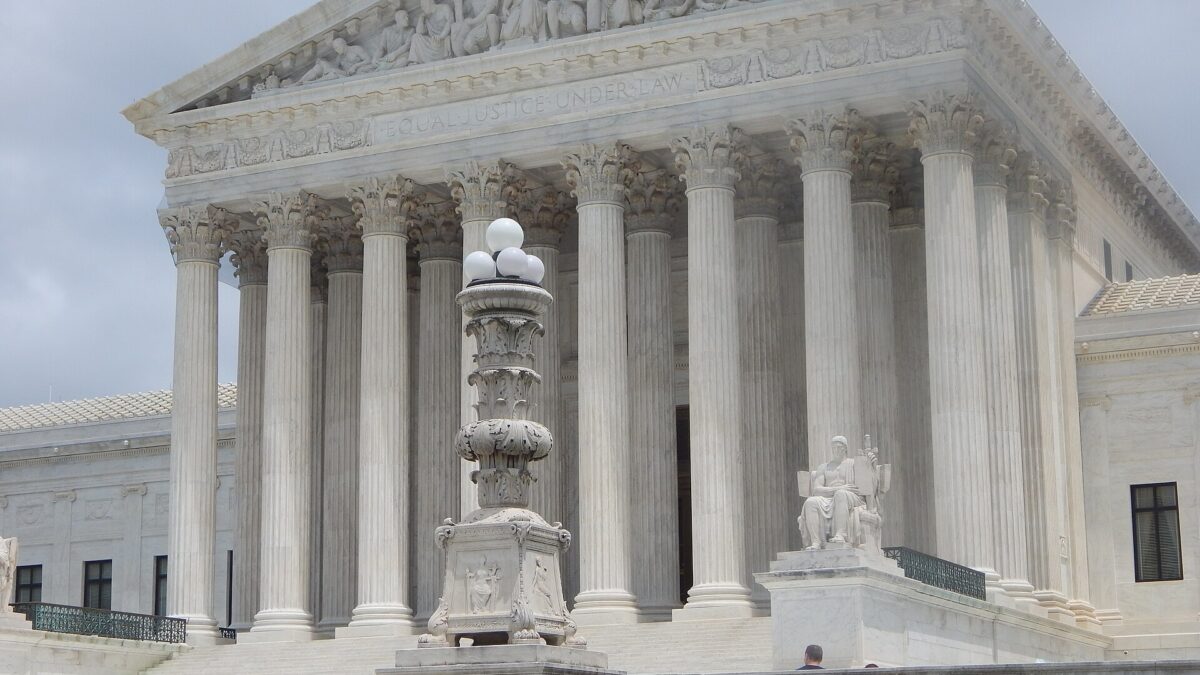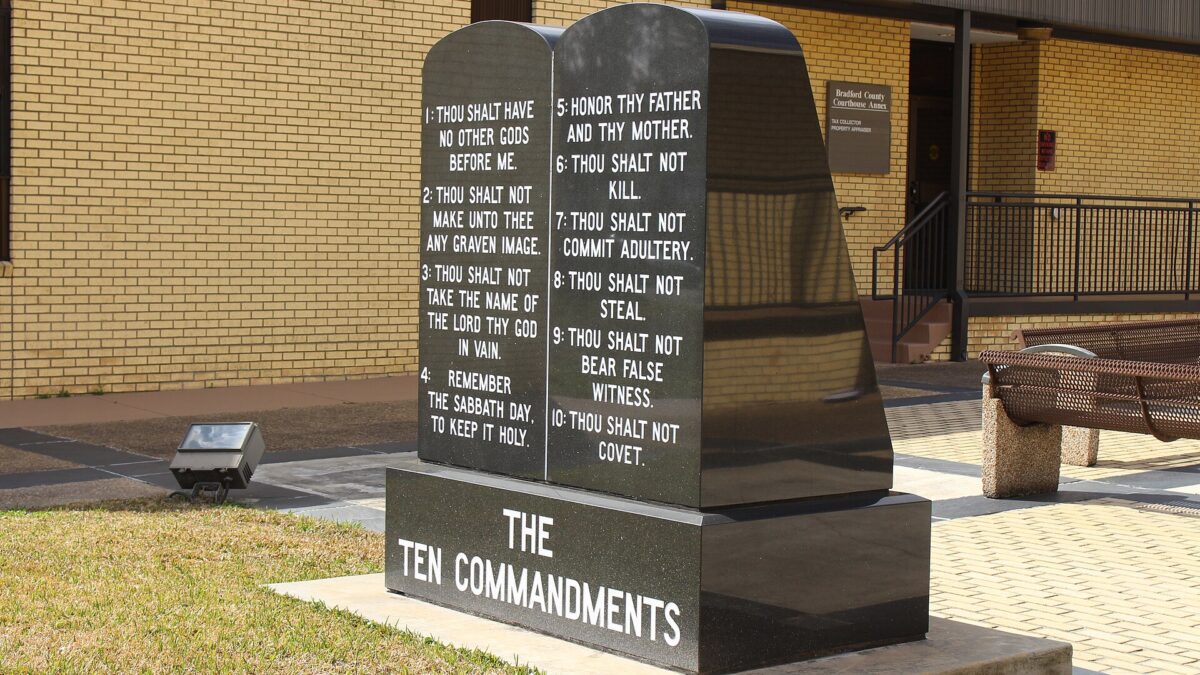

The U.S. Supreme Court has officially been asked to weigh the constitutionality of a Texas law requiring that the Ten Commandments be displayed in public school classrooms.
The moment came on Monday, when the left-wing American Civil Liberties Union (ACLU) and its clients filed a petition requesting the high court take up and hear arguments in Nathan v. Alamo Heights Independent School District. The case involves a challenge by various religious and nonreligious parents against SB 10, a Texas law signed last year that mandates that public elementary and secondary schools display “in a conspicuous place in each classroom of the school a durable poster or framed copy of the Ten Commandments.”
According to Justia, the challengers argued that the statute violates the First Amendment’s establishment clause “by effectively endorsing religion.” They also charged that it breached the amendment’s free exercise clause “by undermining their rights to direct their children’s religious upbringing and coercing their children to honor or revere the Commandments.”
As The Federalist’s John Daniel Davidson previously observed, federal courts have misinterpreted the First Amendment’s establishment clause in decades prior to “excise nearly all formal recognition of religion from America’s public schools.” This includes the Supreme Court, which cited the clause in its 1980 Stone v. Graham decision to nullify a Kentucky statute requiring the posting of the Ten Commandments in public school classrooms.
The Stone ruling was referenced by the U.S. District Court for the Western District of Texas in its August 2025 decision granting the ACLU and Co.’s request for a preliminary injunction blocking the Texas law from taking effect. The lower court held that the challengers were likely to succeed on their First Amendment arguments.
That decision was subsequently overturned (9-8) by the en banc 5th Circuit Court of Appeals in April. Writing for the majority, Judge Stuart Kyle Duncan found that the Texas law “does not violate either the Establishment Clause or the Free Exercise Clause,” and that several of the precedents plaintiffs relied on are no longer applicable given the high court’s more recent jurisprudence on the subject.
“We REVERSE the district court’s judgment, VACATE the preliminary injunction, and RENDER judgment dismissing Plaintiffs’ Establishment and Free Exercise claims,” Duncan wrote.
In their petition to the Supreme Court, the ACLU and its co-plaintiffs regurgitated many of the arguments that the 5th Circuit rejected. They contended that “it is ‘problematically coercive’ for public schools to impose religious messages on a ‘captive audience’ of students,” and that “parents’ free-exercise right to direct their children’s religious education is burdened when public-school instruction ‘substantially interfere[s] with the religious development’ of their children or ‘pose[s] “a very real threat of undermining” the religious beliefs and practices the parent[s] wish[] to instill in the[ir] child[ren].’”
“The Court should grant the petition because the court of appeals, in upholding S.B. 10, flouted this Court’s binding precedents and gutted the religious-freedom rights of public-school children and parents,” the petition reads.
Writing in these pages, Conscience Project Director and attorney Andrea Picciotti-Bayer previously noted how, “despite a widespread misunderstanding of the role of Christianity in our founding and decades of bad Supreme Court rulings, such [Ten Commandments] displays are constitutional.” She further highlighted the “long history and tradition of monuments of the Ten Commandments on public property,” and pointed out how numerous federal buildings in Washington, D.C., contain “scriptural engravings” that have never been categorized as an “establishment of religion.”
“While the founders were uniformly opposed to government imposing religion, they did think religion, especially Christianity, was extremely important to the founding of the country,” Picciotti-Bayer wrote. “They understood that humans are created in the image of God and instilled with dignity. And if people have dignity, they must have rights to protect that dignity. This is the religious inspiration for the huge number of rights enumerated for all citizens at the founding of the republic.”
The ACLU’s Nathan petition is one of many the Supreme Court will consider heading into its October 2026 term. At least four justices must agree to hear a case before it can be considered by the full court.