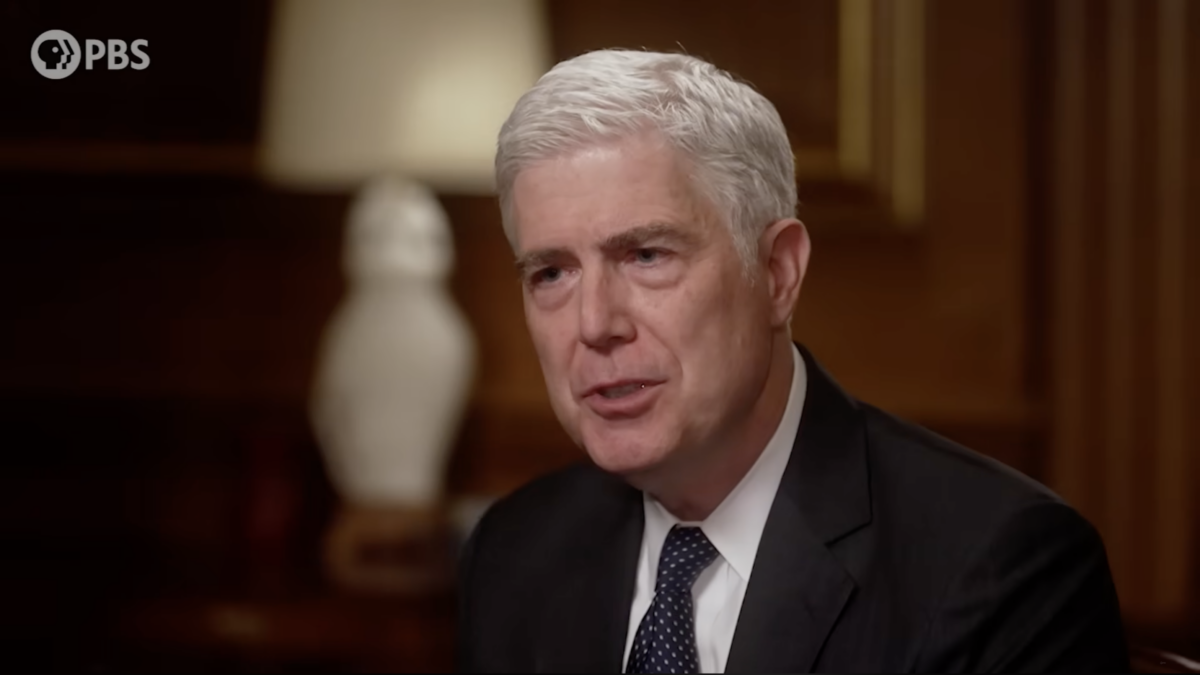

Supreme Court Justice Neil Gorsuch believes America is merely a set of ideas. But when it comes to explaining where those ideas came from, he apparently has no idea.
In an interview with PBS’ Firing Line with Margaret Hoover, Gorsuch rejected the fact that the United States was founded as a Christian nation.
“We have a First Amendment, for crying out loud. No established religion,” Gorsuch said to defend the position that the country’s founding did not rest on a single religion.
“We were never supposed to be a nation that was about one race or one religion,” Gorsuch said, seemingly unaware of Federalist Paper No. 2 by John Jay. “It was about those ideas.”
The “ideas” referenced by Gorsuch are equality, individual rights, and self-government, ideas he points out were enshrined in our founding documents.
But where did those ideas come from?
Christianity.
But don’t take my word for it (and definitely don’t take Gorsuch’s word) — take John Adams’ own words in an 1813 letter to Thomas Jefferson in which he said “The general Principles, on which the Fathers Atchieved Independence, were the only Principles in which, that beautiful Assembley of young Gentlemen could Unite…And what were these general Principles? I answer, the general Principles of Christianity, in which all those Sects were United.”
Jay (mentioned earlier) wrote in Federalist Paper No. 2 that Americans were one “united” people who professed “the same religion” and were bound by shared principles, manners, language and that “Providence” deliberately united them. Jay was a Christian. Or take Noah Webster, who was even more explicit than Jay, writing that “The Christian religion, in its purity, is the basis, or rather the source of all genuine freedom in government … I am persuaded that no civil government of a republican form can exist and be durable, in which the principles of that religion have not a controlling influence.”
In fact, the principles of equality, individual rights, and liberty of conscience (which is the underlying justification for the First Amendment) that Gorsuch uses to argue America is an idea are ideas stemming directly from Christian understanding. Christianity teaches that all men are created in the image of God, and therefore have inherent dignity and worth that no government can change. It also teaches in Romans that God has written His law on our hearts so that our consciences help us determine right from wrong. Because our conscience answers to our Creator and not a government or another human, compelling someone to believe something would violate their conscience, hence the First Amendment. This Christian theology is what made the Declaration’s “all men are created equal” claim and “endowed by their Creator with certain unalienable rights” lines possible. Those ideas were not merely ideas of The Enlightenment, but ideas of Christianity codified into our Founding documents.
Further, at the time of the ratification of the Constitution, 11 of the 13 original colonies had religious oaths of office for Christians. In fact, in “Notes on the State of Virginia,” Jefferson said: “Can the liberties of a nation be thought secure when we have removed their only firm basis, a conviction in the minds of the people that these liberties are of the gift of God?”
The Founders themselves made clear that the Constitution was made only for a moral and religious people — which was likely understood in their day as Christian. In his farewell address, George Washington said “Of all the dispositions and habits which lead to political prosperity, Religion and morality are indispensable supports … Reason and experience both forbid us to expect that national morality can prevail in exclusion of religious principle.” And before Gorsuch says that “Religion” is a broad term, Washington’s address came at a time when public religion was almost entirely Christian (Washington was an Anglican) and therefore his comments would’ve been understood to mean that Christianity is an indispensable support. Adams was likewise clear that “Our Constitution was made only for a moral and religious people. It is wholly inadequate to the government of any other.”
In other words, Gorsuch is partially right: the Founders did codify “ideas” — but those ideas came from somewhere, and that somewhere was Christianity.