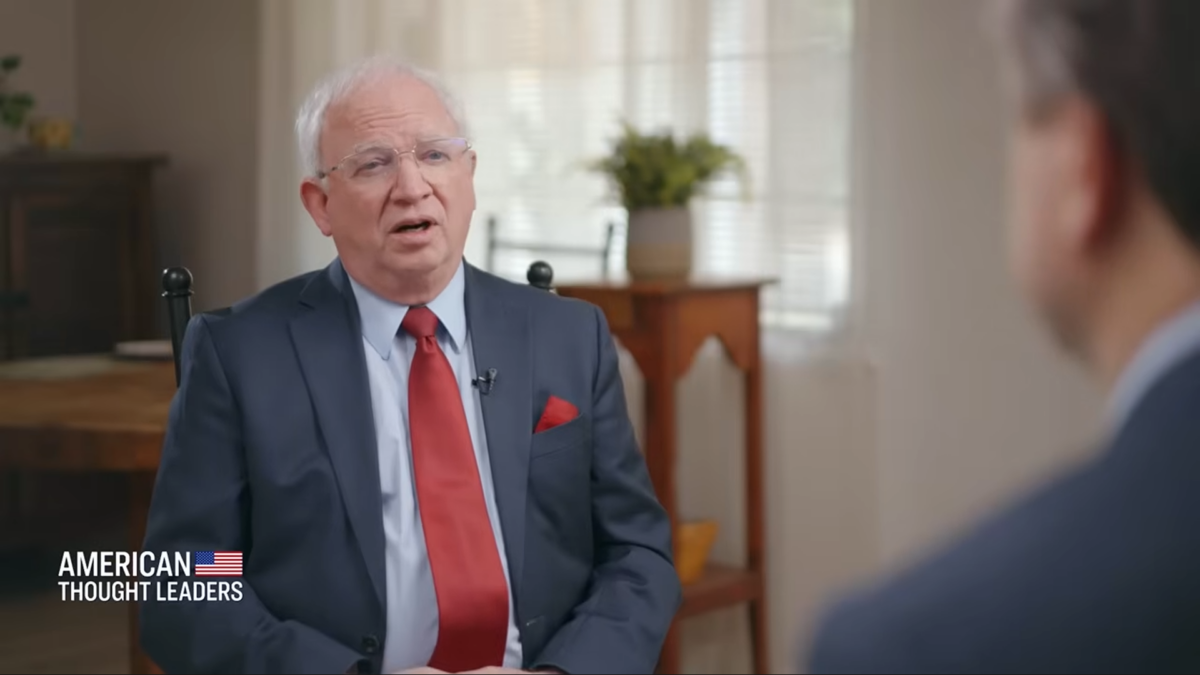
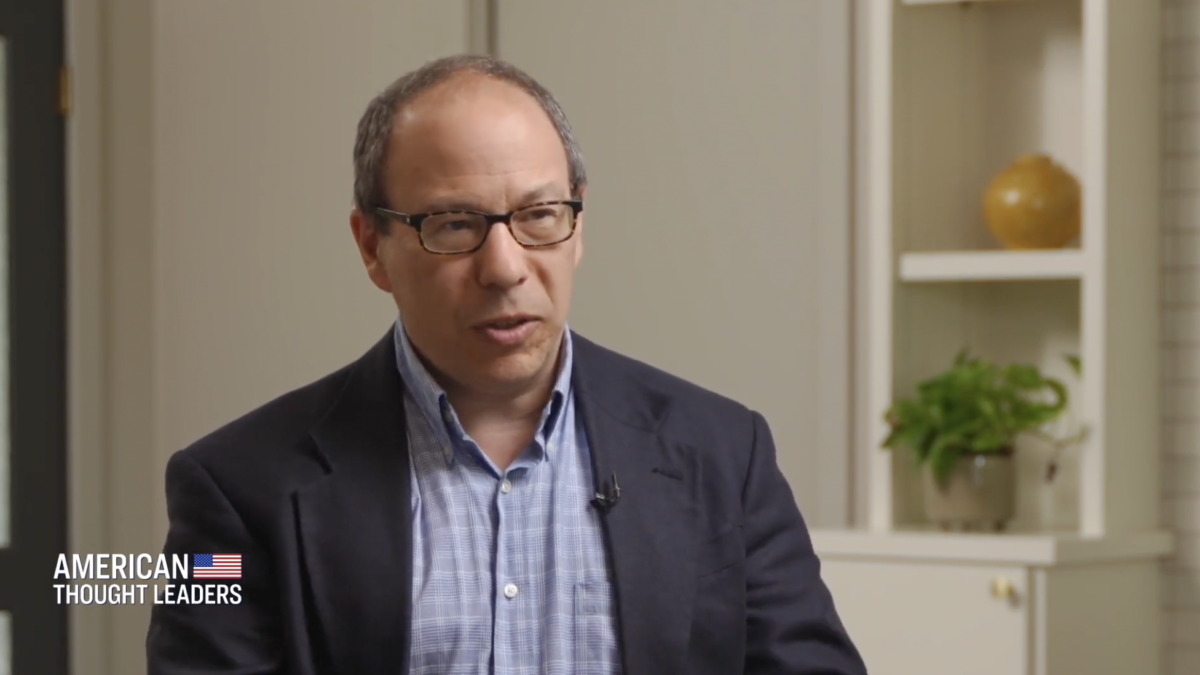

President Donald Trump nominated Adam Candeub last week to serve as assistant attorney general for the Justice Department’s Antitrust Division. This is welcome news. Candeub has a rare combination of sterling credentials plus MAGA bona fides that stretch back to 2016.
The Antitrust Division has been without a Senate-confirmed chief for months. It is about to get one who actually knows what the last decade did to American speech.
Candeub is eminently qualified. A graduate of Yale and Penn, he’s written dozens of scholarly articles that have been twice cited by the U.S. Supreme Court. As even his liberal critics note, his work has reshaped conservative views on tech. He’s the current general counsel for the Federal Communications Commission, former acting head of the National Telecommunications and Information Authority, and a Jones Day alum. Normally, these are the kinds of credentials that would ensure a speedy, uncontroversial nomination. That won’t happen this time, because Candeub is a 2016 MAGA OG — and that makes people on the hill nervous.
In October 2016, when endorsing Donald Trump was a career-ending move in legal academia, Candeub was one of the handful of law professors in the country willing to publicly back the future president. He also took on tech censorship before it was a popular fundraising line, fighting some of the earliest censorship cases against tech platforms including Taylor v. Twitter in 2018 and Murphy v. Twitter the following year.
As a law professor and a telecommunications expert, it would have been far easier to take advantage of the hundreds of millions of federal dollars that had, at that time, begun flowing to the burgeoning field of “disinformation studies.” Candeub did the opposite.
At NTIA under the first Trump administration, he implemented Trump’s executive order on online free speech, pressing the argument that Section 230’s liability shield was never meant to immunize the platforms’ editorial suppression of American citizens. He represented then-Sen. JD Vance in Ohio’s lawsuit arguing that Google should be treated as a common carrier. And he represented the America First Policy Institute in the NetChoice litigation, defending state laws written to stop the platforms from throwing citizens out of the modern public square.
Libertarian critics say this track record makes Candeub an enemy of tech, along the lines of Biden’s Lina Khan. This is entirely inaccurate; Candeub is an enemy of online political censorship. That’s different from flailing around an antitrust hammer just for the sake of it, as Khan was wont to do. Candeub has been explicit that his criticism of Big Tech has been tightly aimed at their past censorship practices, not about the size of firms as such.
When Congress was pushing sweeping populist antitrust bills, Candeub testified against them, warning that they would load costs onto American businesses without doing anything to address the censorship problem that motivated conservatives in the first place. He told the Senate Judiciary Committee that he stands “on the side of economic freedom and business enterprise,” and that his concern is with “the effects of Big Tech on fundamental American institutions such as free speech and the family.”
He has been just as candid about the platforms themselves, acknowledging that they have been “incredibly innovative” and that there is “little to no evidence” they have caused “traditional consumer harm in the form of higher prices [or] reduced output.” He has pointed to Europe as the cautionary tale, noting in 2023 that a continent with a far more aggressive regulatory posture could not claim a single one of the world’s 10 largest tech companies while the United States claimed eight. A nominee who says that in writing is not coming to Washington to break American firms for sport.
Candeub authored the Federal Trade Commission chapter of Project 2025, which the left will treat as a scandal and which is in fact the most useful document for understanding how he thinks. The FTC shares antitrust authority with Justice, so it is worth quoting what he actually proposed rather than what the press release will say he proposed.
He called for investigating “ESG practices as a cover for anticompetitive activity.” (ESG stands for environmental, social, and governance, a series of principles often used to evaluate corporations by left-leaning metrics.) His reasoning is not culture-war boilerplate, it is corporate law. Managers of publicly traded companies who use shareholder assets to earn praise from left-leaning groups, in his words, “appropriate corporate wealth for their own benefit.” Shareholders pay for the executive’s social standing. That is a legal question, not a vibe.
Under the heading “Cancel Culture, Collusion, and Commerce,” he argued that “concentration of industries, particularly in pharmaceuticals, health care, and the internet, encourages government collusion that undermines democratic institutions.” As he noted, that collusion can be explicit or implicit, ranging from government involvement in Big Tech censorship to the creation of massive regulatory burdens that keep smaller competitors from ever entering the market. Anyone who read Missouri and Louisiana’s litigation over pandemic-era jawboning, or who watched the suppression of the Hunter Biden laptop story, understands that this is a description of events rather than a theory.
Michigan State’s student paper ran a records-request story whose most damning revelations were that Candeub had, in private emails, described the 2020 election as “crooked” and the Georgia indictment of Trump as “bullsh-t.” That was the scandal. A law professor held a few widely shared opinions and expressed them in emails to colleagues.
Senators will recycle that material because they have nothing better. What they will not want to litigate is the substance, because the substance is a nominee with two Supreme Court citations, a decade of published scholarship, actual courtroom experience in the defining speech cases of the era, and an on-the-record refusal to sign up for the anti-business populism that would have given them their best line of attack.
The Senate should confirm him quickly. The Antitrust Division has spent enough time without a leader, and the coalition between the platforms and the permanent government has not been waiting around for one.