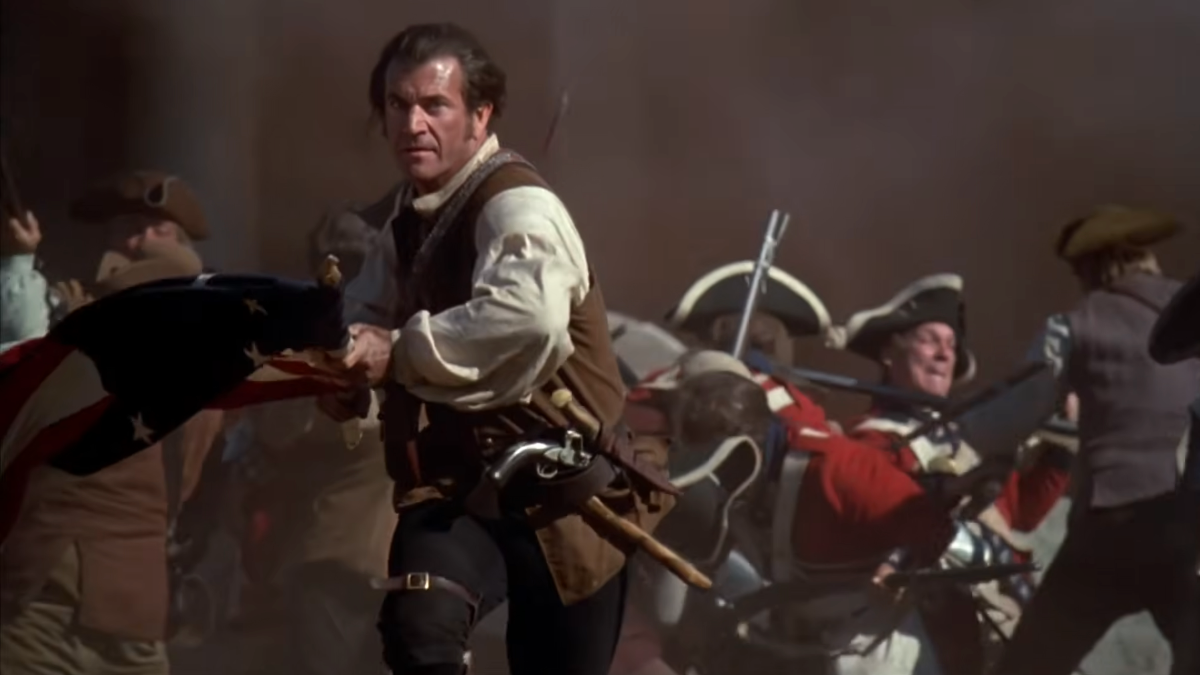

If you’re like me, you’re eager to watch a film or two to help celebrate the 250th anniversary of our nation. Sadly, unlike Hollywood’s extensive catalogue of Civil War-era cinema, there is a depressing dearth of even middling Revolutionary War films (HBO’s miniseries John Adams is quite good, but requires some stamina). Though it’s been more than a quarter-century since its release, the 2000 film The Patriot, starring Mel Gibson, is perhaps the best modern depiction of our great struggle for independence. And, as a recent highly acclaimed history of the Revolutionary War in the South shows, there is plenty of truth in it, too.
Filling an Important Cinematic Gap
Americans may wonder why there are so few Revolutionary War movies, let alone good ones. There are, I think, a few reasons for this. The first is that, unlike other American conflicts, battles were comparatively small and infrequent — Bunker Hill, one of the most prominent battles of the war (and one of the earliest), involved fewer than 6,000 soldiers in total, of whom about 1,500 were casualties. Gettysburg, one of the Civil War’s most well-known battles (about which there is a good major motion picture), involved more than 150,000 soldiers, and total casualties were about 50,000. Second, the signature events of the Revolutionary War were less the battles than political events, such as the signing of the Declaration of Independence or the diplomatic success of persuading the French to enter the contest on behalf of the Americans, neither of which exactly makes for great cinema.
Thus do we have The Patriot, a movie about one of the more ubiquitous qualities of the whole conflict: guerrilla warfare. It was a controversial movie as soon as it was released, largely because of significant and substantial claims of historical inaccuracies, especially in its portrayal of the British military as little more than monsters roaming the American countryside committing war crimes. The depiction of Gibson’s character, a composite of several historical persons including Francis Marion, the notorious “Swamp Fox,” as well as Thomas Sumter, Daniel Morgan, and Andrew Pickens, was also disparaged for ignoring the conduct of these men (especially Marion) during the Revolutionary War.
Nevertheless, the $110 million-budget film did well, grossing $215 million, and was even nominated for three Academy Awards. The film’s creators certainly did their homework. Director Roland Emmerich’s team consulted the Smithsonian Institution; screenwriter Robert Rodat conducted research of colonial-era journals and letters. Nevertheless, even Mel Gibson himself declared aspects of the film to be a “sheer fantasy” when it was released.
Atrocities Were Committed by Both the British and Americans
A few aspects of the film border on the deeply implausible — Gibson’s character, for example, is depicted as an owner of free blacks rather than of slaves, and the movie shows a black character who serves in an irregular militia being declared free by a general order issued by Washington’s Continental Army. But perhaps the most controversial aspect of The Patriot is the portrayal of British atrocities against American civilians. The film’s villain, Colonel William Tavington — based on the historical figure Banastre Tarleton — orders rebel wounded to be summarily executed, shoots a child in the back, and murders the families of militiamen. He commands the burning of colonial civilians in a church, an event of which there is also no historical record.
Admittedly, the portrayal of the British is over-the-top. They were our enemies but not demons — remember, the British war aim was to persuade the colonists to once more become loyal subjects. Yet they certainly committed their fair share of what we would call war crimes, as Alan Pell Crawford’s recent and excellent This Fierce People: The Untold Story of America’s Revolutionary War in the South well demonstrates. In truth, there were also several embarrassing examples of Americans massacring surrendering British troops in the southern colonies, such as at King’s Mountain and at “Pyle’s Massacre.” Obviously, this is a stain on the history of our war for independence.
That said, as Crawford’s book also shows, Tarleton was very much a brutal and merciless man, on multiple occasions executing surrendering colonists, refusing to punish soldiers under his command who raped local women, and destroying civilians’ homes (including that of Sumter, one of the men on whom Gibson’s character is based). British politician Horace Walpole, who knew Tarleton when they were both students, declared: “Tarleton boasts of having butchered more men and lain with more women than anybody.”
What Historical Patriotic Movies Are For
Good historical films both do their best to remain somewhat faithful to historical fact, while also being entertaining and aspirational. In the case of The Patriot, some broader historical realities are well told. It shows how the Americans won the war — not by defeating the British in pitched battle, but by refusing to surrender, by not losing, and by taking advantage of the “strategic depth” provided by the vast American interior, as George Washington realized he must do early in the fight. Guerrilla warfare, especially in the South, kept the British frustrated for years — Francis Marion really did keep a hideout at a place called Snow’s Island, a piece of high ground in the middle of a swamp on the Pee Dee River in South Carolina.
Moreover, The Patriot aspires to tell a truly American story. It is the story of a man who would prefer not to fight but is given just cause to do so when the British destroy his home, confiscate his livestock, and kill one of his children. There were plenty of American colonists who were faced with similar choices over the course of that eight-year conflict, in which British and Hessian troops routinely mistreated colonists. It is the story of a man who prioritizes God and family above all else (Marion was in fact a devout Calvinist, per Crawford). It is the story of people who yearned for self-government. And it is even, admittedly historically implausibly, a story about that freedom being given to black Americans. Whatever its embellishments and inaccuracies, these are noble aspirations indeed.
The Patriot stands up 25 years after its creation and contains more historical truth than many of its detractors are willing to admit. This summer, above all others, it’s worth a revisit.