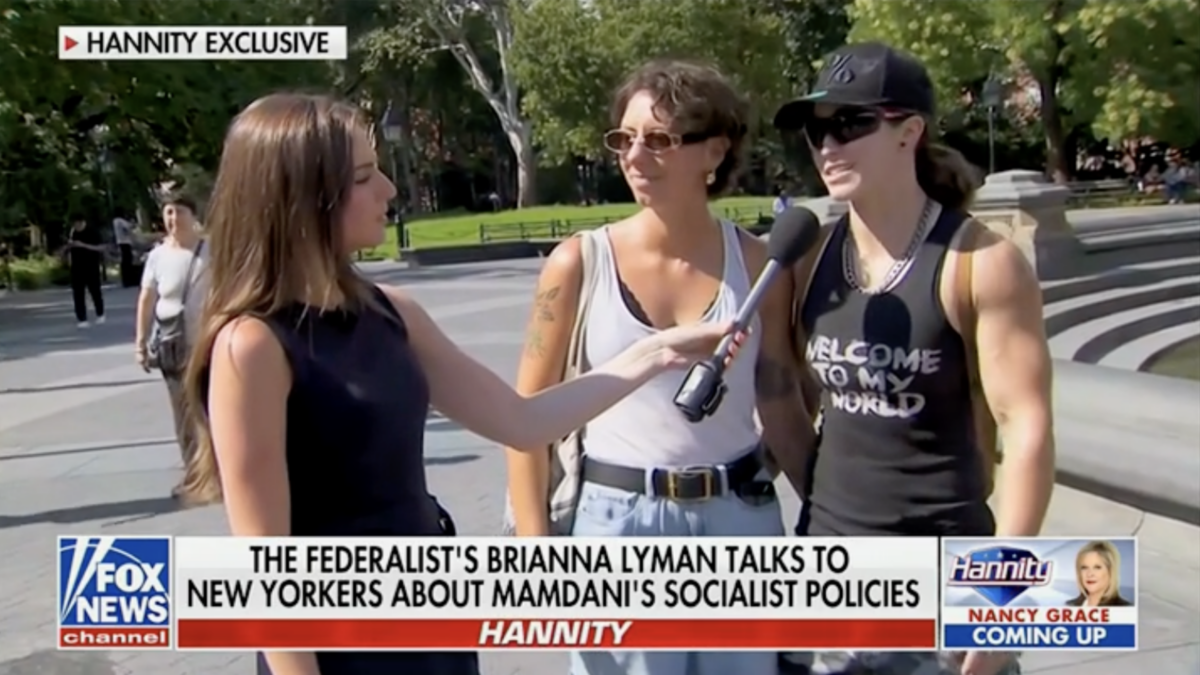

“Commune means community. It’s for the people,” one woman told me Monday when I hit the streets of Manhattan for an exclusive Hannity segment.
I was asking people about Mayor Zohran Mamdani’s plans to implement free buses, city-run grocery stores, and other social programs funded by taxing the rich even more. In most cases, the people I spoke with weren’t too bothered by Mamdani’s plans to strangle the rich. In fact, they agreed with the premise that people should contribute what they can afford so that everyone could have what they “need.”
But surely (I thought to myself) their answers would change once they learned this supposed compassionate philosophy came directly from Karl Marx.
I was wrong.
At one point in America, “Marxism” and “Karl Marx” met with public shunning and condemnation — and with good reason. Communist regimes inspired by Marx’s ideology killed tens of millions of people. Those who managed to survive were left to deal with starvation, poverty, confiscation, tyranny, and political persecution.
But Marxism doesn’t carry the same stigma it once did. Its radical ideas have been repackaged as “equity” and “equality,” or, as one woman told me, being “for the people.” Once voters accept the premise that communism is actually a benevolent force “for the people,” revealing its origins does little to change their minds.
That’s a problem for Republicans, whose chief argument against the rising socialist tide has consistently been pointing at Democrats and shouting “communist!”
Politico reported last summer that “Republicans are racing to make Zohran Mamdani the face of the Democratic Party.” Republicans planned to use Mamdani’s proposals like tax hikes, rent freezes, and government-run grocery stores as their “attack line against ‘radical socialist’ Democrats,” Politico reported.
“Republicans have repeatedly sought to elevate progressive New Yorkers to represent the entire party,” the report continues, “to mixed success in past elections.”
And what was once “mixed success” is increasingly no success.
Republicans wrongly assumed Mamdani’s agenda was so obviously radical that merely attaching other Democrats to him would amount to political suicide. After House Minority Leader Hakeem Jeffries congratulated Mamdani on winning his primary last June, the National Republican Congressional Committee said in a post on X, “Every single Democrat now owns Mamdani’s radical socialist agenda to defund police, abolish prisons & stop ICE from deporting criminals.”
But that assessment was a bad misread of how voters respond to Mamdani (and the socialist label).
The people I spoke to didn’t recoil at the mention of Marx. Some even thought Marx’s ideology was objectively good. Nor were the people I spoke to rare. A recent CNN poll conducted by SSRS found that roughly “a third of Democrats identify as socialists.” For a growing number of voters, “socialist” is not an accusation to be ashamed of. It’s perfectly acceptable to be socialist.
As Victor David Hanson pointed out in a recent piece, the lines are increasingly blurred between “Democrats” and “communists.”
“The more the ossified Democratic Party claims that its growing cadre of socialist renegades are not really socialists,” Hanson wrote, “the more they act like — and even appear comfortable being called — communists.”
“With every new policy they propose,” he continued, “the socialists have been dropping the pretense that they are not Marxists.”
Hanson points out Democrats’ open hatred of capitalism, along with their proposals to confiscate private property, abolish prisons and police, and abolish borders.
As Hanson explains, these policies are becoming more radical, but voters are seemingly less repulsed by such radicalism — which is exactly why Republicans cannot think that just calling someone a “socialist” or “communist” is going to be politically effective. Those labels once communicated something objectionable and repulsive to the average American, but today, many Americans hear “free buses,” “equality,” “free groceries,” and so forth.
How did this happen? It wasn’t overnight, nor did the left try to make Americans like communism by defending gulags and breadlines. Instead, they separated Marxist promises from their consequences.
Take Barack Obama, who in 2008 defended raising taxes on the rich by saying: “I think when you spread the wealth around, it’s good for everybody.”
Marx called for redistribution of resources according to need. Obama repackaged that as giving others “behind you” a chance to succeed (as if the economy is a fixed pie and rich people take from the poor and prevent them from getting rich too). In other words, Obama “softened” forced government confiscation by presenting it as merely helping your neighbor have an opportunity.
Obama and other Democrats have all claimed that forced redistribution of wealth is also merely “paying your fair share.” The talking point helped the left shift the narrative from “the government should confiscate your property and wealth so that everyone has an ‘equal’ amount of nothing” to “there’s a class of millionaires and billionaires who are not paying their ‘fair share’ while working families who ‘play by the rules’ are getting the short end of the stick.” It shifted from class conflict (which is identifiably Marxist) to just a moral obligation that wealthy people have to “help” others and promote “equality.”
Whether it’s Obama, Bernie Sanders, AOC, Mamdani, or whatever other communist wants to come out of the woodwork, the bottom line is they are selling communist promises without ever mentioning the destructive reality of those promises — and it’s working. Republicans will not defeat leftists merely by calling them communists, and if they don’t learn that fast enough, we won’t have a country.