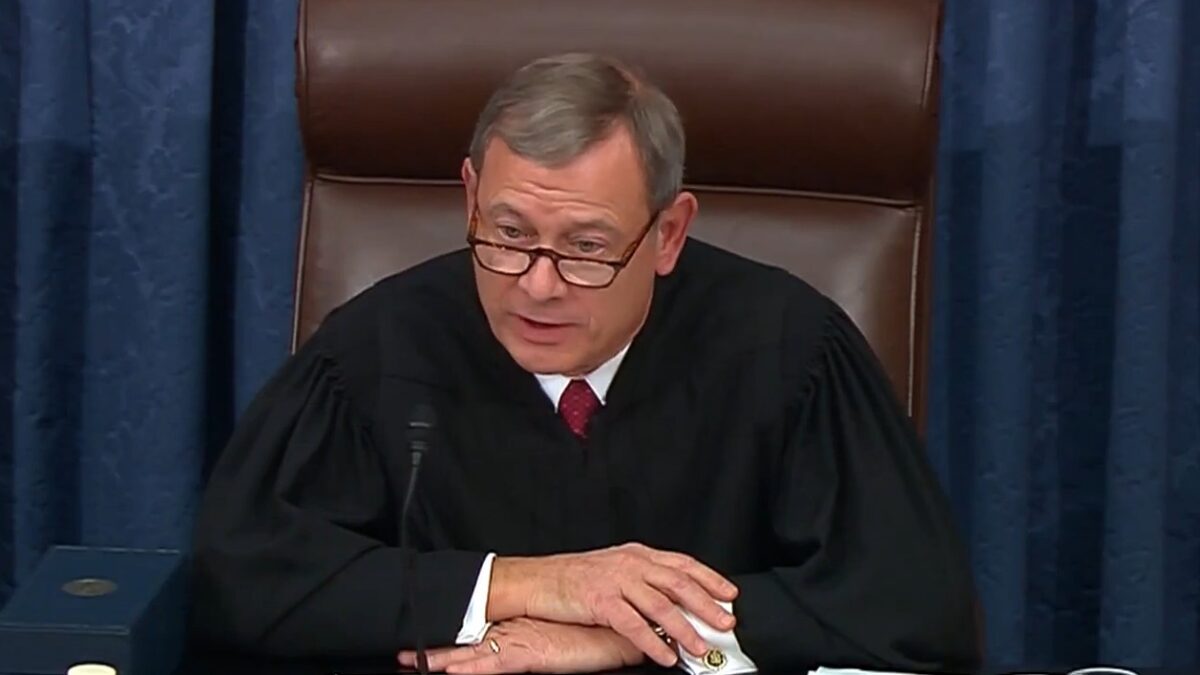

The Supreme Court, led by Chief Justice John Roberts, gave its stamp of approval Tuesday to birth tourism, “the practice of traveling here with temporary authorization solely to give birth and obtain citizenship for one’s children, then returning to raise them in another country,” as Justice Clarence Thomas described in his dissent.
In doing so, Roberts and the high court have given away the country’s sovereignty to random, hostile foreign invaders to take control of the American government in less than a generation.
“The Court has repurposed the Fourteenth Amendment to protect its own set of preferred rights that the Reconstruction Congress never contemplated and that cannot find support in its text,” Thomas wrote. “Today, the Court does so again by recognizing a constitutional right to citizenship for the children of all foreign birth tourists and illegal aliens.”
Thomas wrote about the birth tourism industry, consisting of companies that “reportedly collect large fees from wealthy foreigners to facilitate their trips to give birth in the United States.”
In his dissent Justice Samuel Alito offered a scathing critique of the majority’s approach to the issue. The majority opinion, Alito wrote, went “out of its way to hold that even a child born to a mother who is here for only a brief time is a citizen under the Fourteenth Amendment,” ostensibly because doing otherwise would mean dismantling the entire system of so-called birthplace citizenship, which allows any foreigner anywhere to be considered a “citizen” so long as he was born on American soil.
“Showing merely that the Executive Order is valid as applied to a child born to a birth tourist would be enough to defeat respondents’ facial claim,” Alito said. “The Court’s interpretation is not only contrary to the original meaning of the Fourteenth Amendment, it produces grotesque results. While foreigners who wish to immigrate lawfully must sometimes wait for many years, a child born here to a birth tourist is automatically a citizen.”
Thomas noted another bizarre outcome of the Roberts opinion, stating that it essentially means a Chinese national has more of a claim to American citizenship than an American Indian does.
It is true that tribal Indians belonged to “alien and sovereign” nations and that the United States’ relations with them implicated “intersovereign concerns.” But, temporarily visiting foreigners also belong to “alien and sovereign” nations, and the United States’ relations with them also implicate “intersovereign concerns.” It is difficult to understand why China, for example, would be less alien or less sovereign than the Cherokee Nations. It is also difficult to understand why tribal Indians would be less entitled to American citizenship if born on non-Indian land within the United States than children of birth tourists who immediately returned to China.
As The Federalist’s Brianna Lyman noted, the thousands of Chinese babies whose parents have snatched (and will snatch) citizenship for them through birth tourism in the United States now have a comprehensive claim to the American homeland. All they must do is show up, perhaps at the age of 35, and convince the many millions of foreigners already imported into the United States — and their white liberal enablers — to elect them as president.
That is the clear implication behind Alito’s explanation of the severe national security consequences of the decision:
Suppose that a person’s only connection to this country is that he was born here to a mother who was present just long enough to give birth and then quickly returned to her native country. Suppose that country is a strategic adversary or enemy of the United States. Suppose the child never visited the United States while growing up and was inculcated with hatred of this country. According to the Court, that person is a citizen of the United States. He can enter and leave the country as he pleases. He can travel the world on a United States passport. Even if he plots to harm this country, he cannot be deprived of his status as a citizen, at least under current precedent.
“The Court’s interpretation preserves a powerful incentive to enter or remain in this country illegally,” Alito wrote. “Immigrants naturally prefer affluent countries where economic opportunities are available. Other than Canada, the United States will be the only affluent nation where birth alone is enough to establish citizenship.”