
On June 19, 1865, Union General Gordon Granger arrived in Galveston, Texas, two months after Lee’s surrender at Appomattox. He announced to the city’s residents that all slaves in Texas were free by the Emancipation Proclamation. Some slaves remained enchained in the border states of Maryland, Delaware, Kentucky, and Missouri until the 13th Amendment’s ratification on Dec. 6 of that year, but ratification was a forgone conclusion. The amendment had already passed both houses of Congress, and mourning over Lincoln’s assassination assured assent in three-fourths of loyal state legislatures.
Thus, the Union’s recapture of Texas marked slavery’s practical extinction in America. The anniversary has long been celebrated by some black Americans as “Emancipation Day,” “Jubilee,” or “Juneteenth.” In 2021, Joe Biden signed bipartisan legislation making Juneteenth a federal holiday after unanimous Senate approval.
Conservatives have had a lukewarm relationship with Juneteenth so far, in no small part because Biden codified it in an effort to pander to the Black Lives Matter-led leftist rage mob in the wake of George Floyd’s death. The right has generally viewed Juneteenth as a leftist attempt to subvert Independence Day and divide Americans along racial lines. To the extent that we conservatives let left-wing institutions and media portray the holiday as only a sectarian one, the criticism is justified. But it needn’t be that way.
Conservatives should embrace this holiday as complementary to Independence Day, not in competition with it. Juneteenth symbolizes the triumph of liberty over arbitrary rule, the American Revolution’s culmination. Commemorating Juneteenth repudiates the 1619 Project’s make-believe version of the American founding and embraces our foundational creed as revivified by Lincoln and the Union’s victory.
The 1619 Project, a widely debunked New York Times series, claims that protecting slavery motivated the American Revolution, founding, and, ridiculously, the very Constitution that Frederick Douglass called a “glorious liberty document.” Parents of all races and creeds rebelled as these ideas, meant to undermine our basic freedoms by association with slavery, were introduced into classrooms. But Juneteenth, properly understood, is completely incompatible with the 1619 Project worldview.
This new holiday commemorates the successful effort to hold the Union together and, for the last two years of the Civil War, end slavery. Abraham Lincoln framed his opposition to slavery in terms of the founding, and this formulation found wide electoral support in both 1860 and 1864. Even more tellingly, pro-slavery radicals and Confederate leaders did not embrace our supposedly racist founding. Instead, they openly disdained the Founding Fathers.
John Calhoun, the South Carolina statesman who nearly started the Civil War 30 years early, said that the Declaration of Independence’s claim that “all men are created equal” was an “error.” Calhoun further pilloried Thomas Jefferson for being too idealistic and abstract in crafting the Declaration.
Calhoun said Jefferson’s belief in universal freedom caused him “to take an utterly false view of the subordinate relation of the black to the white race in the South; and to hold, in consequence, that the former, though utterly unqualified to possess liberty, were as fully entitled to both liberty and equality as the latter; and that to deprive them of it was unjust and immoral.” According to John Calhoun, the American founding was not about protecting slavery. It was not even compatible with slavery. Its underlying principles were antagonistic to slavery and would eventually threaten the institution. He was right about that.
Confederate Vice President Alexander Stephens said in his infamous “Cornerstone Speech” that the founders “rested upon the assumption of the equality of races,” an idea that he called “fundamentally wrong,” before asserting that the Confederacy “is founded upon exactly the opposite idea; its foundations are laid, its corner-stone rests, upon the great truth that the negro is not equal to the white man.” Paraphrased, the Confederate VP said, “The United States was not founded on institutional racism, and that is why we seceded.”
Stephens’ “great truth” lost. The founders’ greater truth that “all men are created equal … endowed by their Creator with certain unalienable rights” won. That victory was a nationwide effort that involved ancestors from Americans of all races.
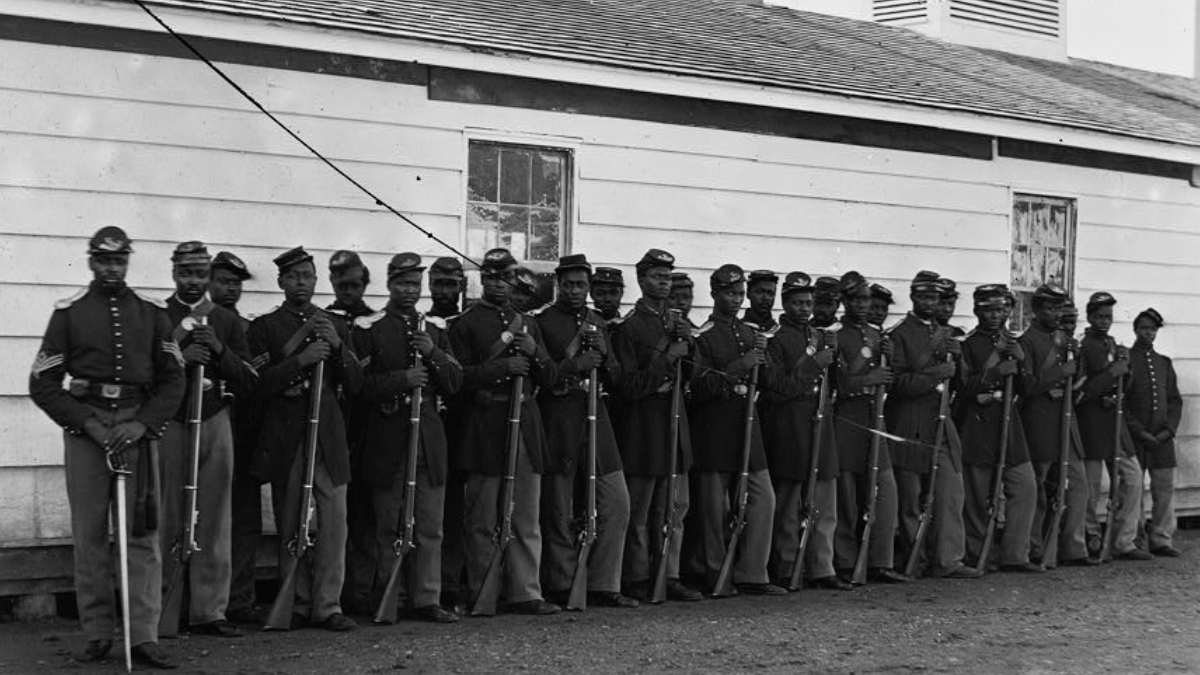
The Civil War claimed more lives than any other American conflict, both in absolute and population-proportional terms. Many casualties were black troops who volunteered to fight under the same flag that the 1619 Project today instructs us to revile as racist and offensive. They understood themselves as defending their own rights and the law itself.
But the majority of Union casualties were white Northerners (and Southerners, especially from states like Tennessee and Kentucky!) who left farms, ranches, and cities to both preserve the Union and destroy the proximate cause of its separation, slavery. (For those incredulous that destroying slavery was a major motivator for Union soldiers by 1864, read James McPherson’s masterly For Cause and Comrades.)
That ending slavery in the United States took so much blood and treasure is a tragedy. That it did end is a miracle. America’s hard-fought triumph over the forces of disunion and degradation, the revival of America’s founding promise, is a victory to which we are all heirs. Let’s double our celebration of American freedom this summer for our 250th. Celebrate Juneteenth.