
The Federal Judicial Center (FJC) has had its fair share of controversies throughout the past year.
The taxpayer-funded agency was caught stuffing citations to left-wing climate activists into its most recent Reference Manual on Scientific Evidence, which offers guidance to federal judges on science-related cases. Subsequent Federalist investigations also revealed the radical left-wing partisanship of the authors tasked with writing manual’s climate and forensics sections.
The FJC is intended to serve as the unbiased educational and research arm of the judiciary. Although it doesn’t have any “policy-making or enforcement authority,” these findings have raised concerns about its objectivity and central role in providing “accurate, objective information and education” to judges across America’s federal court system.
But the deeper The Federalist digs into the FJC, the further removed the agency seems to be from its stated mission.
A new inquiry into the FJC unearthed that the American Association for the Advancement of Science (AAAS) — a left-wing advocacy group masquerading as an objective science organization — influenced the FJC’s aforementioned science manual. In line with The Federalist’s prior reporting, this investigation also uncovered that several of the AAAS fellows who worked on the manual have a history of supporting left-wing ideology.
Origins and Leadership
Before fleshing out the AAAS’s influence on the judiciary and FJC, it’s worth exploring the group’s left-wing background.
According to the Capital Research Center (CRC), the AAAS’s origins can be traced back to the mid-19th century, when it was created to “unify all scientific fields across the United States” and “rais[e] further resources for scientific inquiry.” The group later shifted its focus in the decades that followed from solely pursuing research funding to “general policy lobbying.”
During this step into activism, the AAAS “began to tilt towards socialism and the Soviet Union” in the late 1930s, according to CRC. The nonprofit watchdog noted the left-wing science group’s annual president at the time, Walter Bradford Cannon, “expressed his sympathies for socialism as a model of the scientific economy and society of the future, a position many of his fellow ‘science-activists’ in the AAAS shared.”
The AAAS has carried its partisan agenda forward by increasing its involvement in left-wing “‘science-activism,’ ideological activism performed in the guise of promoting science.” The group was notably involved in the 2017 “March for Science” that protested the first Trump administration’s pro-energy policies.
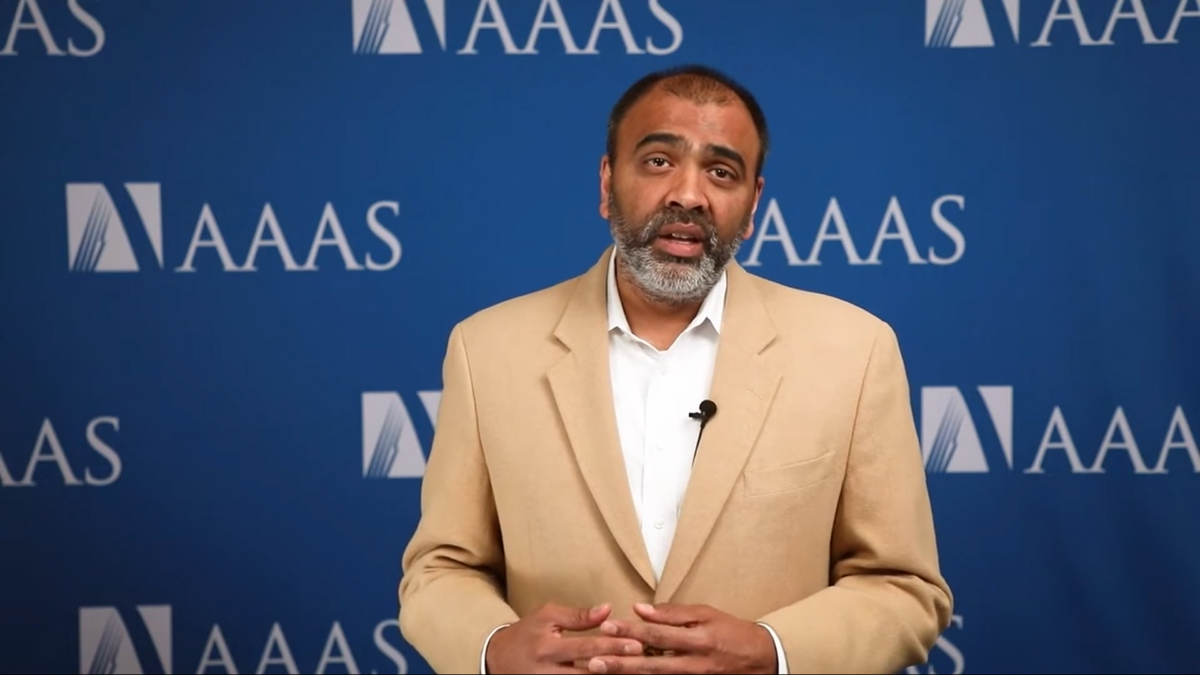
This left-wing activism is perhaps unsurprising when considering the partisanship displayed by the AAAS’s leadership. The group’s current CEO, Sudip Parikh, has regularly criticized the Trump administration and its policy agenda, including the president’s 2020 move to withdraw America from the World Health Organization over its mishandling of Covid. He also attacked a 2022 Supreme Court decision (West Virginia v. EPA) limiting the EPA’s regulatory authority over “greenhouse gas emissions.”
Parikh’s predecessor, former Rep. Rush D. Holt, Jr., D-N.J., appears to be cut from the same cloth. According to CRC, he criticized President Trump’s decision to withdraw from the Paris Climate Accords and “signed the AAAS as a supporter of an open letter” urging the president to revoke his travel ban during his tenure as CEO.
The AAAS is also bankrolled by numerous left-wing organizations and has inked contracts with the federal government, according to CRC. Its funders have reportedly included the left-wing John D. and Catherine T. MacArthur Foundation, the Rockefeller Foundation, the David and Lucile Packard Foundation, and others.
Influence Operations
A trip further down the AAAS rabbit hole unveils just how the advocacy group advances its agenda throughout America’s political ecosystem. Much of this strategy and what the AAAS seeks to accomplish is laid out in its fiscal-year 2024 IRS 990 Form.
As part of its “mission” statement, the AAAS echoes leftist jargon by saying that it strives to “foster inclusivity for scientific excellence.” It brands itself as an organization that aims to “build[] trust among scientists and engineers and broader communities and is a valued source of accurate scientific information that is foundational to countering misinformation” (emphasis added).
Often used by leftists to silence debate and — in the case of the Biden administration — as a pretext to censor dissenting voices, countering “misinformation” is a significant part of AAAS’s platform. According to its 990, the group works to “foster relationships of mutual trust” with journalists, judges, and other politically adjacent communities “as a productive path to address misinformation.”
To accomplish this through U.S. courts, the AAAS cites the work of its Center for Scientific Responsibility and Justice (SRJ), which “fosters collaboration among scientists and judges to enhance their understanding and application of scientific principles and evidence within the legal system.” The center also “aims to expand judicial access to scientific information and education and provides scientists and engineers with opportunities to develop the professional skills and knowledge they need to engage effectively with the judiciary.”
As an example of this initiative in action, the AAAS said SRJ “began developing resources to support judges as they continue to respond” to what the group classified as “challenges brought on by the Supreme Court’s overturning of the principle known as the Chevron Doctrine.” The Federalist’s Margot Cleveland recently noted the high court overturned the unconstitutional Chevron doctrine — “which required courts to defer to an agency’s interpretation of a statute so long as it was reasonable” — in its 2024 Loper Bright decision.
Ties to FJC Science Manual
The AAAS’s history of left-wing advocacy was apparently not a problem for the Federal Judicial Center when it compiled its most recent science manual for judges. The manual shows that at least four FJC staff members who are listed as having worked on the guide boast ties to the AAAS. Unsurprisingly, several of these authors have an apparent affinity for left-wing ideology.
Co-author Ellen Urheim served as a congressional staffer to former Sen. Bob Casey, D-Pa., prior to becoming an AAAS policy fellow for 2024-2025. Federal Election Commission records indicate that Urheim has made several donations to ActBlue, a major Democrat Party fundraising platform under federal scrutiny for its criminally suspect activities.
Co-author Reshmina William, another former AAAS policy fellow, boasts an X account frequented with posts telegraphing her left-wing bias. With “she/her” pronouns in her bio, William has issued tweets that appear to criticize the Trump administration’s immigration policies and a 2023 Supreme Court decision about the Environmental Protection Agency’s regulatory power; espousing “delight” for a show about drag queens; congratulating Pete Buttigieg and his male partner on acquiring a pair of motherless children; wishing Kamala Harris a happy birthday; and quoting from a “fascinating” Washington Post article about lawn management and climate change that said, “A lawn is just a garden under totalitarian rule.”
Other listed manual co-authors and former AAAS policy fellows include Rebekah Petroff and Alexis Allegra.
‘The USAID Of Article III’
These new revelations seemingly underscore a point previously raised by Sen. Eric Schmitt, R-Mo. That is, the mounting findings of the taxpayer-funded FJC’s left-wing drift show that it has become “the USAID of Article III” — an “ideological[ly] capture[d]” body that is “infecting” the judiciary with leftist orthodoxy.
Such developments have prompted Schmitt and a few of his GOP colleagues, as well as Republican state attorneys general, to probe the FJC and its leadership about the agency’s fall from grace. There also appear to be efforts in Congress to slash the FJC’s budget for FY2027.
Whether definitive accountability for the FJC’s conduct is ultimately achieved remains to be seen. What is certain, however, is that the agency is not the “objective” entity that it professes to be.
Read parts one and two of The Federalist’s investigation into the Federal Judicial Center.