

America’s 250th birthday feels more like a funeral.
The lack of enthusiasm most recently presented itself when musicians set to play in the Great American State Fair concert series this summer withdrew, pointing to the polarizing and political nature of the event that had, in their words, been sold to them as a nonpartisan and neutral celebration of America. Country music singer Martina McBride wrote as much on social media, stating that the invitation to perform at a “nonpartisan” event “turned out to be misleading.”
Yet America was hardly a nonpartisan, harmonious nation 50 years ago.
In the lead-up to the bicentennial, the nation was still dealing with the aftershocks of the civil rights era; the Weather Underground had spent years bombing courthouses, banks, and government buildings in a leftist-fueled domestic terror campaign; the Vietnam War had ended in heartwrenching defeat; and the nation was mired in massive inflation, rising unemployment, and pervasive economic despair thanks in part to staggeringly high oil prices.
And yet America’s 200th birthday featured Elvis, the Eagles, Lynyrd Skynyrd, and Aerosmith performing before packed stadiums, while 6 million spectators witnessed Operation Sail. Despite all the turmoil, the American people managed to unify in an outpouring of patriotism. But how? Because Americans were still largely a people with a historic memory and a sense of national “self.” That identity had been largely forged during 40 years of restricted immigration — beginning in 1924 and ending with the Hart-Celler Act in 1965 — that allowed a singular American identity to solidify.
American statesmen like Theodore Roosevelt railed against “hyphenated Americanism.” President Calvin Coolidge, signing the Immigration Act of 1924, was explicit about his desire to keep America American. These were not fringe positions, but the mainstream convictions of a nation that understood itself as a people, not merely a set of propositions.
America in 2026 is no longer the same nation. In fact, in far too many crucial ways, it is no longer a nation in the traditional sense at all. After all, the Latin word for nation is natio, originating from the word nasci, meaning “birth,” denoting a people, not a paperwork process. The ethnic and cultural composition of the country has been altered so fundamentally from its 1976 state that inherited national memory, cultural continuity, and common civic reference points have all but evaporated.
It is within this deliberate restructuring that America fell victim to a decades-long effort by academic, media, and political elites to redefine it as a “propositional” nation — weaponizing the myth that anyone can become an American by simply adopting a set of ideals. Proponents of “America is an idea” have relied on four specific texts to accomplish this redefinition. I call them the Four Myths of American Civic Universalism: Jefferson’s Declaration of Independence, Lincoln’s Gettysburg Address, Emma Lazarus’ poem on the Statue of Liberty, and JFK’s “A Nation of Immigrants.”
Jefferson’s Declaration of Independence
The universalist misreading begins with none other than the nation’s founding document, the Declaration of Independence. Two phrases in particular, “all men are created equal” and “unalienable Rights … to Life, Liberty and the pursuit of Happiness,” have been interpreted to apply not just to Americans, but to the world at large. Most people never read beyond them.
Upon closer inspection, the Declaration was a carefully crafted diplomatic sales pitch designed to win French sympathy and support for the war. It’s no coincidence that Benjamin Franklin went to Paris soon after, armed with its appeals to Enlightenment ideals.
In reality, the core of the Declaration of Independence is legal, not philosophical, citing 27 violations of the colonists’ rights specifically as Englishmen, which were rooted in the Magna Carta and the English Bill of Rights. It followed the Olive Branch Petition, which argued that the colonists were being denied rights as British subjects. Ultimately, it is in our English heritage, and not just Enlightenment universalism, that the document’s true meaning lies.
Today, “all men are created equal” has morphed into the claim that all cultures are equal. That anyone seeking “the pursuit of Happiness” should be welcomed regardless of cultural compatibility. Leftists use this to argue that mass immigration is both rooted in the founding and a form of atonement for America’s past sin of slavery and restrictive (that is, “racist”) immigration laws. Conservatives make an eerily similar case, casting the founding as a war for universal principles that makes anyone who works hard and loves liberty an American-in-waiting.
What gets lost is that the Constitution of 1787 was effectively a counterrevolution to the radical excesses of 1776. There’s a reason universalists, such as Abraham Lincoln, point to the Declaration’s preamble while traditionalists ground themselves in the Constitution’s “to ourselves and our posterity.” Without that constitutional grounding, the Declaration of Independence becomes an open-ended mandate for cultural revolution and demographic transformation.
Lincoln’s Gettysburg Address
G.K. Chesterton wrote in 1922 that America was “the only nation in the world that is founded on a creed,” tracing it to the Declaration of Independence. Conservatives rightfully revere Chesterton, but he was an English outsider describing an America that had already been transformed by the Civil War’s ideological revolution.
That revolution was Lincoln’s deliberate substitution of the “universal creed” found in the Declaration of Independence for the constitutional heritage, as stated in his now-famous Gettysburg Address. “Four score and seven years ago our fathers brought forth on this continent a new nation, conceived in liberty, and dedicated to the proposition that all men are created equal.” This served a practical political purpose.
Lincoln was fielding a Northern force that was 25 percent foreign born, with another 18 percent being second-generation immigrants, and he needed an aspirational and ideological hook in the absence of a shared “American” heritage to unite the German revolutionaries and Irish immigrants against a South that was 95 percent native born. So Lincoln shoehorned a universalist rationale into a war initially launched to preserve the Union.
And this is not a modern critique. The Chicago Times wrote on Nov. 23, 1863, in condemnation of Lincoln’s universalist revisionism, “It was to uphold this Constitution, and the Union created by it, that our officers and soldiers gave their lives at Gettysburg. How dared he, then, standing on their graves, misstate the cause for which they died … ?” The Times of London also criticized it, writing, “The ceremony was rendered ludicrous by some of the sallies of that poor President Lincoln. … Anything more dull and commonplace would not be easy to produce.”
Lincoln’s universalist reframing was a political maneuver, and it was recognized as such at the time.
The Statue of Liberty
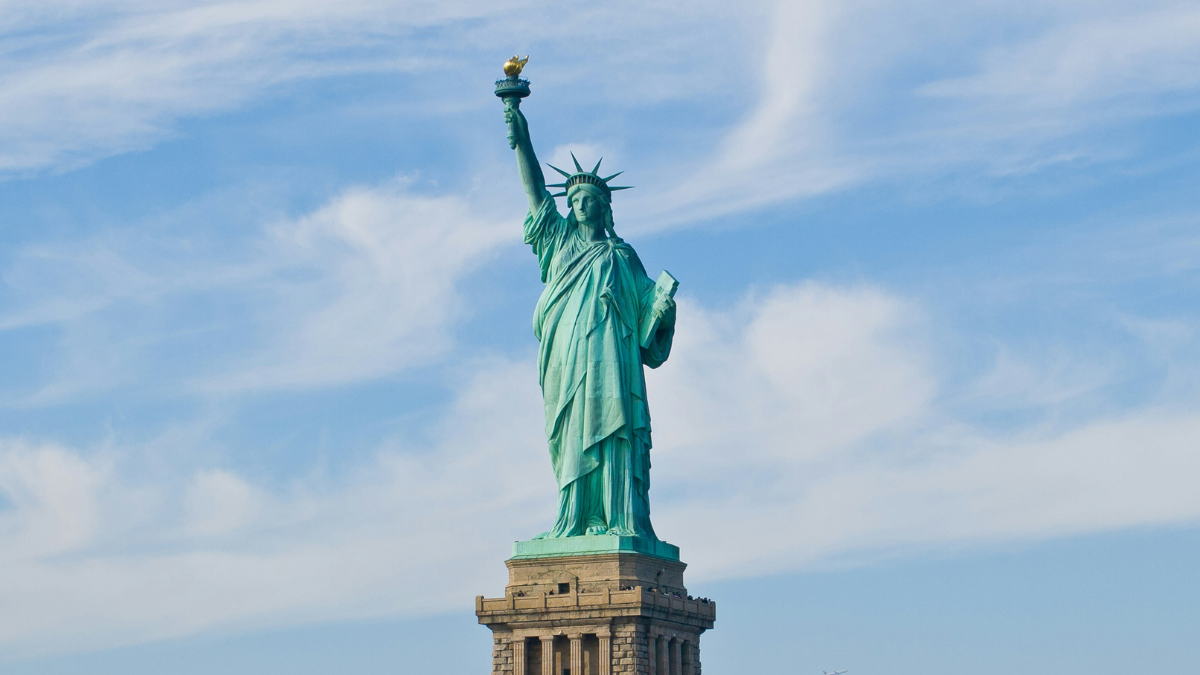
There is an egalitarian ethos around mass immigration that dominates modern leftist thinking in what could be called the “Statue of Liberty rationale.” In truth, the Statue of Liberty was never intended to be the center of gravity for mass immigration. Rather, it was a gift from France commemorating the Franco-American friendship on America’s 100th Birthday, though it wasn’t dedicated until 1886. Emma Lazarus’s poem “The New Colossus” wasn’t affixed to its base until 1903, and even then it carried little connection to immigration.
During the 1930s, however, in direct response to the restrictive immigration legislation of the 1920s, pro-immigration advocates, led by the Slovenian-American journalist Louis Adamic, transformed the poem into a political rallying cry. It was then that the decorative plaque at the base of the statue was transformed into an ideological cudgel against immigration restrictionism.
Today the left uses it to argue admission based on poverty or persecution. The right’s economic liberals use it to argue admission based on GDP contribution. Tired, poor, hungry? Come on in. Wretched refuse? Great. That’s exactly what we’re looking for.
Both visions discard the principle that immigration must serve the cultural and civic continuity of the nation itself. Not all immigrants pose equal benefits or equal risks to that goal. And so the copper Statue of Liberty, once a symbol of friendship between two nations, became the ideological cornerstone of an open-borders America, not by accident, but by design.
JFK’s ‘A Nation of Immigrants’
Today the phrase “America is a nation of immigrants” is treated as multicultural gospel on both the political left and right. But where, and how, did this phrase embed itself so deeply into the American lexicon?
John F. Kennedy first published “A Nation of Immigrants” in 1958. The Anti-Defamation League commissioned the essay, which was expanded into a book that was released posthumously in 1964. This book was used to help justify the passing of the 1965 Hart-Celler Act, which reframed America as a nation that should be welcoming to all immigrants after the 40-plus years of immigration restriction that began in 1924.
Since the Immigration Act of 1924, America had operated on a National Origins Formula, calculating immigration caps based on the existing ethnic proportions, which favored Northern and Western Europe to maintain cultural continuity. Hart-Celler abolished these quotas, banning “discrimination” in visas based on race, nationality, and place of birth. In many respects it became an extension of the Civil Rights Act (CRA) of 1964.
While the CRA legally ended discrimination for those already living in America, Hart-Celler extended that principle outward, making it effectively illegal to prefer European immigration. It also instituted a rigid 20,000-per-country cap that treated foundational European nations no differently than Third World countries, and handed nearly 80 percent of visas over to a family reunification preference system that unleashed a wave of uncapped chain migration that exists to this day.
The politicians who passed it promised nothing would change. Democrat Ted Kennedy stated, “The bill will not flood our cities with immigrants. It will not upset the ethnic mix of our society,” while Republican Hiram Fong said, “Our cultural pattern will never be changed as far as America is concerned.” After signing the Hart-Celler Act into law, Democrat President Lyndon B. Johnson asserted: “It does not affect the lives of millions. It will not restructure the shape of our daily lives.” None of it was true.
In 1960, 84 percent of legal immigrants were from Europe or Canada, and the foreign-born U.S. population was around 5 percent. By 2023, Mexico alone accounted for 22 percent of all immigrants, with India, China, and the Philippines making up another 16 percent combined. Europeans and Canadians had fallen to just 12 percent of the foreign-born population, while the total foreign-born population hit a record high of 15.8 percent in 2025.
Hart-Celler became the legislative instrument that severed the American people from their national heritage, and the politicians who passed it knew exactly what they were doing.
Toward Renewal
In the relatively brief 50 years since America celebrated her 200th birthday, the nation has undergone a dramatic cultural transformation — the seeds of which can be traced back to the very founding of the nation itself. Though not the whole story, four separate texts, selectively misread, distorted, weaponized, and enshrined into law, combined to sever over 200 years of American heritage from the collective consciousness.
For most of that time, America understood itself to be a people, and not a proposition. These were unhyphenated Americans who, despite the ebbs and flows of immigration, still managed to hold on to their collective identity right up until it was made illegal to do so in 1965 and beyond.
If America is to ever experience a renewal, it must first understand not only what was taken from it, but the mechanisms, etched in American mythos, that allowed it to happen.