
The federal courts have never been busier, and the quality of judicial reasoning has never mattered more. At stake in courtrooms across the country are the fundamental rights Americans hold most dear, such as religious freedom, the sovereignty of states, and the accountability of a federal government that too often overreaches. Circuit Judge Stuart Kyle Duncan of the 5th U.S. Circuit Court of Appeals understands that role clearly. Two recent opinions — one checking the hasty work of the FDA in approving mail-order abortions, and another affirming the benign posting of the Ten Commandments in public schools — illustrate why he deserves attention.
Duncan authored the 5th Circuit panel’s May 1 opinion in Louisiana v. FDA, granting Louisiana’s request to stay the FDA’s 2023 rule allowing mifepristone to be prescribed online and mailed to patients without an in-person physician visit. The opinion is a model of clear-eyed legal analysis. Duncan didn’t reach for politics or rhetoric. He applied the law.
On May 4, the Supreme Court issued a procedural pause on the case (the pause expires Monday), and they ought to find that it is a model of principled, careful legal reasoning that deserves close attention.
The core of his reasoning is difficult to dispute: The FDA itself had conceded that it failed to adequately study the safety of remote mifepristone dispensing before approving it. The agency was still in the middle of a remedial safety review and couldn’t specify when that review would be finished. Against that backdrop, Duncan wrote: “The public interest is not served by perpetuating a medical practice whose safety the agency admits was inadequately studied.”
That sentence captures something essential about the judicial role: Courts exist to check the executive branch, not rubber-stamp it. When an agency rushes a politically charged rule out the door — as the Biden administration plainly did in response to the Supreme Court’s decision in Dobbs — federal judges must say so, as Duncan did.
He also addressed the sovereignty interests at stake with clarity. Louisiana had documented how the FDA’s telehealth rule enabled illegal abortions under state law and generated Medicaid costs for complications caused by remotely prescribed mifepristone. Duncan recognized these as legal injuries to a sovereign state, not abstract policy grievances. “Danco’s potential financial losses pale beside Louisiana’s sovereign interest in its laws protecting the unborn and the public’s interest in not exposing women to unsafe medical procedures,” he wrote.
Let us also be plain about what was actually at stake. The idea of a telehealth DIY abortion involving pills dropped in the mail, with no physician present, and no follow-up care guaranteed, should shock the conscience of any decent person. That a federal agency embraced this as sound medical policy, under pressure from abortion advocates who called it progress, makes Duncan’s careful and courageous application of the law all the more significant.
Just 10 days earlier, Duncan authored the en banc opinion upholding Texas S.B. 10, which requires public school classrooms to display the Ten Commandments. Writing for a 9-8 majority, he concluded that such a passive display does not amount to a government establishment of religion. “S.B. 10 looks nothing like a historical religious establishment,” he wrote. “It does not tell churches or synagogues or mosques what to believe or how to worship or whom to employ as priests, rabbis, or imams. It punishes no one who rejects the Ten Commandments, no matter the reason. It levies no taxes to support any clergy. It does not co-opt churches to perform civic functions.”
Religious freedom, properly understood, does not require scrubbing every trace of faith from public life. Duncan said so plainly. That zealous secularists rushed to the courthouse to prevent children from glimpsing the words “thou shalt not kill” on a classroom wall says rather more about their own overreach than any constitutional infirmity in the law. That case, too, is almost certainly headed to the Supreme Court. And, once again, Duncan’s reasoning will be there waiting, a steady and well-researched foundation for the justices to build upon.
Taken together, these are well-reasoned decisions that value life and liberty — guarantees that are not partisan ones but the foundation of our rights as Americans. They reflect a judge who understands that the law exists to protect citizens from the overreach of government, to preserve the freedoms that define this nation, and to keep faith with the constitutional order that makes those freedoms possible.
It is worth recalling that in 2023, Duncan was shouted down by a group of students at Stanford Law School when he came to speak. He returned to his courtroom and kept respecting truth and the rule of law through his opinions — which is, after all, exactly what a judge is supposed to do.
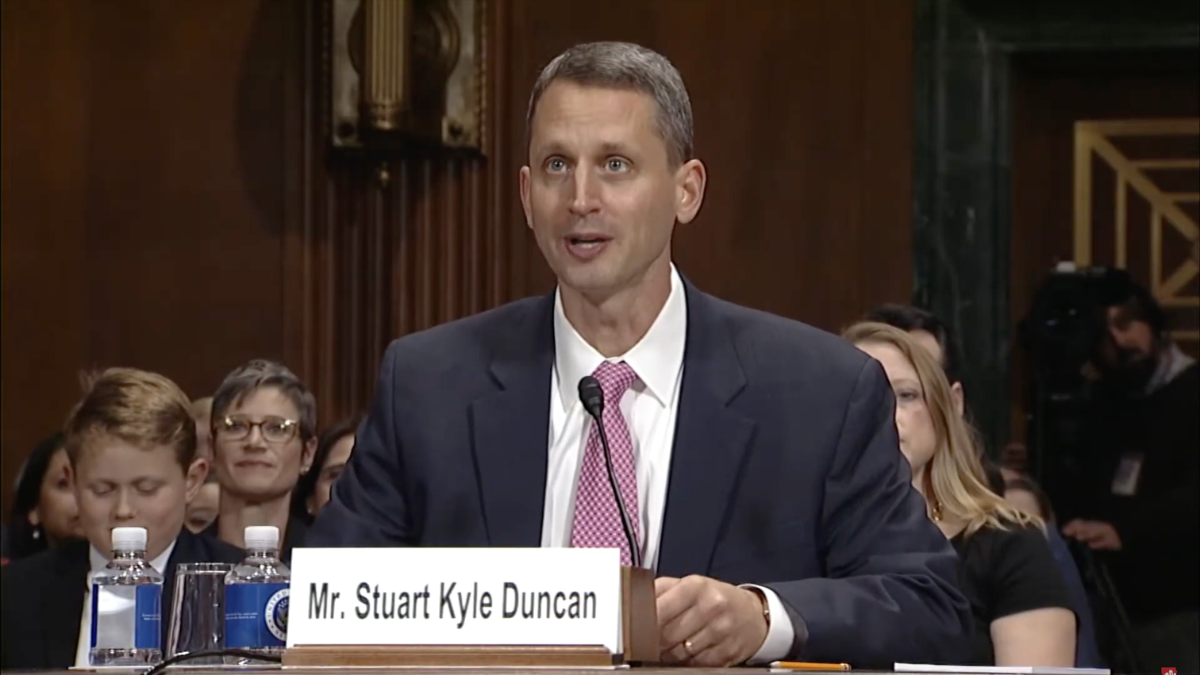
Judge Duncan was appointed to the 5th Circuit during the first Trump administration, confirmed in 2018. He is one example of the kind of judge Americans should celebrate: those who are faithful to the law, gifted in insight and intellect, and humble in the position they hold. That combination of seriousness, consistency, and quiet resolve is the standard Americans should demand from every federal judge and the standard by which future Supreme Court nominees ought to be measured.