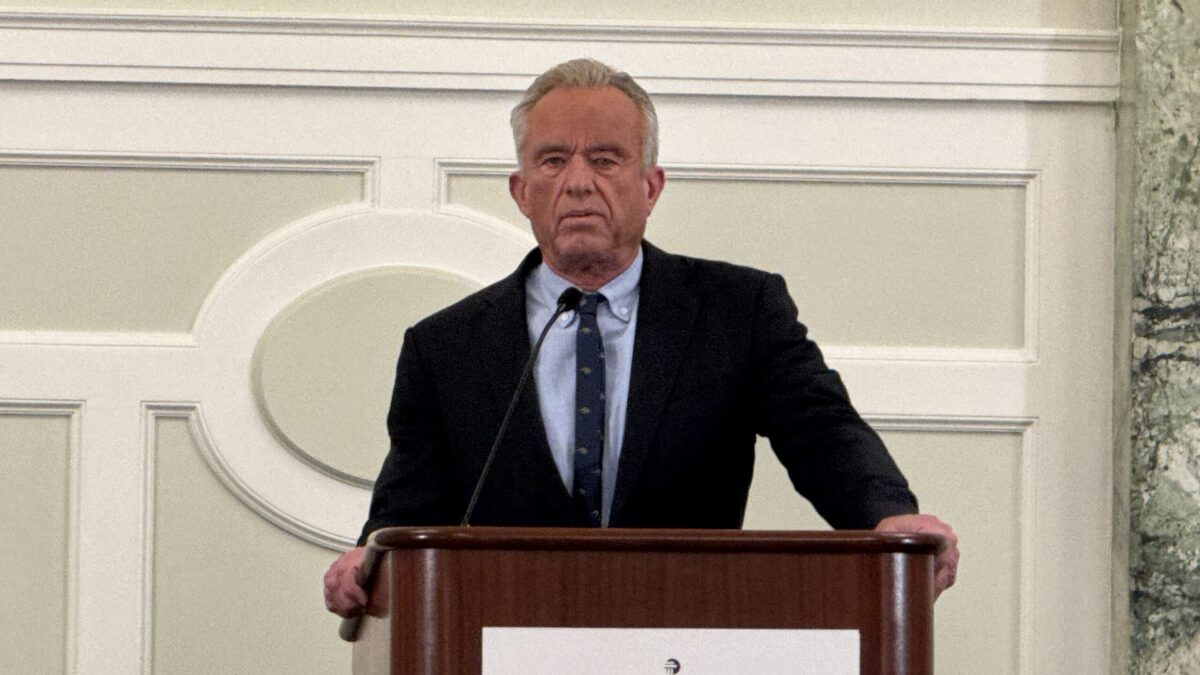

WASHINGTON, D.C. — Department of Health and Human Services Secretary Robert F. Kennedy, Jr., announced Monday a plan to stop psychiatric doctors from overprescribing medications to patients who do not need them.
Speaking at the MAHA Institute’s Mental Health and Overmedicalization Summit in the nation’s capital, Kennedy laid out some dire data showing an enormous amount of Americans — of all age groups — on one or more psychiatric medications, ostensibly in order to “treat” underlying mental health conditions.
Multiple panels at the summit made clear that there is very little underlying evidence to suggest these drugs — like commonplace Selective Serotonin Reuptake Inhibitors (SSRIs) or benzodiazepines — do much of what they promise, particularly in the long-term, and that there are massive monetary incentives for keeping patients perpetually medicated.
However, Kennedy announced a new Dear Colleague Letter from HHS that will begin a plan to start paying doctors to pursue off-ramps for these medications that have run rampant.
The “United States does not just face a mental health crisis. We face a dependency crisis driven by overmedicalization,” Kennedy said. “This is a system-level pattern. Too many patients begin treatment without a clear understanding of the risks and how long they will stay on these drugs or how to come off of them, and that’s not informed consent.”
Running through some quick statistics, Kennedy noted that over 16 percent of American adults takes antidepressants, 10 percent of children are on some form of prescription drug for a mental health issue, 30 percent of college students have used psychiatric medications in the past year, and over 50 percent of nursing home residents are on prescription antidepressant drugs.
The Dear Colleague Letter will kickstart reforms across HHS, including at the Substance Abuse and Mental Health Services Administration (SAMHSA), the Centers for Medicare and Medicaid Services (CMS), the Administration for Children and Families (ACF), and the Health Resources and Services Administration (HRSA).
Health care providers are being directed to “expand the use of evidence-based non-pharmalogic treatments and to strengthen informed consent and shared decision making,” Kennedy said.
SAMHSA, for example, will conduct national training modules on the risks associated with psychiatric medication, how to taper a patient off the medications, and encouraging deprescribing. That agency, along with HRSA, will also train providers at over 1,400 federally qualified health centers — overseeing about 39 million patients — about how to conduct medically supervised taperings for the first time.
CMS, meanwhile, will issue billing guidance that will allow providers to get paid for deprescribing, including the care planning, monitoring withdrawal, coordinating treatment, and tracking outcomes, Kennedy said.
“Psychiatric medications have a role in care, but we will no longer treat them as the default. We will treat them as one option, used when appropriate, with full transparency, and with a clear path off when they are no longer effective,” Kennedy said. “Patients must understand the benefits, the risks, and the consequences of long term use before they start or they continue, and when they consider stopping. Without that information, consent does not exist.”
Given the limited data on the efficacy of these drugs, which millions of Americans take every single day, Kennedy said that HHS is “confronting a basic question: What happens when treatment does not work as intended?”
“Some patients report improvement on SSRIs. Others report emotional blunting, loss of motivation, difficulty continuing use, and suicide ideation,” he said. “Withdrawal can be severe; it can be prolonged.”
Kennedy compared SSRI withdrawal to heroin withdrawal — something he said he had gone through “probably over 100 times” during his 14-year addiction to the substance — noting that in many ways, SSRI withdrawal is worse.
Heroin withdrawal, Kennedy said, is bad for about 72 hours, but SSRI withdrawal includes persistent suicidal ideation — something providers routinely mistake for mental health relapse, when it is really the substance itself, according to multiple panelists at the summit.
“I’ve heard that from hundreds and hundreds of people — the same story again and again,” he said. “It can be prolonged, and for many patients, it’s completely unexpected. And the physicians handle this by saying, ‘Oh, this is your original symptom, reasserting itself. You need to get back on the SSRIs.’ And they get locked in a lifetime cycle that is, for many patients, absolutely cataclysmic.”
“Nearly 48 million Americans experienced depression last year; more than 48 million struggle with substance use disorders,” he concluded. “These are not abstract numbers. These are family members. These are individuals. These are people who other people love. That is the scale of the challenge. We are not going to solve it by defaulting to medication. We’re going to solve it by strengthening prevention, expanding non-drug treatment options, and restoring clinical standards that prioritize outcome over volume.”