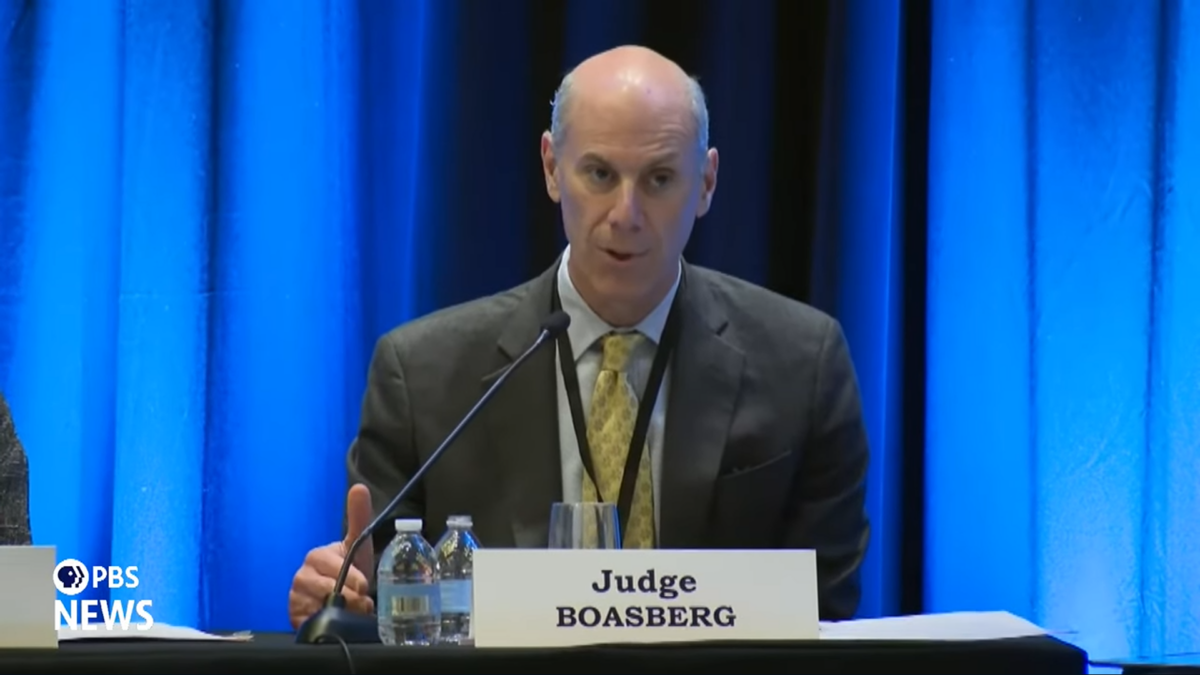

D.C. District Chief Judge James Boasberg suffered a humiliating legal defeat on Tuesday in his efforts to stymie President Trump’s deportation of illegal aliens from the United States.
In a 2-1 ruling, a three-judge panel for the D.C. Circuit Court of Appeals shot down the Obama appointee’s attempted criminal contempt proceedings against Trump administration officials involved in last year’s deportation of suspected Tren de Aragua gang members to El Salvador. More specifically, the panel granted the government’s request for a writ of mandamus, “a rare and extraordinary order from a higher court directing a lower court or government official to stop exceeding their authority,” as described by the Washington Examiner.
The D.C. Circuit panel had temporarily halted Boasberg’s criminal contempt proceedings against the administration back in December. As noted by Judge Neomi Rao in her Tuesday opinion, however, Boasberg nonetheless plowed ahead by “expand[ing]” his inquiry “to extract more information from government counsel about exactly what happened” throughout the aforementioned deportations.
Those actions, Rao summarized, amount to a “clear abuse of discretion” by Boasberg.
“The district court proposes to probe high-level Executive Branch deliberations about matters of national security and diplomacy. These proceedings are a clear abuse of discretion, as the district court’s order said nothing about transferring custody of the plaintiffs and therefore lacks the clarity to support criminal contempt based on the transfer of custody,” Rao wrote for the majority. “Moreover, the government has already provided the name of the responsible official [then-DHS Secretary Kristi Noem], so further judicial investigation is unnecessary and therefore improper. In these circumstances, mandamus is appropriate to prevent the district court from assuming an antagonistic jurisdiction that encroaches on the autonomy of the Executive Branch.”
The Trump appointee went on to note that Boasberg’s contempt proceedings infringe on core separation of powers by “improperly threaten[ing] an open-ended, freewheeling inquiry into Executive Branch decisionmaking on matters of national security that implicate ongoing military and diplomatic initiatives.” She further characterized the Obama appointee’s antics as a “judicial intrusion into the autonomy of a co-equal department.”
“The district court’s improper and unnecessary investigation, with its shifting scope and justification, intrudes upon the Executive in a manner for which mandamus is the only adequate remedy,” Rao wrote, later adding that Boasberg “assumed an improper jurisdiction antagonistic to the Executive Branch.”
Judge Justin Walker, a Trump appointee, joined Rao’s opinion in full and also authored a concurring opinion in the case.
Meanwhile, Judge J. Michelle Childs filed a dissenting opinion spanning nearly 80 pages.
The Biden appointee lamented the majority’s decision, which she argued “has determined that no further facts are needed because, as a matter of law, the alleged contemnors just cannot have committed contempt.” She further contended that, “In so doing, the majority has stymied the district court’s inherent and statutory powers and done so in a way that will affect not only these contempt proceedings but will also echo in future proceedings against all litigants.”
“Now, any litigant can argue, based on their preferred interpretation of a court’s order, that they did not commit contempt before contempt findings are even made,” Childs wrote. “And now, in any challenge where one may wave the wand of separation of powers, the Government knows it can petition this court for mandamus to relieve it from such proceedings. I cannot agree with an approach that sets such precedent.”
Tuesday’s smackdown of Boasberg comes weeks after new documents further revealed the Obama appointee’s role in Jack Smith’s post-2020 Arctic Frost lawfare against Trump and numerous GOP members of Congress.
The files disclosed by Iowa Sen. Chuck Grassley and other Republican senators indicated that members of Smith’s team met with Boasberg in March 2023, presumably about their invasive investigative efforts. The release came following a separate batch of unearthed records that showed the part Boasberg played in authorizing sealed subpoenas and nondisclosure orders targeting GOP senators as part of the probe.