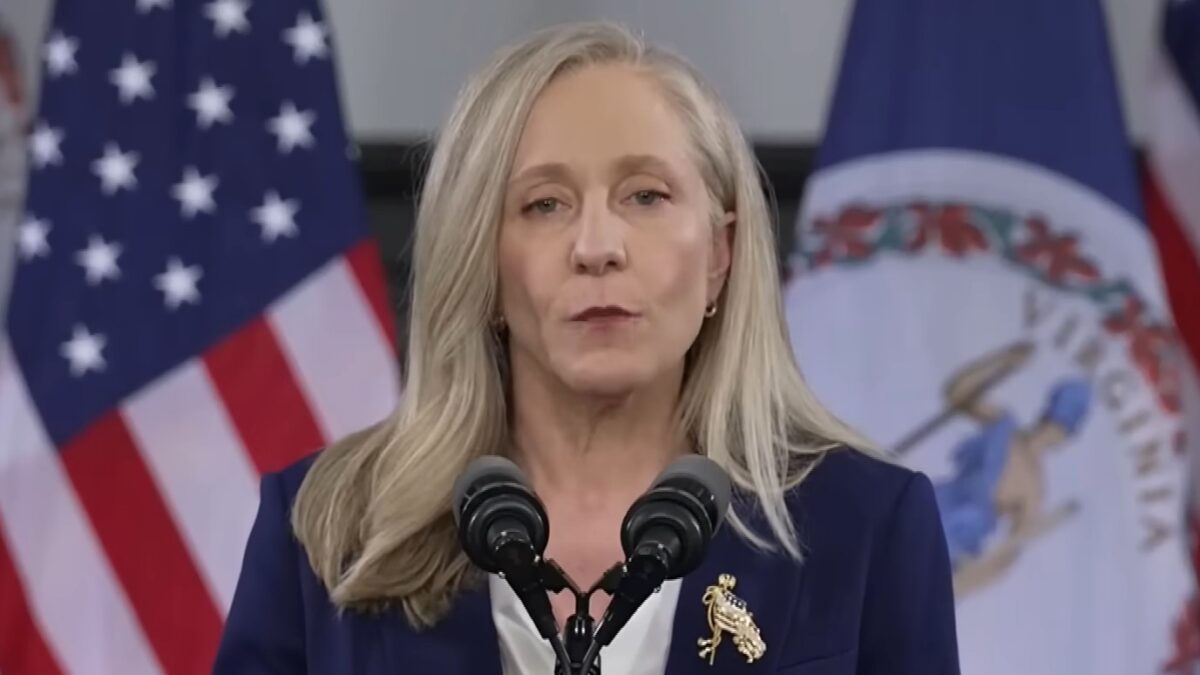

In the midst of her extreme Democrat gerrymandering gamble, Gov. Abigail Spanberger, D-Va., has the worst approval rating of any Virginia governor, no matter the party, since at least the mid-1990s, according to a new poll.
Spanberger has only been in office since Jan. 17, but her massive 15-point landslide election in November has turned into a rating of 47 percent approval and 46 percent disapproval, according to a Washington Post-George Mason University poll. The approval score is on average 13 percentage points lower than all eight of her predecessors going back to 1994.
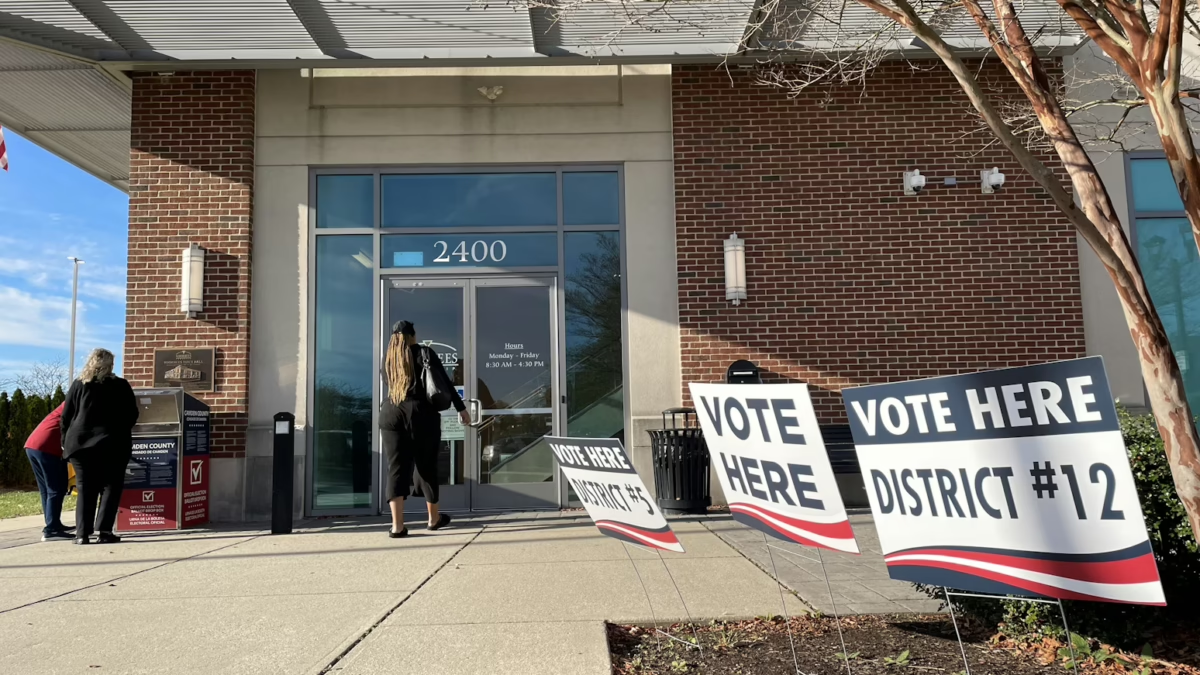
“Virginia voters were misled by Democrats and the legacy press into believing Abigail Spanberger would govern like a moderate. Now that she’s shown herself to be a pawn of far-left Speaker Don Scott and President Pro Tempore Louise Lucas, voters are changing their minds,” Matthew Hurtt, chairman of the Arlington County Republican Party, told The Federalist. “As Spanberger’s polling tanks, Virginians must decide whether we want to give the far-left four more seats in the House. The answer is clear: Virginians must vote ‘no’ on the April 21st Constitutional Referendum.”
Hurtt chairs the Republican Party in a deep-blue county in the Washington, D.C., suburbs. Arlington looks a lot like its deep-blue, highly populous neighbors, Fairfax County, Loudoun County, and Prince William County.
The Democrats’ proposed gerrymandered map slinks multiple congressional districts in the commonwealth into this deep-blue region, effectively disenfranchising huge swaths of Republicans and setting up voters in the rural, conservative Shenandoah Valley to have a congressman who will likely be a professional bureaucrat or lobbyist of the D.C. swamp variety.
The commonwealth is already deeply politically and culturally divided between Northern Virginia and huge portions of the rest of the state, and there is growing sentiment that the all-powerful northern region is destroying life for the rest of the state. Residents in the central and southern regions are already starting to use “Fairfax” as a verb, with Virginians pleading, “Don’t Fairfax Me.”
Spanberger’s election followed a long-running pattern in Virginia politics: In off-year elections, a gubernatorial candidate from either party runs successfully as a moderate in the wake of the opposing party taking the White House the previous year. In other words, Virginians’ vote for governor is often reactionary: Virginians have a long history of electing a Democrat for governor in the year after a Republican presidential candidate wins, and vice versa.
For example, Virginia voted for Republican George W. Bush in 2000, elected Democrat Mark Warner (now U.S. Senator) as governor in 2001, and returned to vote for Bush in 2004. Likewise, Virginia went for Democrat Barack Obama in 2008, voted for Republican Bob McDonnell as governor in 2009, and then went back to vote for Obama in 2012.
Now, as the polling suggests, Virginia voters seem to be recoiling from Spanberger, as her moderate promises deteriorate into radical reality. Compared to Spanberger’s 47-percent approve-to-46-percent-disapprove rating, her immediate predecessor, Republican Glenn Youngkin (2022-2026), had an average score of 54 percent approval compared to 39 percent disapproval.
Democrat Ralph Northam (2018-2022) saw 48 percent approval to 37 percent disapproval; Democrat Terry McAuliffe (2014-2018) had 52 percent approval to 30 percent disapproval; McDonnell (2010-2014) had 59 percent approval and 39 percent disapproval; Democrat Tim Kaine (2006-2010) — now a U.S. Senator — had 62 percent approval to 31 percent disapproval; Warner (2002-2006) had 78 percent approval to 20 percent disapproval; Republican Jim Gilmore (1998-2002) had 63 percent approval to 30 percent disapproval; and Republican George Allen (1994-1998) had 67 percent approval to 27 percent disapproval.
Democrats have also put their political weight behind plenty of other unpopular far-left policies since Spanberger took office, including backing countless proposals to raise taxes after promising affordability, proposing state-enforced discrimination against white men, pushing homosexuality at school, protecting rapists and murderers from justice, and blocking ICE from deporting illegal aliens, among many others.
The gerrymandering gambit may be the most polarizing initiative Spanberger and the Democrats have undertaken, however, as polling among likely Virginia voters shows that the scheme is wildly unpopular. The combined weight of these extreme measures makes it unsurprising that her approval rating has declined precipitously since entering office.