
The FBI recently carried out a search warrant for 2020 election materials in Fulton County, Georgia, giving election integrity advocates renewed hope for some accountability in the error-plagued county. But Georgians are also wondering: if lawbreaking has occurred, will anyone actually be held accountable if the feds don’t step in?
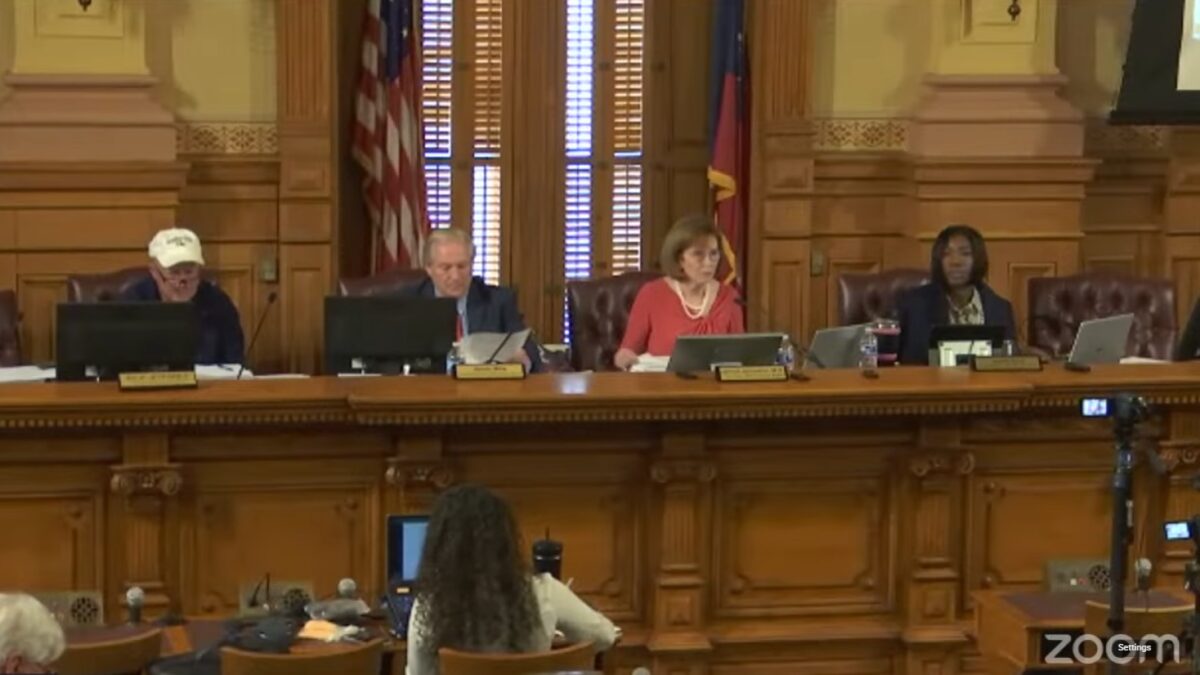
Less than two months earlier, in December, the Georgia State Election Board held a two-day meeting that finally pulled back the curtain on years of stalled election cases. For months, Secretary of State Brad Raffensperger publicly blamed the board for a troubling backlog of 315 cases, but the board’s Executive Director James Mills tells me about 270 of the cases to be adjudicated were received by the board in December.
Still, the narrative that the board is dysfunctional does contain some truth. Board Chairman John Fervier is seen by his critics as an “obstructionist,” and Mills tells me that after Fervier notified the board that he would not be attending the meeting due to personal issues, members came prepared and reached decisions on about 160 of the backlogged cases, with 20 of those continued until their January meeting.
Raffensperger has been another impediment. The board can’t decide cases it doesn’t have, and some inflammatory old cases from the 2020 or 2022 elections, like my own, have still not been delivered to the board for adjudication.
A textbook example of that kind of gatekeeping was exposed in that very December meeting when case #2022-015 was finally heard. It revealed that in 2020, more than 130 tabulator tapes, representing roughly 315,000 votes in Fulton County, were never signed by poll managers as required by board rules. The county’s long-overdue admission caused a national uproar, which Raffensperger attempted to dismiss as a “clerical error.”
The Secretary of State’s ‘Pocket Veto’
The board was created in 1964, but did not gain partial independence from the secretary of state until SB 202 passed in 2021, then SB 189 in 2024 removed the secretary from the board entirely. Raffensperger told Time Magazine he was “not happy” about the move, and critics say his office has since sought to undermine the board while blaming it for the resulting chaos.
Meanwhile, the board has been forced to rely on the secretary of state’s investigators, which creates another inherent conflict — the office managing Georgia’s elections is also investigating its own failures. Worse, in late 2025, Raffensperger took the extraordinary step of withdrawing his investigators entirely from board meetings after members began demanding answers from them about the backlog of investigations.
Although the board recently got some of its own investigators, it is also worth noting here that SB 441, which passed in 2022, gave the Georgia Bureau of Investigation (GBI) concurrent jurisdiction over election crime investigations in some circumstances. The GBI could be tasked by the General Assembly to assist the State Election Board in future case backlogs.
Currently, the cases being heard by the board are investigated by the secretary of state’s office, and after being adjudicated by the board, they may then be referred over to the attorney general’s office, or possibly to a local district attorney, and notice is given to the Department of Justice where appropriate. That process gives Raffensperger enough discretion to exercise a sort of “pocket veto” on cases like the tabulator tape case, sometimes for years.
Attorney General ‘Doesn’t Seek Criminal Charges’
Kara Murray, communications director for Attorney General Chris Carr, told me in an email that his office has jurisdiction “over certain elections crimes but not investigative authority,” and then made some bewildering claims when she said, “No criminal matters have been referred to our office by the State Election Board or the Secretary of State’s Office.”
“All referrals to the AG have been civil matters,” she added.
That is not the case according to Mills, who tells me the board has referred what they believe are serious criminal violations to the attorney general, including voting or registering to vote by noncitizens or felons, voting in someone else’s name, or submitting false registrations. Murray also provided a statement from Carr, who said, “We stand ready to vigorously prosecute any voter fraud based on the facts, the law and the evidence.”
But those statements are even more puzzling in light of an August 2024 report from Fox 5 News in which “Murray said the attorney general’s office doesn’t investigate or seek criminal charges in cases referred by the board.”
While Carr claims jurisdiction over only “certain” election crimes, he has also previously shielded himself behind Official Opinion 2024-1 to act in the role of a mere “legal advisor.” This is arguably a bureaucratic “not my job” evasion, as O.C.G.A. § 21-2-31(5) authorizes the board to “report violations of the primary and election laws either to the Attorney General or the appropriate district attorney who shall be responsible for further investigation and prosecution.”
Carr has also proven that he does know how to get jurisdiction when he wants it. In 2022, he successfully lobbied for the passage of HB 1134, which granted him the concurrent original jurisdiction needed to create a “Gang Prosecution Unit” that has since secured more than 120 convictions.
Yet on election crime, he often opts for “consent orders” that treat felony violations more like expensive parking tickets. I have been unable to find any evidence that Carr’s office has ever criminally prosecuted anyone for any election offense since he took office a decade ago. The small handful of convictions I did find for election crimes during that time were all obtained by local district attorneys.
The attorney general’s office has not responded to follow-up questions, which is unfortunate because the public is left with very mixed messages. Is it fair then to conclude that they sometimes can prosecute election crimes, but never actually do?
Secretary of State Bypasses Board and AG
Meanwhile, Raffensperger recently began to bypass both the board and the attorney general by referring some election cases “directly to District Attorneys who have the legal authority and, willingness, to prosecute,” said Secretary of State Communications Director Robert Sinners.
That is legally appropriate, but as a practical matter local district attorneys are often overwhelmed by violent crime, lack experience with election law, or may be politically aligned with the actors they are investigating. That could create a prosecutorial dead-end that can be resolved if the attorney general is given clear “concurrent original jurisdiction,” which would allow him to act when local officials don’t.
The structural dysfunction of the secretary of state, the attorney general, the GBI, and local district attorneys in enforcing election law has too often led to flagrant disregard of those laws by local election officials. But it is also important to understand all of these issues in the context of the 2026 Republican primary for governor. The secretary of state is technically the attorney general’s client, but they are also political rivals. Raffensperger and Carr have both launched campaigns to succeed current Gov. Brian Kemp.
In a race where election integrity issues remain a litmus test for the Republican base, both men have reason to be defensive. When Raffensperger’s office sends a case to the board, and it is then referred to the attorney general, it is a tacit admission by Raffensperger that Georgia elections remain plagued with issues. And the conflicts between the three sometimes turn high-profile board cases into political footballs, with the board caught between two aspiring candidates who can sometimes seem more interested in politics than principle.
State Sen. Brian Strickland, an announced candidate for attorney general, tells me that he “would support clarifying under Georgia law that our Attorney General has concurrent jurisdiction to pursue charges against individuals and entities that violate our election laws.”
Conclusion: It’s a Choice
What Georgia really needs is both the political will and the infrastructure necessary to adequately punish offenders for election crimes. The General Assembly should immediately fund a fully independent state election board, grant concurrent original jurisdiction to the attorney general over all election crimes, and task the GBI to support the board directly when needed.
Without genuine reform, the Georgia Election Code risks becoming a quaint curiosity or a mere suggestion instead of the system by which public confidence in our elections is restored and maintained.