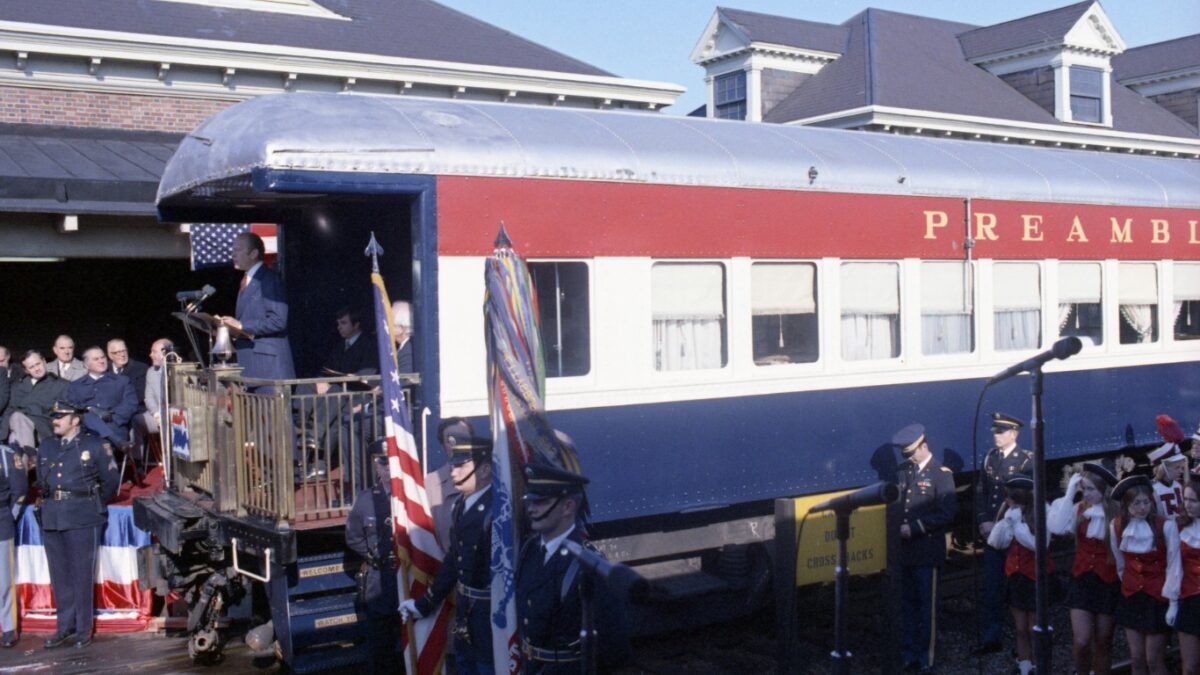

For America’s glorious Bicentennial celebration, a gleaming red, white, and blue steam train traveled across the country with an on-board presentation honoring America’s history and heroes. The American Freedom Train drew huge crowds, over 50,000 at some stops, while many more heard its memorable whistle calling through their towns. Bicentennial committee head John Warner said the train was “certainly the most visible and national” of all the Bicentennial offerings and helped “sew together” locally planned celebrations.
Fifty years later, the Quarter-Millennial version of the American Freedom Train is set to hit the tracks in October and bring the celebration to the people across the following 11 months — but it can only do so if Amtrak will allow it to travel across the country.
Largely the brainchild of John Wayne, the 1970s American Freedom Train helped energize a fractured nation. With the country reeling from Vietnam, race riots, Watergate, and high inflation, the Freedom Train and the rest of the spirted Bicentennial festivities managed something remarkable: They united millions of Americans in a shared celebration of our forefathers and of the great blessings they bequeathed to us.
We are now living at a time that shares a lot of similarities with that Bicentennial era. The country is still reeling from Covid mandates, race riots, the era of peak wokeness, and high inflation. In this context, it is important to get the Quarter-Millennial right and not waste a golden opportunity to remind Americans how fortunate they are to have inherited the blessings of this land and this republic. Indeed, the Quarter-Millennial anniversary of American independence is perhaps the best chance in 50 years to reset how Americans view our nation’s history and heroes.
Yet it remains to be seen whether America is still capable of doing what it did 50 years ago. Most of the Bicentennial festivities were examples of private citizens — or private Tocquevillian civil associations — coming together to plan things from the ground up. The Bicentennial was not a top-down effort run by the government. It was quintessentially American in allowing the citizenry’s various ideas and initiatives to flourish.
Fifty years later, we have unfortunately become a much more litigious and bureaucratic nation. This makes it increasingly difficult for the private efforts of everyday Americans to flourish, which threatens the very heart of the American dream and the American way of life.
For the Bicentennial, the American Freedom Train was able to be “self-insured,” which meant not really being insured at all. Today, no Class I railroad will allow a train to run on its tracks if it doesn’t have access to the insurance coverage and caps that realistically can only be obtained through an agreement with Amtrak. By entering into a charter services agreement with Amtrak and thereby paying Amtrak to move the train between stops, a train can gain the insurance coverage it needs. Otherwise, it won’t be allowed on the tracks. This specific example is a microcosm of the crippling litigiousness and risk-aversion that are all too prevalent in modern America.
The American Freedom Train, which I have been helping to advance in an unpaid capacity for the better part of a year, has asked Amtrak Charter Services to let it pay for services and thereby acquire the insurance it needs to get on the tracks. Those putting on the Freedom Train would provide the steam locomotives (five have been lined up), an engineer and fireman, train cars (nine have been lined up), a full-time mechanic and electrician, all other necessary equipment, and fuel. The train wouldn’t be stopped and displayed on tracks that Amtrak uses; instead, it would be displayed on regional tracks and therefore wouldn’t disrupt Amtrak’s passenger service. And the Freedom Train would pay the going rate to Amtrak, asking no favors despite being an effort to honor the nation’s 250th anniversary.
All the American Freedom Train needs is for Amtrak to accept payment to move the 11-car celebratory train between display cities — about one trip per week — on a low-priority, non-peak-hours basis. This means that Amtrak could move the train whenever it wants, including in the middle of the night.
The American Freedom Train would likely be the most recognizable, far-reaching, and memorable part of America’s 250th anniversary celebrations. Having railroads be at the center of those celebrations would be a boon to Amtrak, which also stands to make money on the deal. Every time the Freedom Train enters a new town, it’d be good publicity for Amtrak.
If Amtrak won’t do business with the American Freedom Train in spite of all this, then the American citizenry would be denied the chance to see the powerful steam locomotive — itself an almost-living symbol of American history — and to experience the train’s on-board presentation and artifacts honoring America’s heroes. But if Amtrak allows the American Freedom Train to hit the tracks, the Quarter-Millennial will stand a chance of matching the glorious Bicentennial in patriotic splendor. At this moment in its history, America needs such a splendid celebration.
In short, Amtrak can either be one of the great facilitators and beneficiaries of the Quarter-Millennial celebration, or it can help stymie and stifle them. It can help make the Quarter-Millennial rise to the level of the Bicentennial, or it can be a key cause of its being a rather pallid imitation of that earlier triumph.
Our founding fathers fought a revolution to institute a government that would secure liberty, allowing private citizens to flourish in the process. The American Freedom Train seeks to honor our forefathers’ legacy. Let’s get it on the tracks and let it bring the Quarter-Millennial celebrations to the people. It’s time to let the American Freedom Train roll.