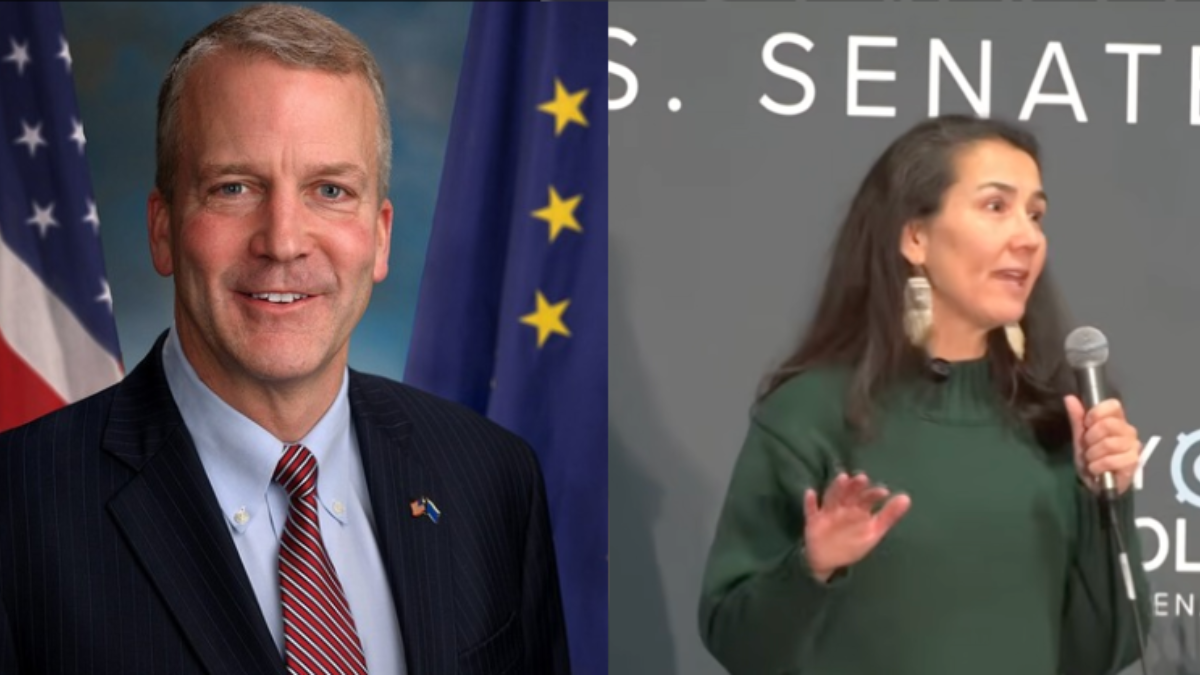

Americans for Public Trust outlined in a Federal Election Commission complaint how “Decoy Dan,” a purported spoiler candidate with the same name as Alaska’s incumbent Republican Sen. Dan Sullivan, may have violated federal election laws by coordinating with a dark money group. Recent reporting by The New York Times alleges that Democrat candidate Mary Pelota’s campaign and the Democratic Senatorial Campaign Committee actively recruited candidates to confuse voters and manipulate Alaska’s U.S. Senate race.
Together, this suggests a more complicated scheme to influence that race and possibly tip the balance of control of the U.S. Senate. Americans deserve answers about what happened in Alaska and whether federal election laws were in fact violated.
The New York Times reported last week that in the summer of 2025, Mary Peltola’s aides directed a staffer to search for every Dan Sullivan in Alaska. Jerid Kurtz, an operative introduced to the Peltola campaign by aides at the Democratic Senatorial Campaign Committee, called a Peltola aide in late May to say he had just arrived in Petersburg, the hometown of Daniel J. Sullivan Jr. (“Decoy Dan”), shortly before he filed to run for Senate.
The Times describes Petersburg as “a tiny fishing village along the Alaska Panhandle, reachable only by air and sea.” Kurtz was not the only notable visitor that spring. Peltola held a campaign event on May 26, three days before Decoy Dan filed his candidacy. Decoy Dan denies any connection, telling KFSK, “I have not been in contact with her or her campaign.”
The Times also reported on texts in which Peltola advisers, watching a focus group, wrote, “Do we have a scheme for you.” The Peltola campaign and the DSCC deny recruiting anyone. Decoy Dan has maintained, including through his attorney in court, that his campaign is genuine.
Public discussion has largely coalesced around the view that ballot-stacking is not illegal. That view misses the bigger legal story. That story is found in Americans for Public Trust’s Sept. 8 complaint.
The complaint describes how Decoy Dan’s only known campaign consultant, who was only made known after metadata revealed her relationship with the campaign, also held a leadership role at a dark-money group that spent more than half a million dollars attacking Sen. Dan Sullivan in the three months leading up to the August primary. Holding both a role within the Decoy Dan campaign and an outside group that attacked the campaign’s primary opponent could have violated federal election rules on coordination.
Uniquely Vulnerable Ranked-Choice Voting
Under Alaska’s ranked-choice voting system, voters rank candidates by preference. If no candidate secures a majority, the lowest is eliminated, and those ballots shift to the next choice. Rounds continue until two remain. Ballots become “inactive” if they rank no remaining candidate, give two candidates the same rank, or skip two rankings in a row.
Consider a supporter of the senator who mistakenly ranks only Daniel J. Sullivan instead of Dan S. Sullivan. The state’s sample ballot lists Decoy Dan first, as “Sullivan, Daniel J. Jr.,” with the senator next, as “Sullivan, Dan S.” When Decoy Dan is eliminated, that ballot either moves to whoever the voter ranked next or, if the voter ranked no one else, drops out of the count entirely. In the Aug. 18 primary, Decoy Dan won 2.5 percent of the vote, and polls put the race within 1 or 2 percentage points.
Text messages the Times reviewed suggest the operatives were counting on exactly this kind of confusion. According to the Times, Peltola advisers “seemed to make fun of voters while watching a focus group, surmising the participants would be susceptible to being tricked into voting for a ballot spoiler.”
The Decoy Dan Campaign
Daniel J. Sullivan Jr., a political newcomer, first tried to appear as “Dan S. Sullivan,” the senator’s actual middle initial, and he registered as a Republican for the first time two days before filing and launched a campaign website mimicking the senator’s format and color scheme.
Alaska Division of Elections Director Carol Beecher found that his declaration was not filed in good faith and decertified his candidacy. But Alaska’s courts held he could remain on the ballot without deciding whether his candidacy was intended to mislead voters.
Decoy Dan’s campaign has confirmed working with Anchorage consultant Amber Lee, a longtime Democrat supporter who previously worked on a pro-Peltola super PAC. Lee also serves as a director and corporate secretary on 907 Initiative’s board, which has only four voting members, according to the group’s corporate records.
Americans for Public Trust alleges 907 Initiative spent nearly $1.5 million against the senator this cycle through August, including about $575,000 in the 90 days before the August primary, days after Decoy Dan announced his run for U.S. Senate. Federal Communications Commission records show one 907 invoice for 119 anti-Sen. Sullivan ads on KTUU airing June 3-9 at $112,365.
This is notable because 907 Initiative reported $793,705 in revenue and just $32,549 in net assets on its latest tax return covering 2024. The spending exceeds half its annual revenue and surpasses its total 2024 ad spending in under three months.
Federal Election Law and Coordination
Since the Times’ reporting, public discussion regarding ballot-stacking has coalesced around the idea that ballot-stacking, while unethical, is legal. But the complaint from Americans for Public Trust alleges principal violations of federal election law, not political gamesmanship.
Under federal election rules, an ad counts as coordinated when it meets three conditions. First, someone other than the campaign pays for it. Second, it names a candidate in that candidate’s state within 90 days of an election. Third, certain conduct links the spender to the campaign, such as a request from the campaign, material involvement by the campaign, a shared vendor, or a contractor who worked for the campaign within the previous 120 days.
The complaint alleges that all three conditions are met. According to the complaint, 907 Initiative paid for ads naming the senator inside the coordination window that opened May 20. Lee, a paid campaign contractor, sat on 907’s board while the group reserved ads against her client’s opponent. Decoy Dan’s pre-primary FEC report lists $4,380.41 owed to Lee’s firm for “Website Services and Campaign and Digital Consulting,” and the complaint alleges that she helped him file and helped author his campaign materials.
A coordinated ad counts as an in-kind contribution to the campaign. Because 907 Initiative is a corporation, any such contribution would be prohibited, no matter the amount. Violations aggregating $25,000 or more cross the felony threshold if they were “knowing and willful.”
In response to the complaint, 907 Initiative said it is “in full compliance with applicable campaign finance laws, including federal coordination rules,” and Lee has said she is an unpaid board member who does “not manage [907’s] independent expenditure activity.”
Whether any violation was “knowing and willful” is what separates a civil penalty from a potential felony. That standard generally requires proof that a person knew the conduct was unlawful, not simply that a violation occurred, and that awareness may be shown through circumstantial evidence. Justice Department guidance treats concealment efforts and a person’s professional experience as relevant.
The record appears to contain several such indicators. On June 1, the NRSC sent Lee a written preservation-of-records demand warning of potential violations of the Federal Election Campaign Act after her name appeared in the metadata of Decoy Dan’s campaign announcement. Her dual roles continued after the notice; she reportedly left the campaign in mid-August and remains on 907’s board.
The timing is also hard to dismiss. Decoy Dan’s website domain was registered May 28, 907’s first anti-Sullivan ad aired the same day, and the candidate delivered his declaration of candidacy to the Alaska Division of Elections on May 29.
That scale of the anti-Sullivan advertising is also relevant to Lee’s duties as a 907 director and its secretary. Directors and officers of a nonprofit corporation owe a fiduciary duty of care, which requires them to stay informed and to oversee the organization’s financial decisions.
Here, a single broadcast advertisement buy of $112,365 equals more than a third of everything 907 spent on advertising in all of 2024. A director claiming ignorance of spending on that scale would be conceding a lapse in the very oversight that a director and officer’s duty of care requires.
Lee’s public statement to the Alaska Beacon that she does not manage 907’s spending is irrelevant to coordination rules. Federal law considers an agent “materially involved” if they influence an ad’s content, timing, or placement, or if the spender uses a common vendor or agent who recently worked for the campaign and shares campaign plans. Here, she was a vendor to the Decoy Dan campaign and a director and officer of the 907.
Each of 907’s communications is evaluated separately under these rules. The question for each ad is whether the payment, content, and conduct standards are met, not whether Lee supervised 907’s overall program or signed individual buys. Her statements confirm her continuing governance role but do not resolve factual allegations that turn on material involvement, the flow of information, or her alleged status as a common agent of both 907 Initiative and the Decoy Dan campaign with access to nonpublic information.
None of this proves a violation. And only investigators can determine what Lee knew or did. No one has been charged, and this article finds no wrongdoing.
Unanswered Questions
Alaska Division of Elections Director Carol Beecher deserves credit for her efforts to protect Alaska voters. The exposure of the ballot-stacking scheme is important too. But Americans for Public Trust deserves credit for having identified the federal question missing from the current debate.
Gov. Mike Dunleavy has ordered a state investigation, saying the new reporting “substantially supports” the Division of Elections’ findings, and federal prosecutors have reportedly issued new subpoenas.
Yet the most consequential questions remain largely unasked: Were 907’s advertisements attacking Decoy Dan’s campaign opponent coordinated in violation of federal election laws? Did other violations occur? Were other groups involved?
Americans for Public Trust has presented evidence that requires an answer. Regardless of Tuesday’s outcome, Alaskans deserve one.