
Florida’s former top elections official has introduced a bill that aims to make Election Day Election Day again, a proposal that would put an end to the flood of mail-in ballots arriving days after the polls close.
Rep. Laurel Lee, a Republican who represents Florida’s 15th Congressional District, asserts the Ballots by Election Day Act will bring back a “commonsense standard to federal elections” by requiring ballots be received by the close of polls on Election Day. If they’re not, they won’t be counted.
“When the polls close, voters should have confidence that the voting is over and election officials can move forward with determining the results,” Lee said in a press release. “The Ballots by Election Day Act applies that commonsense standard to federal elections across the country and provides greater certainty for voters, election officials, and the American people.”
California Chaos
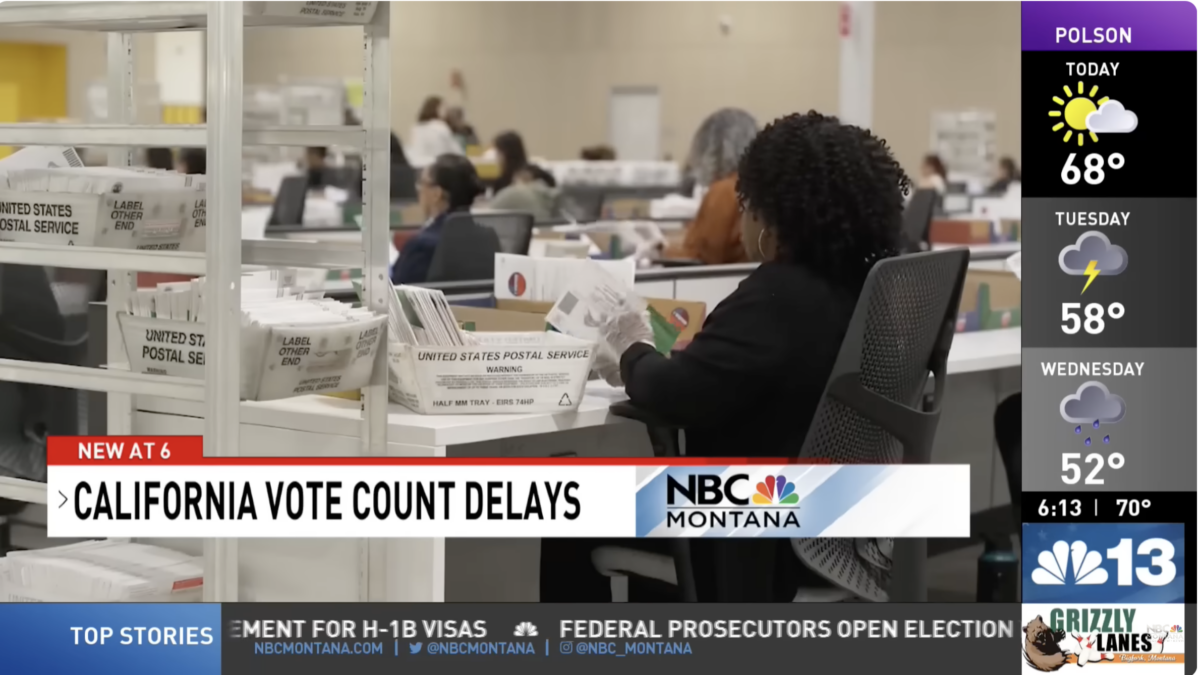
Uncertainty — chaos, really — has reigned in states like California, which accepts ballots a week after Election Day, if postmarked by Election Day. The Golden State’s June primary saw another long vote count, with election officials still tallying votes several days after the June 2 contests. As The Federalist’s Hayden Daniel quipped at the time, “Colombia, a mountainous country infested with drug lords and guerrillas, is counting its votes more efficiently than the state of California.”
Mail-in ballots received after Election Day continued to pour in. Over time, the nationally-watched Los Angeles mayoral race saw radical leftist City Council member Nithya Raman grab the votes she needed to leapfrog the relative conservative in the race, reality television personality Spencer Pratt, to claim the second and final spot on November’s general election ballot.
In 2024, California’s extended Election Day forced the country to wait more than a month to learn the majority-minority power balance in the U.S. House of Representatives.
California’s lax voting rules understandably have created suspicions of election manipulation, and have done nothing to lift flagging voter confidence. The Democratic Party stronghold sends mail-in ballots to all registered voters, and third parties are free to collect unlimited numbers of ballots. Such harvests have led to massive mail-in ballot dumps that can push a candidate to victory.
California is not alone. Fourteen states and the District of Columbia accept postmarked ballots after Election Day, with varying grace periods.
‘Greater Opportunity for Fraud’
The Supreme Court this summer did no favors to election integrity when it issued its 5-4 ruling in Watson v. RNC, a case challenging Mississippi’s 5-day grace period for receiving mail ballots. Authored by (kind of) conservative Associate Justice Amy Coney Barrett and backed by (kind of) conservative Chief Justice John Roberts and the court’s three liberals, the majority opinion shrugged off arguments that the constitution lays out when Election Day is — and when ballots must be in to count.
“The election-day statutes say nothing about ballot receipt, and we cannot add to the words Congress chose,” Barrett wrote.
Justice Samuel Alito penned the dissenting opinion, shared by justice Neil Gorsuch, Brett Kavanaugh and Clarence Thomas.
“Allowing absentee ballots to pour in over the days and weeks after election day, by which point preliminary election returns are being publicly reported, creates greater opportunity for fraud and risks further undermining the public’s confidence in election integrity,” Alito wrote. He added that “[i]f ballots received after election day are added to the set of ballots that dictate the election’s outcome, the electorate’s choice does not occur on election day, and the federal election-day statutes are violated.”
Congress has the power to end the chaos. But will it? Probably not, at least anytime soon.
‘Election Day Should Mean Election Results’
Lee’s Ballots by Election Day Act does what Barrett asserts the Constitution does not do. It establishes a clear deadline when ballots in federal elections must be received — by the close of the polls on Election Day. Ballots that arrive after would not be counted.
Lee, who previously served as Florida Secretary of State, said the bill is modeled after the Sunshine State’s Election Day deadline.
“Florida has shown that we can provide voters with accessible ways to cast their ballots while maintaining a clear deadline for when those ballots must be received,” the two-term congresswoman from the Tampa-area district. “Election Day should mean election results.”
The comparison is stunning. As 77 WABC reported, Florida counted about 85 percent of the 3.3 million ballots cast in last month’s primary election in 45 minutes. In Los Angeles, elections officials didn’t hit the 85 percent mark until six days after the city’s June primary election. About 2.2 million ballots were case in the Los Angeles election.
Florida Sen. Ashley Moody, a Republican, is leading a similar bill in the upper house. She called on Congress to “bring Florida’s blueprint for elections nationwide.”
Much would have to change in order for the Florida blueprint to become law. Democrats have balked at every turn in passing the SAVE America Act. The popular election integrity package would require documentary proof of citizenship to register to vote in federal elections, and voter ID to cast a ballot. It also would significantly limit mail-in ballots. Senate Democrats have filibustered the bill, and Republican leadership isn’t courageous enough to force Democrats to fight to keep the filibuster in place.
‘Plainly Constitutional’
On Thursday, the Trump administration asked the Supreme Court to lift a lower court’s temporary restraining order blocking the implementation of U.S. Postal Service rules for mail-in ballots. The rules are designed to keep noncitizens from voting in U.S. elections. Leftist groups and Democrat state attorneys general have sued to stop the attempt to vet mail ballots, rules drawn from President Donald Trump’s executive order.
The Supreme Court earlier slapped down U.S. District Court Judge Indira Talwani’s permanent injunction, finding the far-left Obama appointee prematurely moved to block the Trump administration.
“The Rule’s regulation of the U.S. Mail—not federal elections—is plainly constitutional,“ the administration wrote in its filing. ”While the States have primary authority to regulate the manner of elections, they cannot choose to use the federal mails to carry out their elections but then insist that their election-related mail is somehow exempt from the Postal Service’s rulemaking authority.”