A Utah judge ruled Tuesday evening that Tyler Robinson, the man accused of assassinating Charlie Kirk, will stand trial for aggravated murder, meaning the state can seek the death penalty.
Coming up on one year after Kirk was assassinated on Sept. 10, 2025, Judge Tony Graf ruled that state prosecutors submitted enough evidence to meet the probable cause threshold necessary to bind the case over for trial. The threshold included not just evidence that Robinson committed the murder, but that the murder was aggravated and could have caused the deaths of others around Kirk.
In his order read from the bench, Graf reviewed in detail all the evidence presented at the preliminary hearing, which included video evidence, forensic DNA evidence, and Robinson’s own alleged admissions over text and in online chatrooms.
“Viewed in the light most favorable to the prosecution, this evidence is sufficient at this stage to support a reasonable belief that defendant is the individual who shot and killed Charlie Kirk,” Graf stated.
As per the aggravating factor, making this a death penalty case, he added, “The state need not establish at this stage that the defendant calculated a particular ballistic probability. It must, however, present evidence permitting a reasonable inference, both that another person was exposed to the statutorily required degree of risk, and that the defendant was aware of the circumstances giving rise to that risk. The evidence described above is sufficient.”
“The court’s determination does not rest on crowd size alone, or an assumption, assumed probability of wind ricochet, over penetration, or bullet deflection,” he continued. “It rests on the evidence concerning the location and manner of the shot, the documented position of several individuals in and around the canopy area, defendant’s opportunity to observe those circumstances, and the preliminary hearing requirement that reasonable inferences be drawn in the state’s favor. Whether the state can prove the aggravating circumstance beyond a reasonable doubt remains for trial. Count one is bound over for trial.”
The final day of hearings began with the prosecution laying out the “mountain of evidence” it has against Robinson. Despite the fact that this preliminary hearing was to determine probable cause to move to trial, the biggest focus of closing arguments from both the defense and the prosecution was the aggravating factor that controls whether this will be a death penalty case.
Prosecutors are seeking the death penalty, and in order to do so, they need to not just show proof of murder, but aggravated murder, which would be “aggravated” because of certain factors surrounding the actions of the shooter. In this case, prosecutors are arguing that Robinson fired into a crowd of thousands of people, putting others’ lives at risk beyond that of the target, Kirk.
“Tyler James Robinson shot and killed Charlie Kirk because he disagreed with him, and he did it by firing a high-powered rifle into a crowd of over 3,000 people,” Utah County prosecutor Ryan McBride said.
“You can’t shoot a rifle into a crowd of 3,000 people without knowing that you create a great risk of death to all those around your target. Just can’t do it. It’s common sense. Shooting ranges have a line of fire. You can’t go in front of the line of fire, and there’s a reason for that, and we all understand the reason for that, because you create a great risk of death to anyone who crosses in front of you when you’re shooting a rifle, or any gun for that matter.”
“There were people everywhere, people on the railings, people in that amphitheater, people in front of Charlie Kirk, and people behind Charlie Kirk,” McBride continued. “As he [Robinson] laid down, and as he approached that rooftop on the Losee Center roof, as he approached the edge of that rooftop, he would have seen this mass of thousands of people. As he lay down and took up aim, he would have seen all of those people. As he looked through that scope, his scope likely passed over the faces, heads, and bodies of multiple people before it rested on Charlie Kirk.”
Robinson’s defense attorneys have tried to argue that there is no evidence to suggest the aggravating factor because he only shot Kirk, did not reload his gun, and he never rechambered his gun after firing the shot, meaning there was no greater risk to others.
To that, prosecutor Chad Grunander responded, “Tyler Robinson doesn’t get to hide behind the fact that on September 10, 2025, he was true to his aim. Not when he shot into a crowd of people and shot and killed Mr. Kirk, with people immediate, with a person immediately to his right, within a couple of feet.”
“If the defendant had flinched even a quarter of an inch at that distance, math tells us at the target point it would have been a difference of 41.7 inches, approximately three and a half feet,” he continued. “That would have more than covered the security to Mr. Kirk’s right. If he had flinched even a half an inch, that would have resulted in a difference of 83.4 inches at the target point, a seven-foot difference, and that could have impacted a number of people there.”
The prosecution said there are four categories of evidence that by themselves at the very least show probable cause to go to trial, and that the state believes prove Robinson killed Kirk.
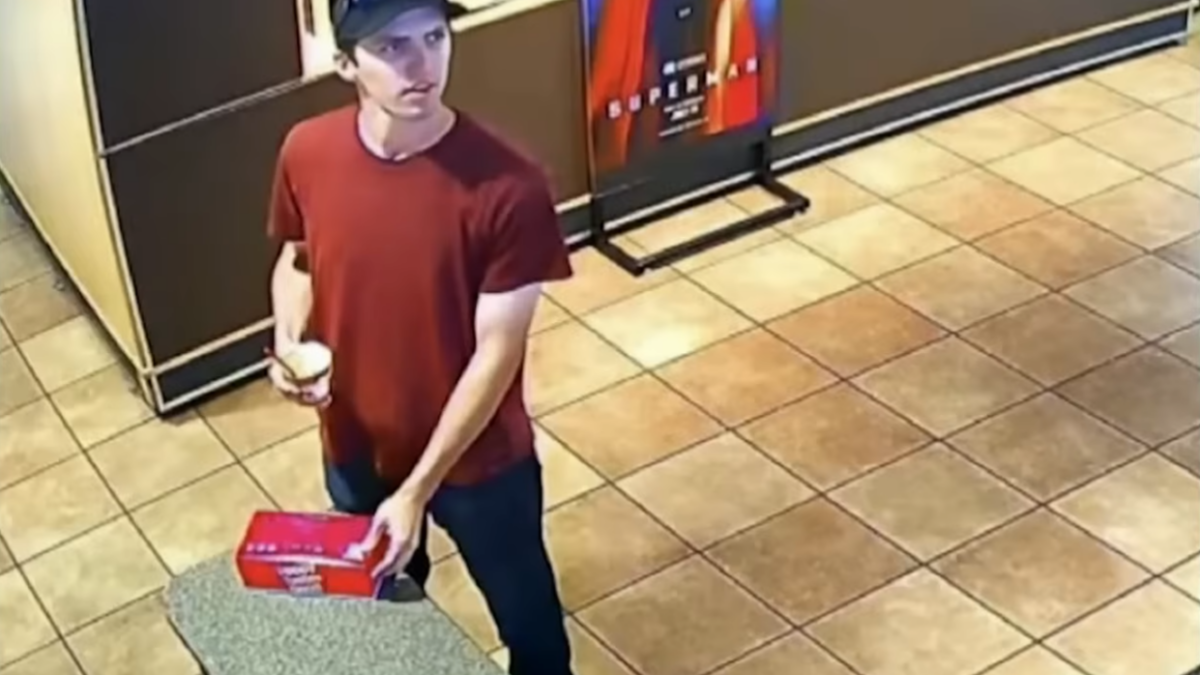
McBride went through the video evidence showing Robinson doing reconnaissance on the area the morning of the shooting, and then returning at the time of the shooting.
“The defendant then returned at 11:54 a.m., this time, dressed to kill, black shirt, long pants to obscure the rifle he had concealed down his pants, and he made his way through campus the same route of ingress into campus that he had taken during his second scouting mission,” McBride said. Robinson then placed the gun at a “predetermined drop point,” he continued, only to return after midnight to pick it up.
There is also overwhelming DNA evidence tying Robinson to the gun, McBride said, “And make no mistake, Your Honor. This was the murder weapon. This was the rifle that killed Charlie Kirk.”
But in addition to the video and DNA evidence, McBride said that “we know that the defendant is the shooter … because he admitted to it.”
“That morning before he left, he left a note for his boyfriend, stating that he left on a mission. He had the opportunity to take out Charlie Kirk, and then after he had shot and killed Charlie Kirk, the defendant texted that same boyfriend and admitted to doing this. ‘You weren’t the one who did it, right?’ ‘I am. …’ And then after that, he also claimed credit to all of his friends on the Discord app,” he stated. “The defendant did the same thing that I have asked you to do, Your Honor. Yes, he pointed his friends to the surveillance evidence and said, ‘Look at it. It was me.'”
The defense took time to attempt to undercut DNA evidence, argue against the aggravating factors, and argue against enhancements to some of the other charges.
The case will now move to trial, but it is unclear how quickly that will happen. Utah legal commentator Greg Skordas noted that the right to a speedy trial is a right Robinson holds, and added that the Kirk family also has an interest in a timely resolution of the case.
Skordas also said that this is one of the slowest preliminary hearing schedules he has ever seen and speculated that the trial may not happen until next year and could even bleed into 2028.
Evidence presented by the prosecution and defense during the first week of preliminary hearings may be reviewed here: Day 1, Day 2, Day 3, Day 4, and Day 5.