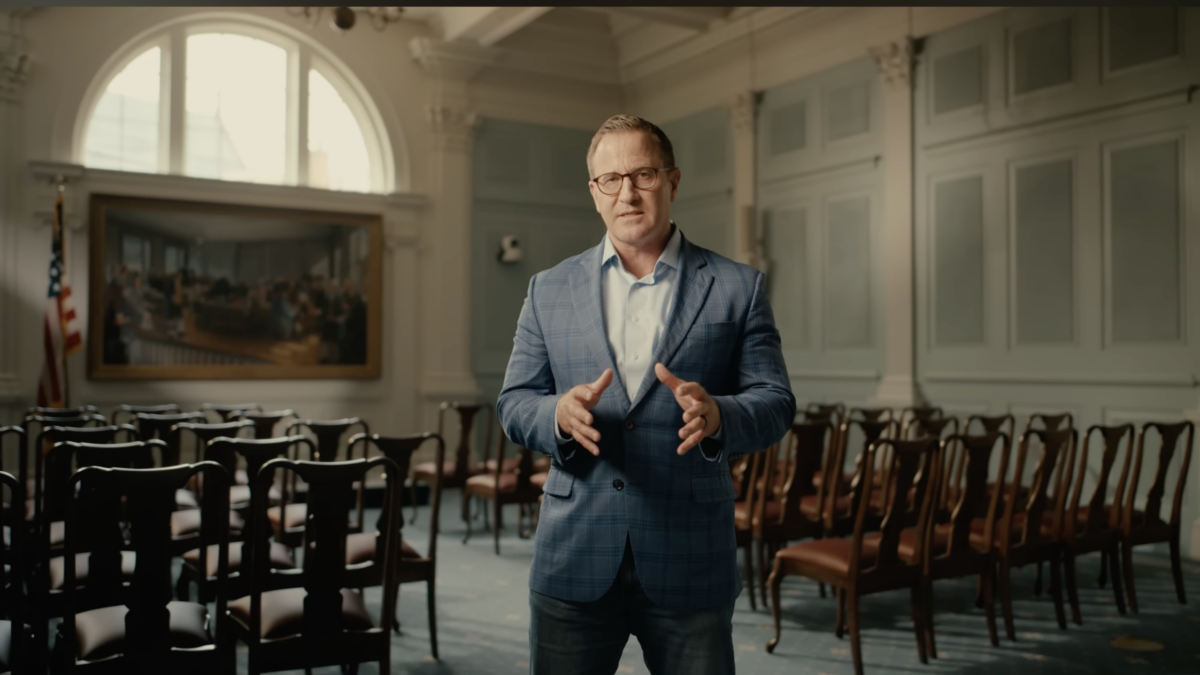
A new documentary, The Thread of Liberty: Keeping Our Republic, produced by Ned Ryun, asks viewers whether the American republic can survive if it loses the very thing the Founders believed made self-governance possible. That is, virtue — virtue that stems from religious conviction.
Narrated by Ryun and featuring historians and scholars including Victor Davis Hanson, Larry P. Arnn, and Roger Kimball, and others, the documentary explores the “thread” between liberty, faith, and national character. Rather than treating the Constitution as a self-executing document capable of preserving freedom on its own, the film argues that the Constitution and Declaration depend on a virtuous people who understand that their rights originate not from government, but from God.
The film opens by contrasting our current success with the collapse of all other republics that came before us — a poignant reminder the United States of America is not invincible. Rachel Bovard points to what Alexis de Tocqueville found nearly two centuries ago in Democracy in America, that is, America has this vast network of churches, charities, civic associations and institutions that cultivated habits of responsibility and community. These voluntary institutions allowed Americans to govern themselves, reducing the need for a big government because citizens voluntary acted with the type of virtue required to have ordered liberty.
The documentary argues that these institutions were indispensable to American life and a result of Americans’ virtue that stemmed from religion. But what happens when government co-opts this very role?
Thread of Liberty: Keeping Our Republic explains how the Progressive movement under Woodrow Wilson, Franklin Delano Roosevelt, and others steadily shifted the responsibility away from families, churches, local communities, and volunteers and instead toward the federal government. As those institutions because weak, so did the ability to self-govern that those institutions once helped sustain.
Another good moment in the film comes from a part on George Washington’s voluntary surrender of power after the Revolution. After leading the army to victory, Washington resigned his commission and returned home. The movie argues this was the product of virtue Washington possessed because of the virtuous character of the nation because of faith. That is, Washington, like the colonists, believed humans are bound by something higher than political power. If rights come from God, power is temporary and rather meaningless in the grand scheme of things. The movie argues that if we remove that conviction, it becomes more difficult to create leaders who are willing to relinquish power voluntarily — something best exemplified by the rise and growth of the progressive administrative state.
The film also reminds Americans of one simple truth: the Founders did not invent self-governance, they just codified it. But they were able to codify it because self-governance had deep roots in the colonies precisely because of the national character of the people.
The Constitution and Declaration, as Thread of Liberty: Keeping Our Republic points out, are tools the Founders left for us to continue self-governance, but that the Founders were unable to give us the virtues so indispensable for successful self-governance. Instead, religion would have to provide grounds for virtue. But what happens when people become less religious and therefore less virtuous?
Threads of Liberty: Keeping Our Republic forces Americans to ask what happens — or what will happen — to our republic when the very thing that makes the voluntary self-governing institutions and morality possible disappear.
Thread of Liberty: Keeping Our Republic can be streamed on Youtube, here.