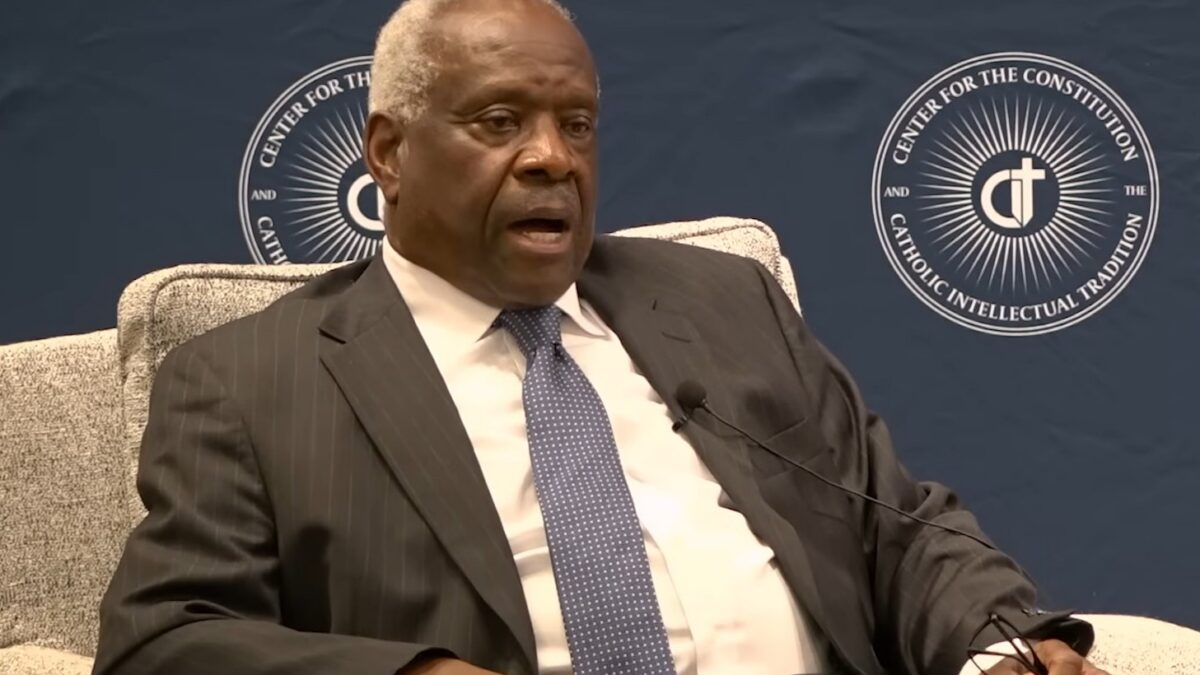

In dissents released today, Supreme Court Justices Clarence Thomas and Samuel Alito slammed the historical illiteracy of Chief Justice John Roberts in imposing a “medieval English ‘feudal’ principle” on the American people, allowing any foreigner to become a citizen simply by being born on American soil.
In his majority opinion for the court, Roberts strained to reimpose a form of feudalism soundly rejected by the American Founding. That legal principle guarantees random foreigners the privilege of American citizenship through an English common law basis that the Founders rejected. Feudalism reflected a king-subject relationship based on soil, and the Roberts court’s reasoning imposed that alien tradition — that persons are subjects, not citizens — on the United States.
“The Court’s account is not historically accurate,” Thomas wrote in his dissent, which was joined by Gorsuch. “The Court says that the Citizenship Clause incorporated the English feudal principle that subjects owed lifetime servitude to the King who owned the soil on which they were born, but Americans—unsurprisingly—rejected this feudal principle.”
Even the English, Thomas wrote, “moved on from ‘the darkness of the middle ages'” that Roberts just revitalized.
“Before saddling the Nation with a medieval rule, we had better be certain the Constitution requires it,” Alito says his separate dissent, calling the system “birthright subjecthood.”
‘Master and Servant‘
Thomas noted Roberts’ reliance on a 418-year-old English common law case called Calvin’s Case, which established the principle of “‘jus soli.” Under jus soli, “people owed perpetual allegiance to the King of England if they were ‘born within the dominions’ that he owned.”
Roberts claimed the principle had been adopted into the understanding of American citizenship, and then “incorporated [it] by reference in the Citizenship Clause.” Thomas’s dissent points out this is false:
The English principle was a rule of feudal servitude, not a rule of citizenship. … The English principle instead determined a person’s permanent feudal bondage to the King, which he could not unilaterally abandon. It was based on the notion that ‘[a] man owed personal service to the lord of the soil, the same as his master owed it to the king; and it was born with the child and only ended in the grave’—a relation of ‘master and servant.’
…On the Court’s telling, the law of citizenship in the United States was fixed to an English rule that everyone born on the soil was permanently bound to serve the sovereign. This principle of permanent feudal allegiance, according to the Court, was repurposed into a rule of citizenship and adopted by ‘all of the states.’
The Founders Directly Rejected Roberts-Style Citizenship Feudalism
American Founders contemplated the subjection of English feudalism and roundly rejected it out-of-hand. They believed Americans are not born into a state of subjection to a king, but rather, as citizens with rights equal to those of every other citizen, must consent to their government and its decisions.
The social compact Americans create through their consent also requires current citizens’ consent to expand their membership. Under the Founders’ principles, foreigners cannot rightfully obtain citizenship merely by showing up or even obtaining a place to live in our land; they have to obtain the affirmative consent of current citizens to permanently join our society. Anchor babies and their parents do exactly the opposite — violating citizens’ consent to obtain our privileges through essentially theft and fraud.
“John Adams famously wrote that the feudal theory meant that ‘the common people were held together, in herds and clans, in a state of servile dependence on their lords’ in ‘a state of total ignorance of every thing divine and human,'” Thomas noted, before citing the Declaration of Independence to back his argument.
Americans ’emphatically rejected’ this theory. ‘T]hey began their settlements, and formed their plan both of ecclesiastical and civil government, in direct opposition to . . . the feudal syste[m].’ They then dissolved ‘all Allegiance to the British Crown.’ And, they set up a new system of government in which the people were not regarded’as servile dependents. Instead, the people were sovereign, and the government derived its legitimacy from them. In this new system of government, feudalism had no place. The soil did not belong to the government, but to the people. And, those who were born on it did not owe the government a lifetime of obeisance or servitude.
In the same year as the Citizenship Clause of the Fourteenth Amendment was ratified, Congress passed a statute “rejecting the feudal principle and explaining that it supported the right of all persons to expatriate and change their citizenship,” Thomas notes.
The Reconstruction Congress expressly opposed the feudal principle that the Court claims that it adopted. As its Committee on Foreign Affairs saw the matter, ‘[t]here is nothing American in the oath of the land barons of England.’ It described the English rule’s ‘claim of indefeasible allegiance and perpetual service’ as ‘the symbol of feudalism and force.’ Instead of the feudal principle, the congressional Report explained that American law viewed people as taking on a new citizenship, as relevant here, when they changed their ‘domicile.’