
On June 8, members of the D.C. Bar elected Joshua Mogil their next president. Mogil is a senior associate at WilmerHale, one of the four firms that sued the Trump Administration and secured a ruling striking down its executive order as unconstitutional retaliation. He spent the Obama and Biden Administrations inside DOJ, including a tour as Deputy Chief of Staff to Deputy Attorney General Lisa Monaco. He worked under Sally Yates at DOJ and credits her as his professional hero, the Acting Attorney General fired by President Trump in 2017 for refusing to defend his travel ban. His campaign platform was, in his own words, “empowering the D.C. Bar to speak out in support of the rule of law” against what he called “unprecedented attacks on our system of justice.” If you wanted to design the perfect avatar of the partisan legal machine, you could not improve on his resume.
Three weeks before that, on May 14, 2026, the Department of Justice sued the District of Columbia’s Board on Professional Responsibility, which had recommended disbarring Jeff Clark, a former senior Justice Department official, over a letter he drafted in 2020 and never sent. The DOJ suit and Mogil’s election are the latest battles in a multi-front war against one of the most powerful bastions of leftism: lawyers.
Few appreciate that the same profession that has spent a decade pursuing political opponents through disciplinary complaints, novel prosecutions, and ideological licensing requirements also controls who is allowed to practice it. The American legal profession does not lean left by a polite margin. Among the largest firms, Democratic-to-Republican giving runs about 12 to 1, and the rest of the profession leans strongly left as well. This is the talent pool from which judges, prosecutors, regulators, and a vast share of legislators are drawn, and the bodies that regulate them are more uniform still.
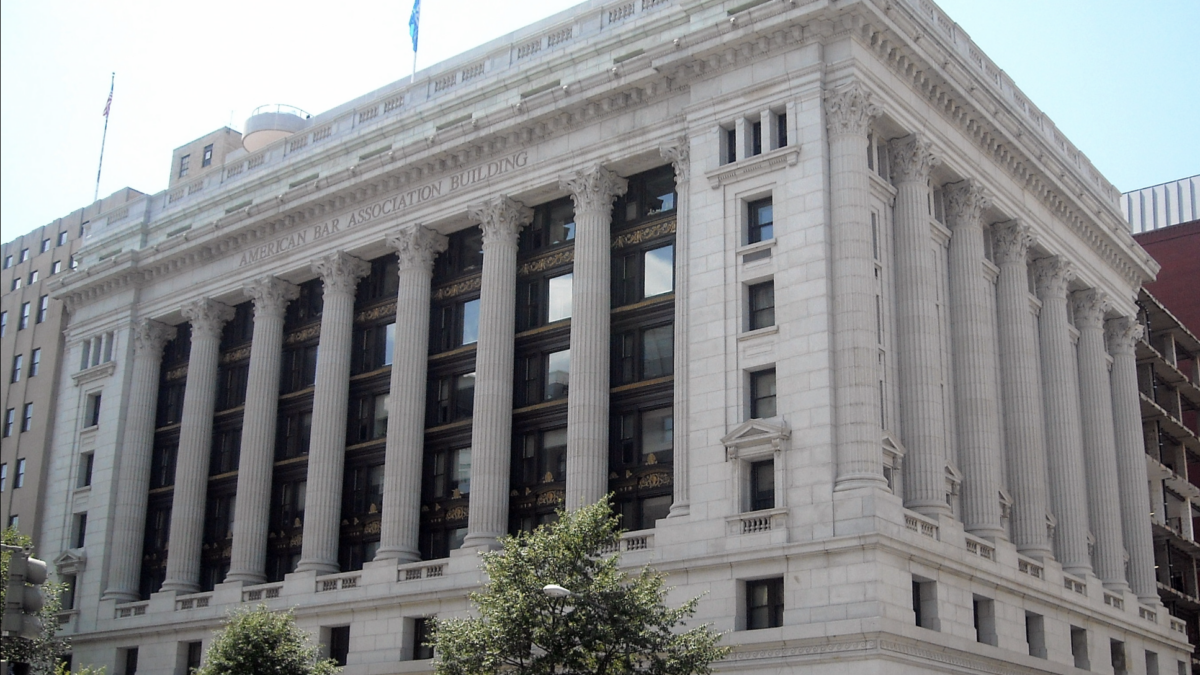
The American Bar Association (ABA) is the sole federally recognized accreditor of American law schools; in most states, you cannot sit for the bar unless your school carries its blessing. For years, ABA Standard 206 obliged those schools to prove a “commitment to diversity and inclusion” in admissions and hiring, defined by race, gender, and ethnicity. Schools complied because losing accreditation is death. Then the political weather turned: a January 2025 order against DEI, a February letter from the attorney general warning that the ABA’s accreditor status was under review, and an April order aimed squarely at that status.
The ABA suspended the standard within weeks and voted formally to strike it in May 2026. An ABA council member, a former dean, allowed that he still personally agreed with the diversity mandate “and what it tries to achieve,” but thought it appropriate to remove it anyway.
This is the same machinery that jammed diversity mandates into every accredited law school under Obama, now being pried loose under Trump. For 15 years, the profession was happy to wield compulsory ideology as long as it flowed one way. The objection on offer today is not to coercion. It is losing the monopoly on it. Trump is not introducing politics into a neutral institution; he is attempting to level a field that has been tilted for a generation.
Second front: discipline, the same machine in reverse. John Eastman is facing disbarment in California, Jeff Clark in D.C. Grant, for argument’s sake, that both men’s post-election conduct warranted real scrutiny. The 65 Project, launched after the 2020 election, exists expressly to file bar complaints against lawyers tied to one political movement, on the stated theory that menacing a lawyer’s license deters disfavored advocacy. Complaints were aimed at U.S. attorneys and a sitting attorney general. These complaints generally beget a process by, you guessed it, an apparatus run by Democrats. The chilling is not a side effect. It is the goal.
Third front: the firms. In 2025, the administration issued executive orders against major firms tied to its opponents, threatening clearances and federal contracts. Several of the largest folded at once. Paul Weiss pledged $40 million in pro bono work for favored causes and an audit of its hiring; Skadden, Willkie, Milbank, and others followed at $100 million apiece, the pledges eventually totaling nearly $1 billion. Trump called the haul “damages.”
There is real risk that the firm campaign becomes a Pyrrhic victory. Nearly five months later, reporting found little sign that the deals had changed how the capitulating firms actually operate. The firms chose their own penance, defined it vaguely, and then largely declined to perform it.
Worse, the pro bono delivered after the settlement has often pointed in the opposite direction. Latham & Watkins, one of the nine settling firms, took on the defense of major media outlets in a defamation suit brought by Trump Media, the President’s own company, six months after signing its pledge. Paul Weiss, which committed $40 million to causes the administration supports, has continued the longstanding pro bono campaigns its chair personally helped found, including high-profile litigation against right-wing figures and firearms manufacturers. The capitulation produced a press release. The pro bono kept flowing exactly where it had been flowing all along.
Meanwhile, the four firms that refused to kneel and sued instead, Perkins Coie, WilmerHale, Jenner & Block, Susman Godfrey, won in court and watched the orders against them struck down as unconstitutional retaliation. The rulings came from the U.S. District Court for the District of Columbia, where Democratic voter registration runs at roughly 76 percent, and Democratic-appointed judges dominate the bench. Which is exactly why the upstream fight, where the same partisan apparatus is the institution itself and not the referee, is the harder and more important war.
A firm’s pledge, especially when made unwillingly by individuals who don’t actually agree with its premise, evaporates with the administration that squeezed it. An executive order dies the moment the next president signs its repeal. Those are byproducts. The licensing and disciplinary apparatus is the source: self-governing, election-proof, accountable to no one outside itself. For two decades, the organized right poured itself into the courts, won its judges and its doctrines, and changed strikingly little about the lived reality of the profession, because courts are downstream and the focus was most generally on SCOTUS and red states. The bar, especially in D.C., is upstream. It decides who may enter, what they must profess to stay and what will end them. The left grasped the value of that ground long ago. The right is only now arriving.
So let’s name the thing plainly. What is unfolding is the most serious attempt in living memory to wrench the gatekeeping machinery of the legal profession away from a slanted guild run as a partisan instrument governing a partisan profession. The DOJ suit, the accreditation review, the assault on Standard 206 are not scattered skirmishes. Control the license and you control the profession; control the profession and you control a commanding share of the people who write, enforce and interpret the law itself.
The strategy has five pillars. End the ABA’s federal monopoly on law school accreditation by recognizing competing accreditors, as the Department of Education already does in medicine, business and engineering. Decouple bar admission from accredited-school graduation, as California, Virginia and others already permit through apprenticeship pathways. Bring federal antitrust and constitutional scrutiny to state bars operating as partisan instruments hiding behind state-action immunity, a doctrine meant for genuine sovereign regulation that has long since stretched past it. Impose real costs on bad-faith disciplinary complaints through fee-shifting and sanctions, so that filing one is no longer free. And strip ideological attestation out of licensure entirely, in admissions, CLE and discipline alike, so the license certifies competence and ethics and not fealty to anyone’s politics.
None of this is radical. It is antitrust law and the First Amendment, applied at last to a guild that has spent too long hiding behind state-action doctrine and learned-profession deference to avoid both. The high priests will tell you, as every priesthood does, that their authority is technical, neutral, above the fray. They will not reform themselves; no priesthood ever has. The keys have to be taken.