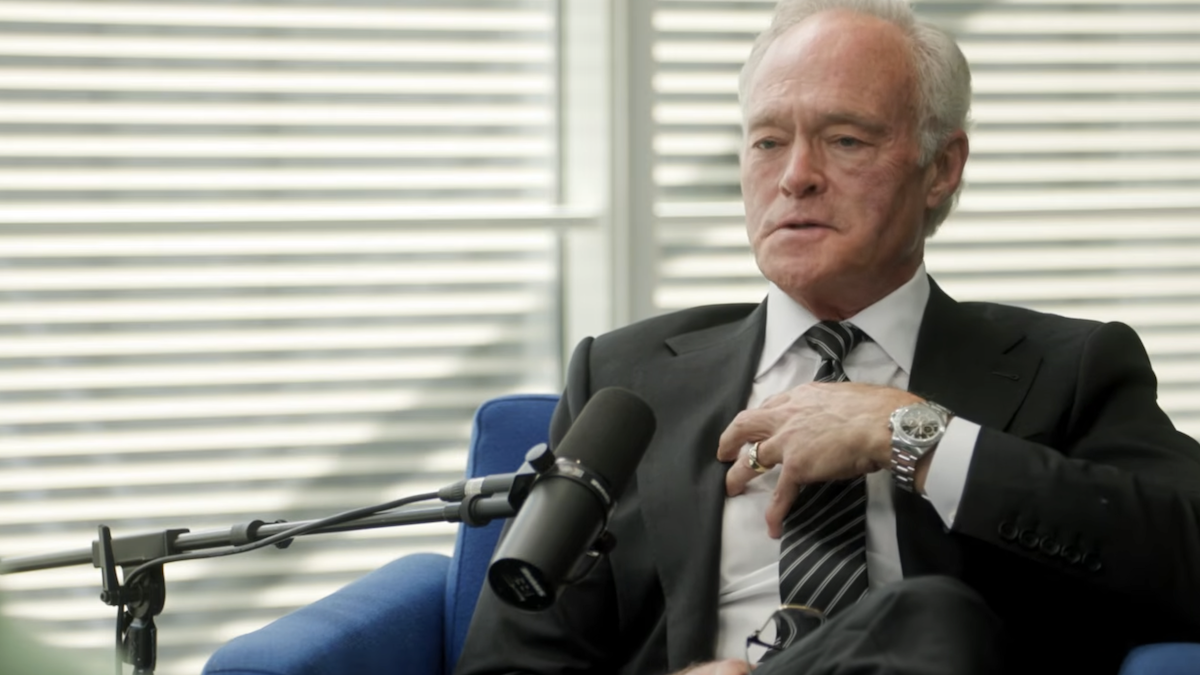

Scott Pelley knows his career as a prominent TV content creator has come to a relatively uneventful end, so he’s trying to make the most of it in the way people in his profession best know how, which is to gin up a bunch of hysteria with hopes of terrifying people. Sadly for him, though, it’s not really working and it’s mostly just sad to watch.
After his fabulous public crash-out last week, Pelley, now a former CBS 60 Minutes correspondent, saw fit to sit with The New York Times for an hour and talk about how important he is between bouts of crying. In an interview with the publication’s The Interview podcast, Pelley perfectly demonstrated why TV broadcast news is in rapid decline — the bottomless arrogance, the galactic sense of entitlement, and, most crucially, the detachment from any sense of reality experienced by people who don’t read scripts on TV for a living.
For anyone mercifully spared the recent melodrama at CBS, Pelley was fired last week after attempting to dress down his superior in front of colleagues and then having that encounter leaked to the press, likely by Pelley himself. (Whoever leaked it was sure to include that Pelley was given a round of applause by his coworkers, something he reiterated in his podcast interview.) Pelley, and presumably some of his peers, are very upset that CBS has hired new people who aren’t fire-breathing statists to lead its news division, including 60 Minutes.
As is always the case, leftists like Pelley don’t like being told that their anti-American tendencies, which include lying and manipulating the public via their media platforms, are destructive and intolerable, so he’s acting out. But while it’s embarrassing for him, it’s constructive for the rest of us. Let’s look at a few quotes from his podcast interview.
Pelley: “Newsrooms are sort of like the military or the police or the beautiful people at the [Fire Department of New York] down the street. It is a life-threatening job in many instances.” Relatedly, he said his firing and the trouble some of his colleagues went through “is like your spouse being murdered.”
If you didn’t know, Scott Pelley is sort of like a U.S. Marine parachuting into a war zone, confronting enemy fire. He’s important. So are all his friends who work(ed) at 60 Minutes.
Pelley: “We felt that she was making statements that she couldn’t back up and was coming into the news division with hardened preconceived notions that didn’t seem to be thought through.”
Here, Pelley is referring to Bari Weiss, the new head of CBS’s news division, having asked the 60 Minutes staff why a substantial portion of the public believes the program to be politically biased. It’s not a particularly challenging question, even if you disagree with the premise. But because Pelley and so many like him are never even exposed to the premise, he took offense (like a child who has just been told Santa isn’t real). Throughout the interview he repeatedly asserted that it was the new CBS News management who failed to critically evaluate their own capabilities, rather than himself. This is standard behavior for the people who have been working in the quickly dying news media all their professional lives.
Pelley: “My understanding from people directly involved in that interaction is that Bari Weiss was quite livid that Anderson Cooper was allowed to say those things and that she, Bari, was not consulted beforehand, which in our normal course of business would not have been done anyway.”
The “normal course of business” Pelley was referring to digs right to the root of the dying media’s problem. The “normal course of business” is quickly becoming unprofitable, and also audiences are finding that the people on TV proclaiming to tell the truth, people like Pelley, are lying. On top of that, Pelley and the rest so often insult and belittle others, including their employers, with impunity, and the rest of us who don’t work in that business wonder how they get away with it. They do so because there’s a dynamic unique to the news media business where insubordination is considered brave and commendable. Where that might get you fired elsewhere, it gets you more recognition and respect in the dying media business.
Times are changing. The “normal course of business” is quickly disappearing, along with Scott Pelley.