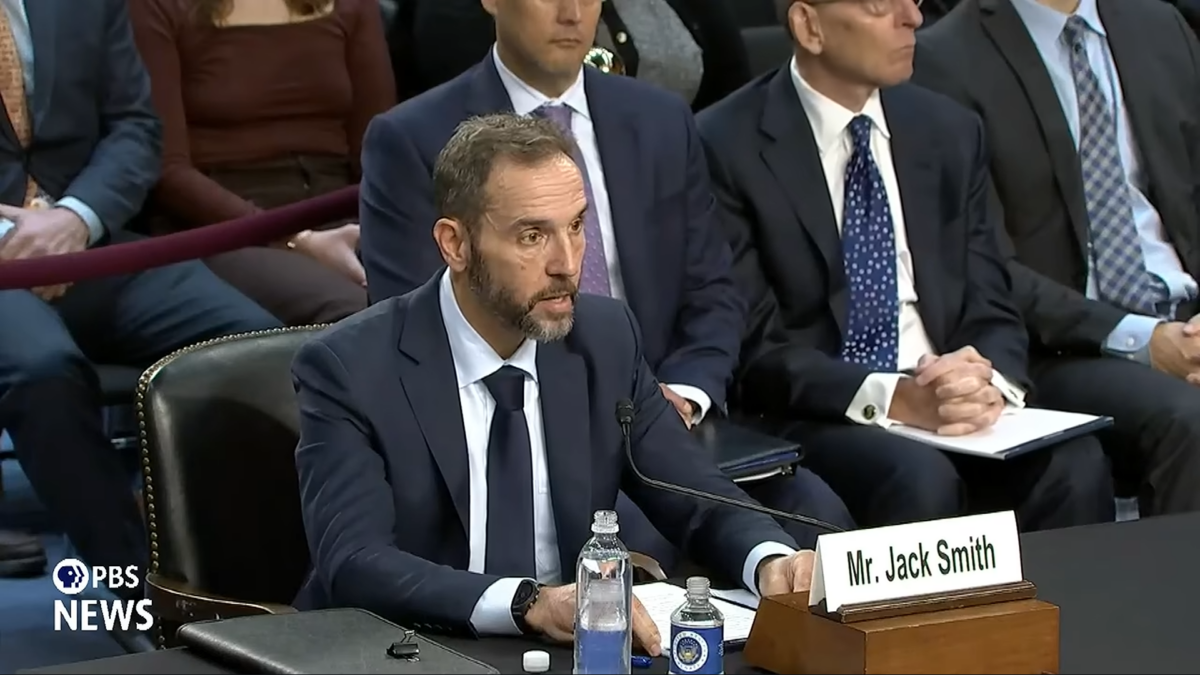


Supreme Court Justice Ketanji Brown Jackson said it’s “absolutely a legitimate question” as to whether lower court judges should defy the Supreme Court when it comes to emergency docket decisions.
U.S. District Judge Richard Gergel of the District of South Carolina was interviewing Jackson at the American Law Institute earlier this month when he said: “I have found, as a district judge, it mystifying at times, where an emergency docket decision of maybe just two or three pages, appears to countermand longstanding Supreme Court precedent. Are we to apply the brief, the short stay decision, or denial of stay? Or are we to follow 50 years of precedent? It’s a perplexing thing to do.”
Jackson said it is “absolutely a legitimate question and a legitimate concern.”
“I mean, what is a lower court judge to do after the Supreme Court has intervened early on to tell everyone who’s likely to win the case?” Jackson continued, later adding it’s “mystifying” that the Supreme Court could stay a decision even after a lower court judge “made findings of fact” or held hearings.
Jackson’s comments are especially insane given that there is nothing new about lower courts being bound by the Supreme Court’s guidance (including an emergency order). But this wasn’t the only time Jackson was seemingly unaware how the court she sits on works.
The high court ruled 6-3 in Louisiana v. Callais that Section 2 of the Voting Rights Act is designed to enforce the Constitution’s prohibition on intentional racial discrimination, but not force states to engage in race-based discrimination by creating majority-minority districts. The court held that Louisiana’s congressional map that had two majority-Black districts was an unconstitutional racial gerrymander.
Shortly after, the Supreme Court released an order in an 8-1 decision that, as described by The Federalist’s Shawn Fleetwood, would “fast-track the transmission of its decision to the lower courts rather than wait 32 days, as per normal custom.” The decision was made “in accordance with existing SCOTUS rules,” as Fleetwood pointed out. The decision allowed Louisiana to move toward new maps mid-election cycle rather than using the current, unconstitutional maps.
Jackson issued a dissent claiming the court’s 8-1 decision “has spawned chaos in the State of Louisiana.”
“Not content to have decided the law, [the Supreme Court] now takes steps to influence its implementation,” Jackson wrote. “The Court unshackles itself from both constraints today and dives into the fray. And just like that, those principles give way to power. Because this abandon is unwarranted and unwise, respectfully, I dissent.”
Justice Samuel Alito, joined by Justices Clarence Thomas and Neil Gorsuch, wrote a concurring opinion that said Jackson’s charges “cannot go unanswered.”
Alito said that Jackson’s position “would require that the 2026 congressional elections in Louisiana be held under a map that has been held to be unconstitutional.” Alito added Jackson’s dissent offers one “trivial” reason for her proposed course of action, and another that is “baseless and insulting.”
Alito points out that Jackson, in her claim that the court was appearing “partial,” failed to explain “why [her] insistence on unthinking compliance with [Supreme Court] Rule 45.3’s default rule does not create the appearance of partiality (by running out the clock) on behalf of those who may find it politically advantageous to have the election occur under the unconstitutional map.”
“The dissent goes on to claim that our decision represents an unprincipled use of power. … That is a groundless and utterly irresponsible charge,” Alito wrote. “What principle has the Court violated? The principle that Rule 45.3’s 32-day default period should never be shortened even when there is good reason to do so? The principle that we should never take any action that might unjustifiably be criticized as partisan?”
It’s hard to ignore that Jackson is treating standard functions of the court as possibly illegitimate whenever they happen to produce an outcome she dislikes.
Editor’s note: This piece has been updated since publication.