
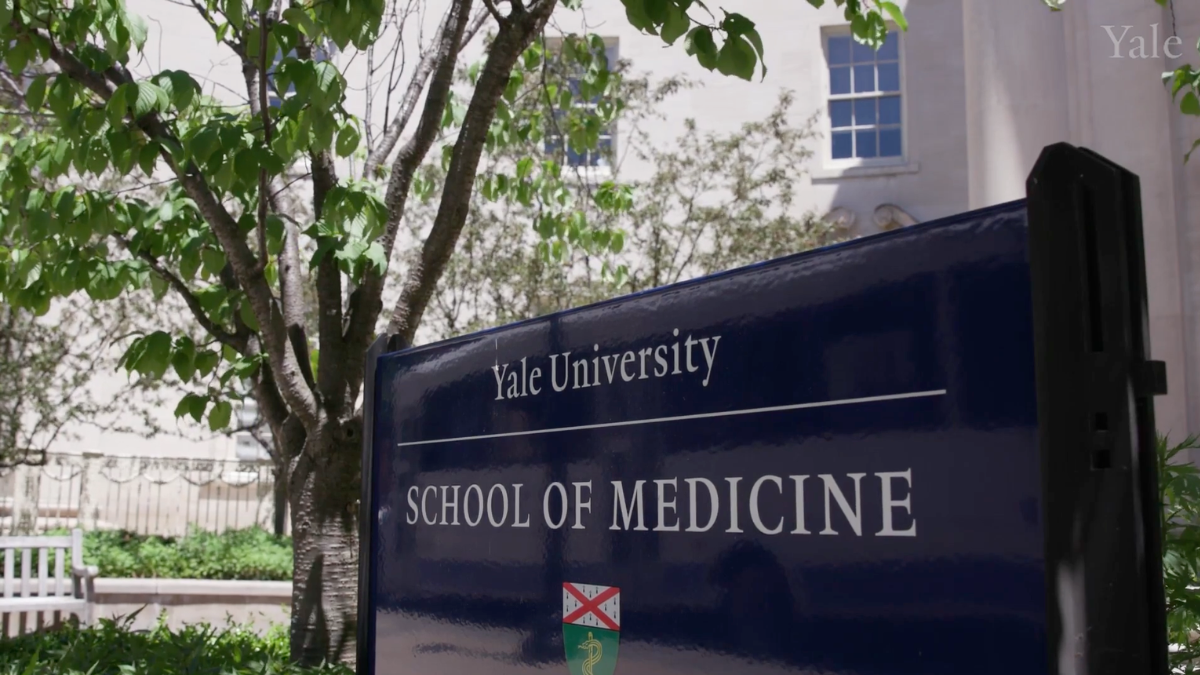

As Yale celebrated its 325th commencement last week, the institution’s medical school faced new scrutiny for alleged racial discrimination in admissions. The Department of Justice sent a letter to Yale School of Medicine on May 14 notifying it that “the Department finds that Yale continues to intentionally discriminate against applicants based on their race.”
That letter presents evidence that black and Hispanic students were significantly more likely to be admitted than white and Asian students with the same MCAT scores and grade point averages, an outcome that “cannot be explained by a coincidence.” Specifically, “Yale’s use of race resulted in a Black applicant being as much as 29 times higher odds of getting an interview for admission than an equally strong Asian applicant with similar academic credentials.”
The finding by the department that Yale Medical School continues to racially discriminate in its admissions was greeted by criticisms that seem to misunderstand what constitutes racial discrimination. For example, a radiologist named Jeff Anderson responded on X that all groups of students who were admitted to Yale Medical School had very high standardized scores: “Every last one of these are overly qualified I assure you. There’s just simply not enough seats.” The implicit argument is that once applicants have met a certain threshold on their scores, race can be used as a tie-breaker to allocate the limited number of spots.
But as far as the law is concerned, “good enough” is not good enough: Race simply cannot be used as a criterion in admissions decisions no matter how high applicants’ scores are. Yale Medical School is not obligated to accept the students with the highest test scores and is free to consider other factors, as long as race or ethnicity (or factors that are proxies for race and ethnicity) are not among them. Given the staggering differences by race in the odds of receiving an interview among similarly academically situated students, it strains credibility that Yale passes the test.
Neither the Supreme Court nor the Department of Justice is suggesting that test scores are the only indication of merit. But they are both clearly stating that the racial background of the applicant is not a lawful consideration for admission.
A prominent surgeon, Terry Simpson, seemed to confuse racial background with the merit of overcoming challenges when he argued on X: “If you have 100 applicants from privileged, high-performing educational pipelines with nearly identical scores, resumes, research access, tutoring, and opportunities, it is not irrational to also value the applicant who achieved similar academic success despite poverty, instability, underfunded schools, family hardship, or lack of institutional advantages.”
Dr. Simpson oddly assumed, with no information from Yale Medical School, that white and Asian applicants are privileged while black and Hispanic applicants are disadvantaged. But making this assumption is built on nothing more than racist stereotypes, attributing to all black and Hispanic applicants the merit of having overcome challenges based on nothing more than the color of their skin, without any other individualized evidence whatsoever. An applicant’s race, by itself, does not indicate this type of merit or lack thereof.
So, why does the Department of Justice believe that Yale has in fact used race in this impermissible way rather than having collected and considered information about personal challenges that happen to correlate with race? According to the DOJ, first, Yale gave its admissions staff a “holistic metrics model” developed by the Association of American Medical Colleges to guide the school’s assessment of applicants. That model specifically listed “race” and “national origin” as criteria for the admissions staff to consider, which is clearly prohibited by the Students for Fair Admissions decision.
Second, the Department of Justice noted that Yale Medical School’s test score differences between accepted students by race had not changed following the Students for Fair Admissions decision. More than three years ago in that case, Yale argued in its amicus brief that “no workable race-neutral alternatives [would yield] the level of racial diversity … necessary.” As the department notes, “Given this statement, the lack of any change in Yale’s admissions outcomes after Harvard [is] evidence [of] a willful failure to comply with that decision.”
That is, Yale asserted that its admissions demographics would change if the school ceased considering race; yet its admissions demographics have remained unchanged, pointing to ongoing noncompliance with civil rights laws forbidding racial discrimination.
By its own admission, Yale Medical School has seemingly been caught engaging in racial discrimination, not engaging in holistic admission decisions, the latter of which would be legally permissible as long as race were not among the holistic criteria. Defenders of Yale seem to think race can still be considered as long as everyone is high-scoring or if we imagine that race is equivalent to disadvantage. Equality under the law does not allow this.
Yale doesn’t have to admit the students with the highest test scores, but whatever the other criteria, the school may not consider race or proxies for race.