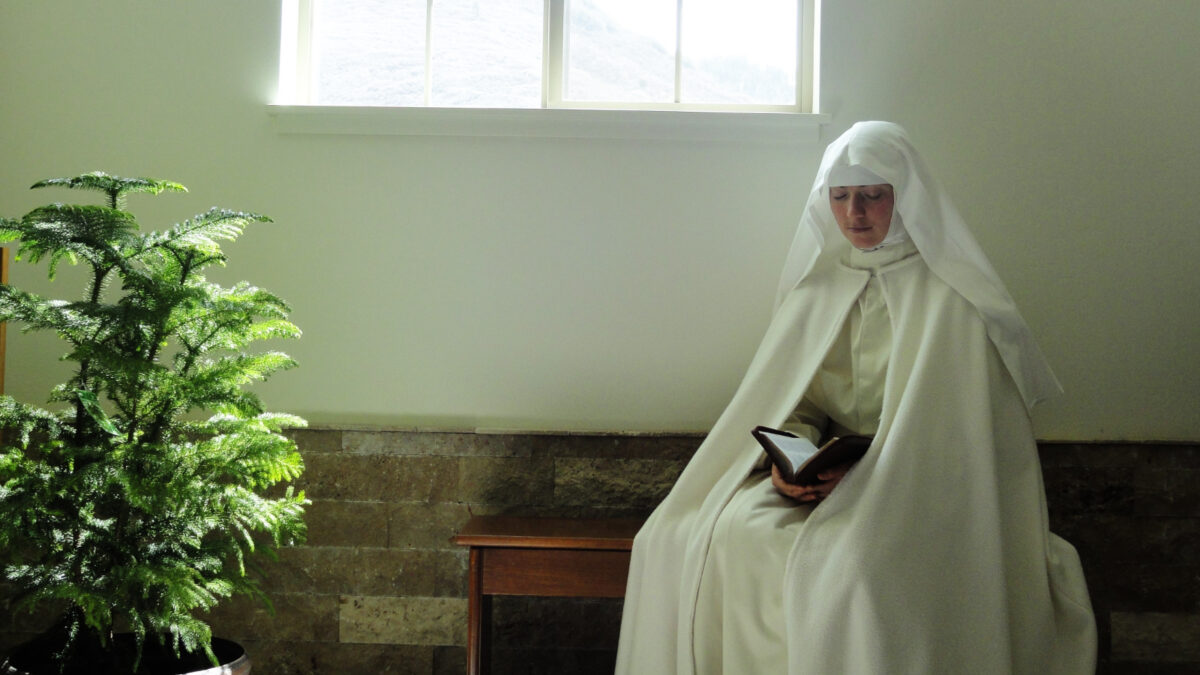

The Norbertine Canonesses of the Bethlehem Priory of St. Joseph are cloistered religious women whose midnight prayers sparked a viral, global response — and opened an unexpected window into the quiet suffering of modern mothers.
In 2023, Leanne Bowen, a Catholic artist, arrived at the priory for a self-guided retreat.
In an interaction with one of the canonesses assigned to aid her, Bowen came to understand the midnight prayer on her schedule, the traditional Matins, as a sacrificial offering for mothers. She posted about the experience on Instagram, and the story quickly went viral, triggering a flood of outreach, and the sisters’ reputation as holding a “motherhood hour.”
The Matins — prayers, hymns, psalms, and other scriptural readings incorporated into the Divine Office of the Catholic Church, and sung traditionally in the dark hours of the night leading into a new day, can be prayed in late afternoon or evening hours, but the Norbertine canonesses rise for the liturgy at midnight.
Though the prayers are lifted for “all of humanity,” according to the sisters — not specifically for mothers, as Bowen’s post implied — the providential misunderstanding struck a nerve in the hearts of mothers everywhere. Like a mother waking to tend to her child in the dark, quiet of the night, so too, these women woke, gathered, and offered prayerful sacrifice, hidden from the eyes of the world.
Years later, the canonesses continue to receive a steady stream of messages, as mothers share what they refer to as “heartwarming, and at times heartbreaking, stories.”
Requests, they said, have been received from around the world; from those they have never met, and mothers they know well whose struggles they never imagined. Some are Catholic, while some are not religious at all. Fathers concerned for their wives have requested prayer, as well as individuals with no children.
The messages in the emails vary but share a common thread, they said. Mothers request prayers for their children or themselves in their vocation, and share gratitude for prayers offered. They say fathers also contact them, as well as grandmothers, looking back over the hard years and seeing God’s hand in all that they went through to raise their beloved children. Correspondents are sometimes unexpected and from widely varied walks of life, appreciative of an act of charity done in a spirit of self-sacrifice.
Sanctifying Suffering
Even the mother who claims no religion and adheres to no faith sends up wordless prayers in the night. She cries out for increased strength and fortitude, patience, and wisdom.
The night work and worries of mothers, the vulnerability and tiredness culminating in the late hours, is a significantly unifying shared human experience. Except that it is increasingly no longer shared. In the U.S., multigenerational homes have given way to family estrangement. Young women are rejecting organized religion at rates higher than ever historically recorded.
As fallible humans in a secular world, the weight of raising a new life is a monumental task. Women are expected to accomplish more and more outside of the home, where achievement is calculated in material gains or losses, discounting the very real spiritual experience of a woman’s intrinsic call to mother.
Only within the realm of faith, a greater meaning and purpose unfold. Suffering becomes sanctifying, sacrifice strengthening, the breakthrough of beauty of a heart beating for a little soul acknowledged. Eternal gains won.
American women need a healthy Christian community, especially where familial bonds are broken, to build up the vocation of motherhood. And whether they know it or not, they inherently desire that context for the good of themselves and their children.
“In an age when so many things are done ‘virtually,’ it seems that the very real and concrete sacrifice of rising in the dark of night to pray and to intercede on behalf of others, has spoken very loudly to people of the very real and concrete love of God,” the canonesses said. “‘You are not alone’ is a statement that has been repeated in the posts about Matins, and this statement is so very true.” God’s presence, which can seem abstract and distant, becomes more concrete within the shared experiences of Christian community.
Divine Providence
The providential misunderstanding of the Norbertine canonesses has another dimension — the founder of the order, St. Norbert, is known in Catholic tradition as a patron of expectant mothers and couples desiring children.
“We can only describe the whole situation as God’s way of reaching out to so many souls who are in need of His love and strength in their trials,” the sisters said. “He chose our community and this little misunderstanding to reach them.”
As many young women reject religion, others are entering religious life as a radically beautiful way to offer their inherent womanly love. At the Bethlehem Priory of St. Joseph, an increase in vocations has led to the need for an expanded monastery and church.
Reiterating their mission to lift up all peoples, the canonesses continue to offer a message mothers need now more than ever: “You are not alone.”