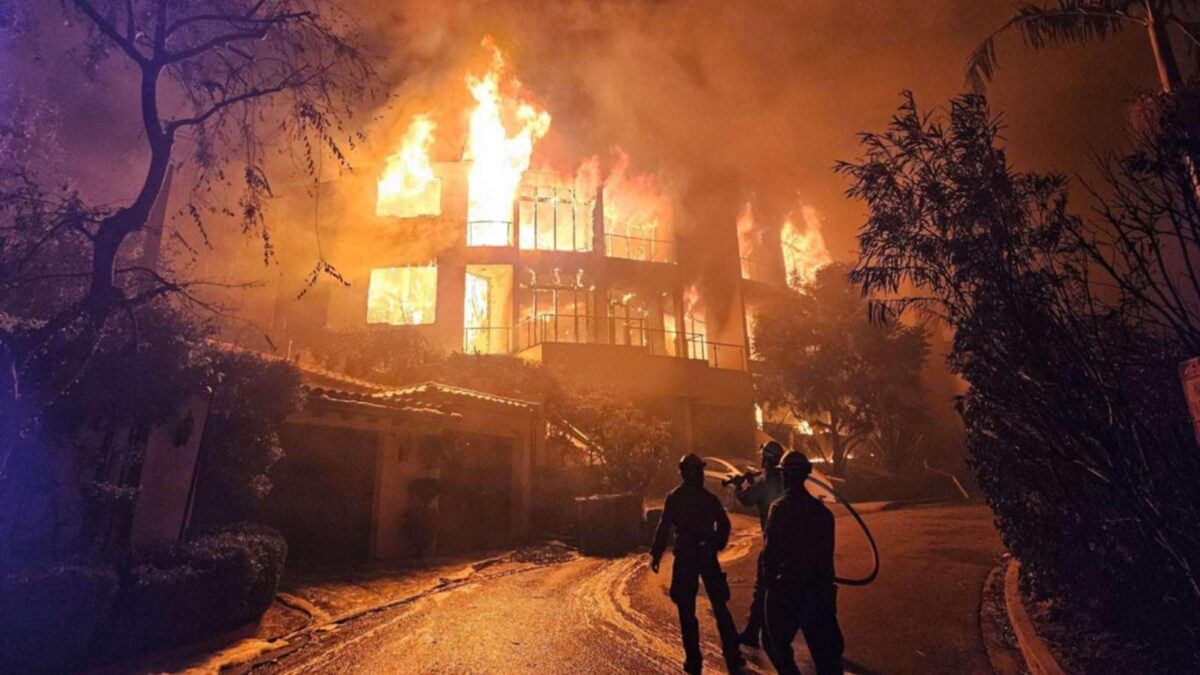
Twelve people were killed while thousands of others were displaced after the Palisades wildfire ripped through Los Angeles County in January of 2025, becoming California’s third-most destructive wildfire in history. Prosecutors now allege the cause wasn’t climate change or bad luck, but radical left-wing ideology.
Thirty-year-old Jonathan Rinderknecht was obsessed with alleged United Healthcare CEO killer Luigi Mangione and hated the rich, according to prosecutors. Rinderknecht — an Uber driver — had been “ranting” to customers about capitalism and vigilantism, as well as Mangione, in the days leading up to his alleged arsonist act.
As The New York Post reported, “When asked why someone would ultimately set the blaze, Rinderknecht allegedly responded that it ‘would be out of resentment of the rich enjoying their money as “we’re basically being enslaved by them” and compared such an act of “desperation” to the murder for which Mangione was charged,’ according to the memo.”
Mangione is accused of fatally shooting UnitedHealthcare CEO Brian Thompson on a New York City street. A manifesto purportedly written by Mangione said the murder “had to be done.”
“Frankly, these parasites simply had it coming. A reminder: the US has the #1 most expensive healthcare system in the world, yet we rank roughly #42 in life expectancy,” Mangione allegedly wrote, adding that “corruption and greed” are problems that he was the “first to face … with such brutal honesty.”
Thompson’s murder was an act of pure depravity that left two children without their father. But not everyone saw it that way. Self-described journalist Taylor Lorenz described Mangione as a “morally good man” and called him a “revolutionary.” Lorenz said women fawning over the alleged assassin “want somebody to take on this system. … They want someone to tear down these barbaric establishment institutions.”
Sen. Elizabeth Warren, D-Mass., said, “Violence is never the answer, but people can only be pushed so far” and eventually “take matters into their own hands in ways that will ultimately be a threat to everyone.”
University of Pennsylvania Assistant Professor Julia Alekseyeva called Mangione “the icon we all need and deserve,” though she later retracted her statement as “insensitive and inappropriate” after condemnation.
Mangione was defended again just recently by Hasan Piker, who suggested during an interview with The New York Times that Thompson was “engaging in a tremendous amount of social murder” as if that were true or justified his being assassinated on a New York City sidewalk.
Strikingly, Mangione’s alleged actions did not meet with unequivocal condemnation or a unified, public rebuke of vigilante murder. Instead, leftists showered him with indulgence and justification (and some with praise). By Mangione’s own alleged account, his actions and the grievances used to legitimize them shaped how he saw violence, that is, as a justified response to some great moral injustice. Democrats in the media and politics consistently agree with this twisted ideology.
When corporate media and high-profile Democrats elevate alleged vigilante murderers to the status of a Robin Hood sort of hero, they are signaling that political violence can be a form of justice and is therefore justified. When they treat Mangione’s alleged actions as “revolutionary,” they are creating a framework that makes violence permissible if perpetrated for the “right” reason on the “right” victims.
In the case of Rinderknecht’s alleged arson, he seemingly drew inspiration from Mangione, taking matters into his own hands to “fight” the rich. But it was Democrat pundits and politicians who lionized Mangione and built the permission structure that undergirds the left’s ongoing campaign of political violence, which now allegedly includes plunging Los Angeles County into a fiery inferno in which 12 individuals and thousands of properties were incinerated.