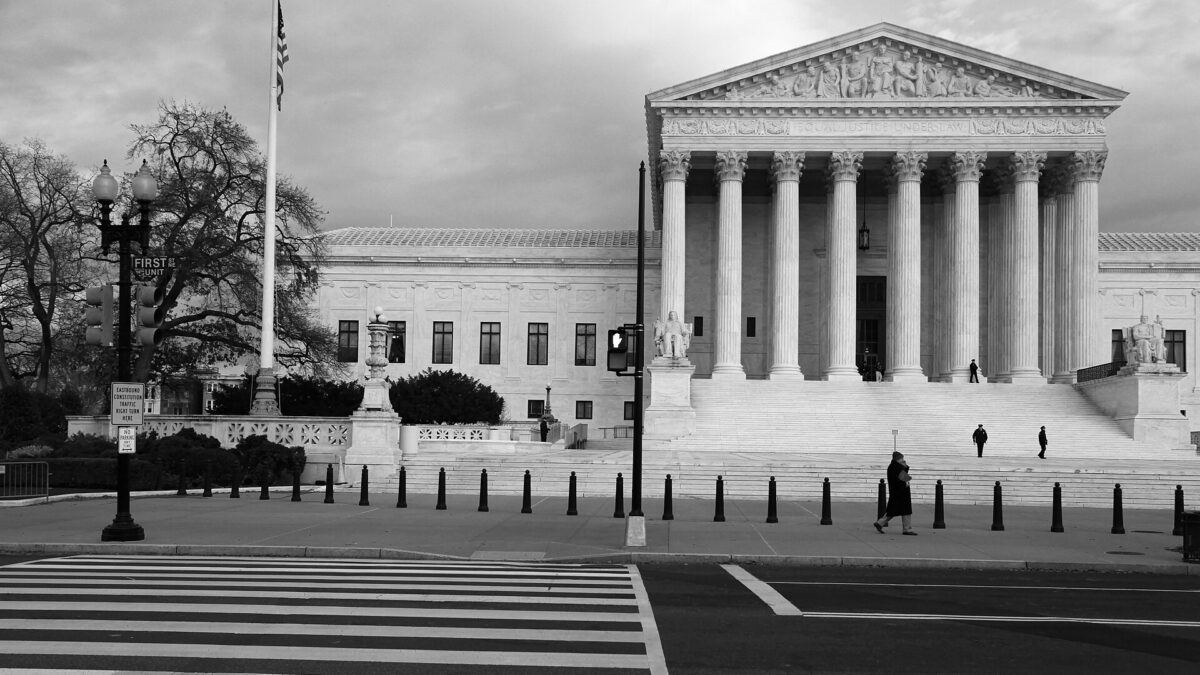
Shortly after the Supreme Court’s decision in Dobbs v. Jackson Women’s Health Organization was leaked, the public saw just how far pro-abortion activists were willing to go to try and stop the court from overturning Roe v. Wade after a would-be assassin was arrested outside Justice Brett Kavanaugh’s home.
But the attempt on Kavanaugh’s life was not the only serious threat facing the justices and court amidst the Dobbs v. Jackson Women’s Health Organization decision.
In her new book, Alito: The Justice Who Reshaped the Supreme Court and Restored the Constitution, The Federalist’s Editor-in-Chief Mollie Hemingway reveals for the first time that Justice Samuel Alito’s chambers were targeted with a suspicious white powder after the decision was formally released.
The justices had been “somberly informed” by Chief Justice John Roberts on April 29, 2022 that Politico obtained a copy of Alito’s draft majority opinion overturning Roe v. Wade and planned to publish it. The publication of the leaked draft — and the release of the official opinion itself –triggered protests, intimidation, and threats directed at the court’s conservative majority. But the threats went far beyond what has been reported.
“Alito’s small staff fielded a constant stream of vicious, threatening, and insulting phone calls,” Hemingway writes. “On June 27, one of the staff members opened an envelope, and powder came spilling out.”
The substance, initially feared to be anthrax, turned out to be dirt and a ground-up battery, but the staff was shaken up, Hemingway reported. Notably, “Justice Breyer visited Alito’s chambers to comfort the staff when he left that week, his last term on the court.” Such empathy was exhibited by Justice Neil Gorsuch’s “chambers,” which “sent doughnuts over to the Alito chambers and said how sorry they were about what they were going through” after the draft was leaked.
Those gestures stood in stark contrast to what Hemingway describes as “a surprising lack of empathy” from “the justices who were not targeted.”
Meanwhile in the aftermath of the leak itself, the atmosphere inside the court was fearful.
“Many clerks were sobbing, scared, and incredibly upset” with “older staff [trying] to calm them down,” Hemingway writes. The fear was understandable, as Hemingway writes that:
“[Justices] who joined the majority opinion immediately began fielding calls from concerned friends and family. They were moved to secure locations and given increased security. Even their adult children and extended family members had to be moved for their protection.”
Alito himself later observed that the leaks made the conservative justices “targets for assassinations because it gave people a rational reason to think they could prevent [the overruling of Roe] by killing one of us,” Hemingway reported.
The fear wasn’t hypothetical, for while the white powder sent to Alito’s chambers post-opinion release turned out to be non-deadly, Kavanaugh was nearly murdered after the leak when 26- year-old Nicholas Roske showed up to his home armed with a Glock pistol, ammunition, zip ties, a tactical knife, pepper spray, a hammer, duct tape, and other items, according to a criminal complaint. Roske said he wanted to get rid of at least one judge — but ideally three — in order to stop Roe v. Wade from being overturned.
While that attempted attack made headlines, Hemingway’s new book makes clear that it was only a piece of a much broader intimidation campaign.