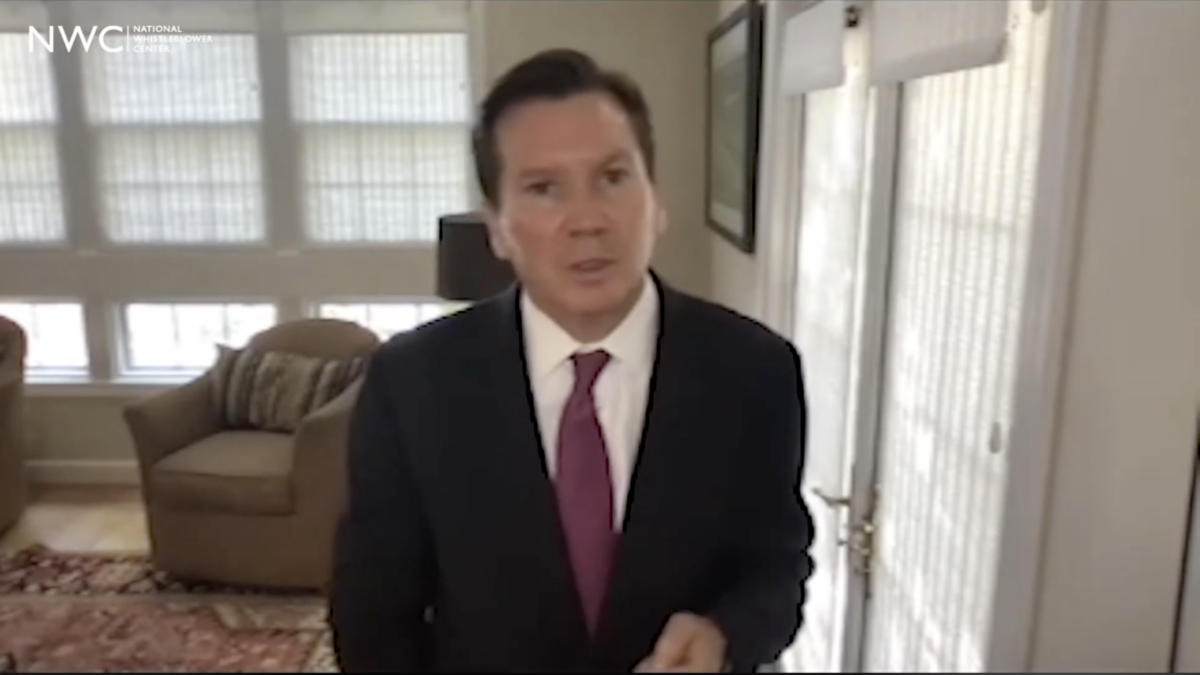

Former Intelligence Community Inspector General (ICIG) Michael Atkinson admitted under oath that he personally ordered a secret rewrite of the whistleblower complaint form in August 2019 that was used as the basis for a phony impeachment operation against President Donald Trump, going so far as to admit changing the form looked “suspicious.”
Newly unveiled testimony from October of 2019 shows that Atkinson conceded the change he ordered to the whistleblower complaint form “looks suspicious” but said the timing was merely “unfortunate.”
“So the timing is unfortunate. It looks suspicious, I get that,” Atkinson testified. Atkinson said that after several media inquiries highlighted that the then-current form required first-hand knowledge of wrongdoing in order for a complaint to meet the urgency threshold to be sent to Congress, he ordered his staff to secretly change the rules so that second-hand hearsay complaints could be a legitimate basis for expedited processing.
“What I should have done was I should have explained when we changed the form why we were changing it,” he said. “I should have been more transparent about the reasons and the motivations for the change in the forms.”
The admission vindicates years of reporting by The Federalist that exposed the “suspicious” change that conveniently coincided with the first impeachment inquiry into the president — reporting that was attacked as a conspiracy theory but is now confirmed by the IG’s own testimony.
The Federalist co-founder and CEO Sean Davis reported that between May 2018 and August 2019 the intelligence community quietly got rid of the requirement that whistleblowers must have “direct, first-hand knowledge of alleged wrongdoing” to file an expedited complaint to Congress. The intelligence community’s “Background Information on ICWPA Process” required the ICIG to have first-hand information to find an urgent concern complaint “credible” and transmit it to Congress. The old form – approved in May of 2018, according to Davis – explicitly warned under a bold heading that the ICIG “cannot transmit information” based on second hand-knowledge and rather, the ICIG would need “FIRST-HAND INFORMATION.” The original form went so far as to state that whistleblowers unable to provide “nothing more than second-hand or unsubstantiated assertions” would not have their complaint processed under the Intelligence Community Whistleblower Protection Act (ICWPA). While the underlying law does not require the complainant to have first-hand knowledge to file a complaint, the ICIG’s own guidance made clear that second-hand information alone was insufficient for the ICIG to deem a complaint credible and expedite it to Congress.
But the form was quietly changed, with a new version uploaded to the DNI website in September of 2019 that removed the entire aforementioned section, according to Davis’ reporting. “The markings on the document state that it was revised in August 2019, but no specific date of revision is disclosed,” Davis reported. The new version permitted complaints that had only second-hand information to be processed for expedited review.
Conveniently, that form change came around the same time that the anonymous Ukraine whistleblower filed a complaint based on second-hand information that would later be used to impeach Trump. (In a phone call with the president of Ukraine, Trump suggested investigations into political corruption that could implicate Joe Biden and his son, Hunter should continue.)
Notably, the Department of Justice Office of Legal Counsel determined the complaint did not meet the statutory definition of an “urgent concern,” as Davis reported. The Federalist inquired with DNI following the change being made public about why the whistleblower form was secretly revised and when and for what reason, but a DNI official refused comment, according to Davis’ reporting.
Days later the ICIG released a statement arguing the language of the old form could be misread and that the form was merely clarified.
Nonetheless, the whistleblower complaint triggered an impeachment inquiry. As The Federalist’s Margot Cleveland reported at the time, it was clear the whistleblower “was not acting alone, and members of the intelligence community inspector general’s officer were likely providing an assist in an attempt to bury Trump.”
That “assist” was the admittedly “suspicious” change to the form. As Cleveland wrote at the time “If, prior to this charge against Trump, the ICIG refused to accept complaints based on second-hand information, but altered its procedure to trigger the ICWPA for the president, that is a huge scandal and implicates many besides the so-called whistleblower.”
For this reporting, however, Davis and The Federalist were mocked as conspiracy theorists. National Review editor Ramesh Ponnuru accused Davis of being an “expert on lying and making things up,” with a reference to Davis’ bombshell reporting.
Law & Crime’s Jerry Lambe published an article calling Davis’ reporting a “debunked” “conspiracy theory.” Lambe wrote that Trump had begun “breathing new life into an already debunked conspiracy theory claiming that the rules governing intelligence community whistleblower complaint submissions were changed just prior to the August 12 complaint concerning Trump’s phone call with the president of Ukraine.”
The Intelligencer’s Jonathan Chait consulted “actual experts in intelligence law” who “immediately pointed out that Davis’s reporting was false and was based on a simple misreading of a change in the wording of a form.”
Media Matters’ Timothy Johnson wrote a piece headlined “The Federalist’s Sean Davis demonstrates the pathetic lows of right-wing media during the Trump impeachment inquiry” and claimed “none” of Davis’s reporting “was true.”
Politifact rated a claim by the president emphasizing Davis’s reporting as “false,” instead claiming that “First-hand knowledge by a whistleblower has never been required since the law protecting intelligence community whistleblowers was enacted..”
But Atkinson’s own 2019 testimony, now public, confirms the ICIG did change their rules and that Davis and The Federalist weren’t “conspiracy theorists,” but rather, the only real journalists around.