

WASHINGTON, D.C. — If you were looking this past weekend for a place to be served inexpensive drinks, enjoy blaring music in a half-empty room, and stare at screens instead of talk to human beings, Polymarket’s D.C. pop-up bar was the place to be.
Polymarket, the worldwide cryptocurrency prediction market that allows betting on everything from sports to war, hosted a pop-up bar in the nation’s capital over the weekend called the “Situation Room,” which it described as “the world’s first bar dedicated to monitoring the situation.”
“Imagine a sports bar … but just for situation monitoring — live X feeds, flight radar, Bloomberg terminals, and Polymarket screens,” the company said.
Polymarket bought out Proper 21 on K Street NW and completely transformed the atmosphere, plastering the walls with screens showing market data and betting odds for a variety of different things.

The business model raises concerns about the morality of betting on, and making money off of, things like missile strikes or the deaths of world leaders, effectively commodifying human suffering.
As one American University student, who was not impressed with the Situation Room, told The Federalist, the entire endeavor takes the unfortunate, yet revolutionary CNN-invented concept of a 24-hour news cycle and makes it interactive. Starting in the 1990s, people became glued to their screens watching CNN — now they can bet on what they might see on those screens.
And while alcohol and bar settings are normally perceived as social lubricants, the strength of the glue that 80-plus screens provided at the Polymarket bar seemed insurmountable for many there.
Excessive screen time has been associated countless times with antisocial behavior in children and adults, and has also been pegged as a source of marital problems. It is not just young people though. As The Washington Post points out, Boomers are glued to their phones as well.
In terms of young people socializing, the event verged on offensive, given that screen addiction is already an impediment to going out and meeting people — like, say, a potential spouse — and the concept of this bar was essentially that people can collectively ignore each other in favor of screens.
‘Monitoring the Situation’
The Polymarket bar started off its three-day pop-up tenure with a disastrous opening night on Friday, as none of the screens worked due to an apparent power issue, forcing the bar to give out free drinks and close the operation after only an hour.
It would be unfair to judge the event solely on that failure, however, and the bar did get everything up and running the following night. That did not stop one individual, who was certainly monitoring the situation, from asking a group not to stand near the aluminum scaffolding holding up one television for fear of it falling on them.
When I first walked into the Situation Room on Saturday night, I noticed two things instantly: The bar was only about half full (which is rare in D.C.), and the music, which was almost exclusively from the 1980s, was blaring loudly.
A professional cameraman appeared to be forced to find the narrowest angles in order to have actual people fill the field of the shot. Whether he was affiliated with Polymarket is unknown.
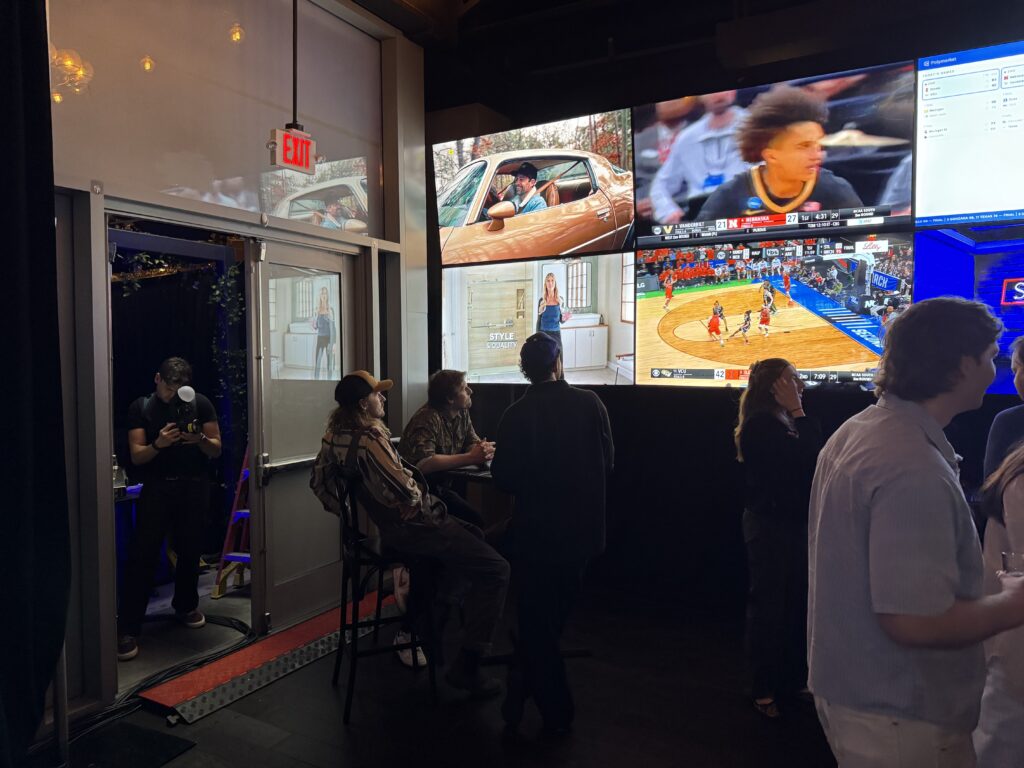
The music was actually probably the correct volume for the type of environment Polymarket was trying to achieve. But when there are not enough people in the first place and there is a disincentive to engage in conversation because people are shuffling aimlessly around finding new screens to stare at, the normal hubbub of voices that would naturally mix with the audio did not exist.
Men — mostly men — in their 20s and 30s could be seen swaying and nodding their heads to the music as they divided their attention spans between the phones in their hands and the market data on the walls. There were women there too. To put it in party terms, the ratio of men to women was about 70-30 (translated into Gen Z crypto-bro influencer terms, one might say the ratio was “totally shot”). But that only matters if the men were interested in speaking with the women there, and many seemed too preoccupied by screens to notice or care.
Reminiscent of something like church camp or a sixth-grade dance, the few women who were there mostly spoke to the other women, and the men were basically standing near each other, mouths half-agape, staring at screens.
The first person I spoke to, a man in his early-mid 20s, fit this description, but was nonetheless extremely excited to be there. He was there with a male friend and had been staring at screens and hadn’t spoken a word since the moment I walked through the door. He seemed stunned that someone he did not know would initiate conversation with him. He was nearly speechless, which was obvious because he could barely figure out how to respond to the question “How are you liking the Polymarket bar?”
“I love it. Honestly, I love it. This is so g-dd-mn exciting,” he said. “Everybody’s here, everybody’s looking, everybody’s involved, you know, like it’s different — monitoring the situation! Where else can you experience this in D.C.?”
It is true, it is difficult to find a dead bar in D.C. on a Saturday night — and notably, the bars that are packed are not adorned floor-to-ceiling with screens.
He also said, “There’s a lot of beautiful women here,” which was an interesting thing for him to be excited about, since he did not attempt to speak to any of them. When asked about whether the screens were keeping people from talking to said women, he replied, “Of course!”
His friend added, “If I’m a beautiful woman, I’m not coming here.”
They both left about 30 minutes later without speaking to anyone else.
‘Alright, This Is Lame’
There were others who chose not to stick around for a long period of time. In fact, the situation was not as bad an indictment of young people’s abilities to socialize as one might think.
While there was certainly an outsized amount of antisocial behavior, exacerbated by the environment created by Polymarket, numerous people came, had a drink or two, disliked it, and left to pursue an actual social setting on a Saturday night.
“Alright, this is lame,” one man in his 20s said to his friend after taking a moment to capture the scene and turning around to leave before even ordering a drink. They told me they have been there for “30 seconds.”
“It’s not the vibe,” another man said, leaving.
“Maybe it’s not good because it’s free,” a woman in her 20s said, likely talking about the lack of a cover charge.
What Is It About These Screens?
After leaving the Situation Room and heading for a nearby pub (where people were actually conversing) to gather thoughts about what I had witnessed, I made the realization that a lot of other bars have screens. It’s the definition of a sports bar to have televisions showing multiple games, where people are engaged with the screens because people care about the teams competing.
So why were the social outcomes so diametrically opposed, and what is it about those screens versus these screens? Maybe it comes down to the community versus the individual.
People watching the game at a sports bar are all experiencing the same cultural event. No matter which team they are rooting for, it’s a shared experience that actually creates camaraderie around being invested in the game itself. Sure, there is lighthearted antagonism around the competition, but the likelihood that it turns into ordering another round after the game is much higher.
Antagonism is better conversation than silent screen-gaping. It gets people talking, they share interests, and there is social cohesion. With a place like the Polymarket bar, everyone is on his own island.
You might go with a friend or two, but even your own group is stratified in interest because you have different bets on different things, or even different styles of gambles on the same event. So one person is left watching market A while his friend is watching market B in a different part of the room. And even the people who might be watching the same market are not themselves connected by anything other than the topic, because they could have wildly different bets on the issue.
The clearest sign of the Situation Room’s failure was not the light attendance or the antisocial tendencies of the people excited to be there; it was the people who left because the main thing Polymarket left behind is the human experience.