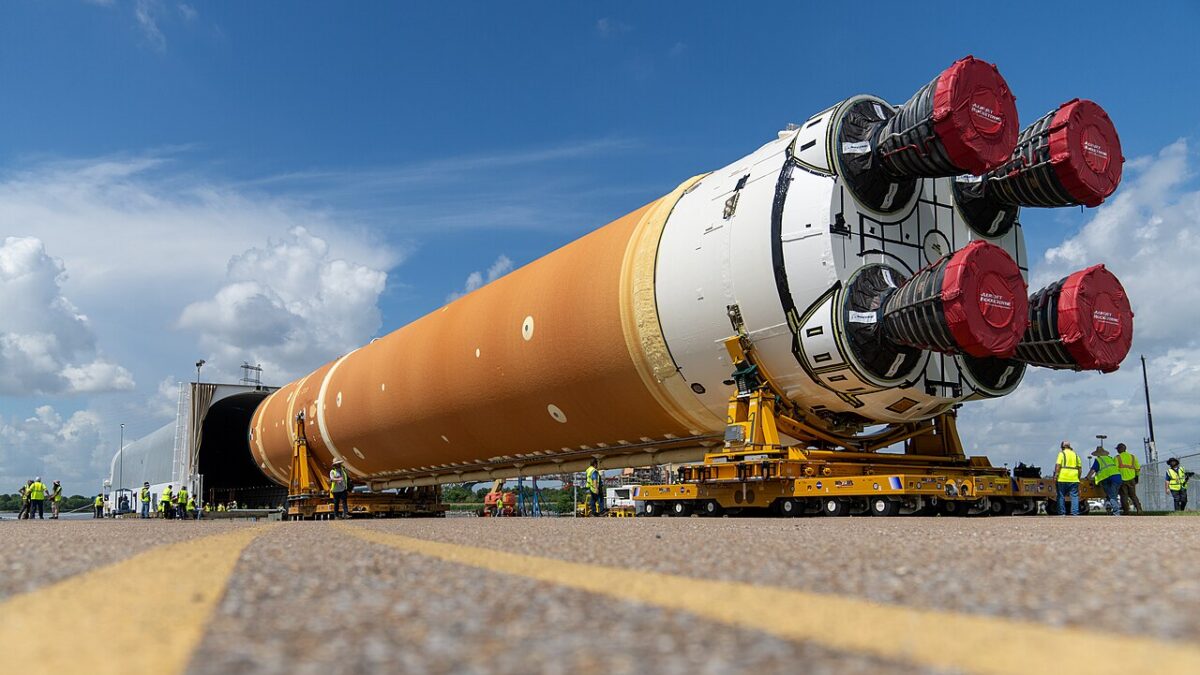

After so much anticipation and excitement, the launch of Artemis II, which was supposed to fly a group of astronauts around the moon’s orbit, was delayed yet again. Evidently, “it wasn’t a leak that ailed the rocket, but not enough flow of helium to the spacecraft’s upper stage.” This issue will likely push back any launch until at least April.
This marks the second recent delay for the Artemis II mission, which was originally set for launch in early February, but could not because of a hydrogen leak (not to be confused with disrupted helium flow). While such delays are frustrating, it should be known that the whole Artemis II project was originally planned to launch five-plus years ago. No doubt, the NASA personnel are hardly bothered by another month or two of delay.
However, in light of NASA’s track record for the past few decades, all of this is symptomatic of a hopelessly ineffective and inept organization. Even with hundreds of billions of dollars of funding over the years, NASA has dramatically regressed in general competence. Already, it is stumbling in achieving something that it did over half a century ago: flying to the moon and taking a few steps on it.
NASA’s embarrassing slide into irrelevance and mediocrity illustrates just how an organization originally devoted to science and exploration can degenerate into another useless barnacle on the Leviathan state. Almost all of it has to do with corporatism and leftist double standards. This is why the shuttle for the Artemis II mission is manufactured in part by Boeing, the same company that recently produced a shuttle responsible for leaving two astronauts, Butch and Suni, stranded at the International Space Station after experiencing technical difficulties.
Somehow, despite this failure with what should have been a routine mission, Boeing is still enjoying its multibillion-dollar contract to help produce the shuttle for Artemis II. Meanwhile, SpaceX, which was commissioned to build the shuttle and human landing system for the moon landing mission of Artemis III, has been criticized for not meeting deadlines and is now forced to compete with Jeff Bezos’ space company Blue Origin for outfitting future Artemis missions.
To be clear, SpaceX has a proven track record of building spaceworthy, reusable ships along with massive machines, “Chopsticks,” capable of catching these ships. The company also managed to finally save Butch and Suni after nine months of NASA’s dithering. So while the world waits for Boeing to fix its rickety ship to maybe take a tour around the moon, SpaceX and Blue Origin are facing enormous pressure (and receiving substantially less funding) to put together a functional moon colony along with a fleet of sturdy shuttles.
Supposedly, all this newfound urgency and accountability arise from the possibility of China beating the U.S. to land on the moon once again. All of a sudden, after decades of low expectations, the federal government now expects an old, flabby, useless NASA to return to muscular Cold War shape and achieve major breakthroughs.
By now, it should be apparent to everyone that this will not happen until today’s NASA is completely dismantled and replaced. With its glory days long behind it, the organization now regularly fails in everything it is charged to do. It has ceased being a meritocracy and is now only capable of wasting money, generating pointless roadblocks for missions, and making infinite excuses for its mediocrity. Rest assured, this most recent delay of Artemis II will only be one among countless more to come.
Acknowledging this, the federal government should stop browbeating private companies to do the impossible and instead demand that NASA justify its own existence. From being the premier institution to pioneer space travel and triumph over the Soviet Union in controlling the heavens, it has become just another bloated, woke bureaucracy that funnels money to equally bloated, woke corporate cronies.
Considering that nearly all technological innovation in this field has come from private entities such as SpaceX, NASA seems to do little more than allocate public money to its favorite companies. And if that’s all NASA does, this responsibility should fall to those with more expertise in budgeting, efficiency, and taking risks, not the current set of dunces who are more concerned with self-preservation than scientific discovery.
For now, the U.S. still enjoys supremacy in space travel and has the greatest potential to expand the boundaries of humanity beyond Earth. The money and infrastructure are there, but the will and overall vision are lacking. This needs to change, and it has to start from the top. To paraphrase America’s greatest astronaut, Neil Armstrong, one small step in restructuring NASA now could lead to one giant leap for the American space program in the years to come.