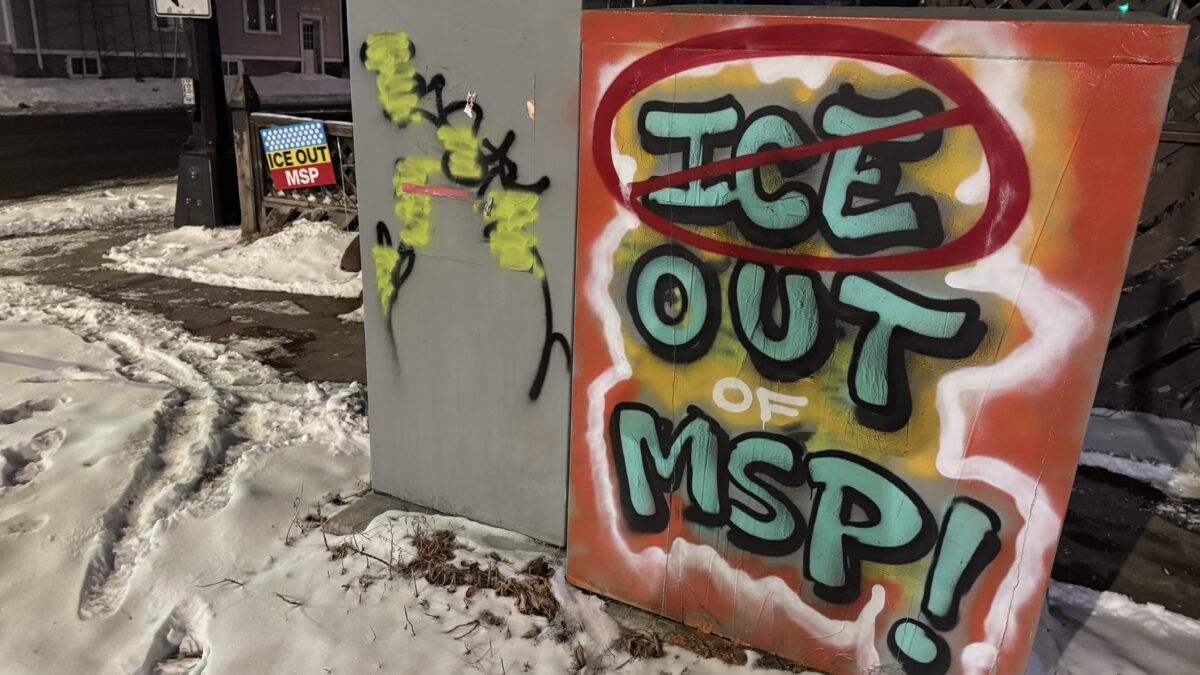

MINNEAPOLIS, Minn. — For a city that is persistently in the news for left-wing rioting and obstruction, it will come as no surprise that Minneapolis is overrun with political agitators who terrorize its residents.
But Minneapolis’ de facto militia occupation is not some organic outgrowth from a self-righteous people. Rather, it is a highly technical, well-strategized force that is entirely self-aware of its political power — and when, where, and how to escalate tensions or surge forces.
After walking around Minneapolis, blending in with the agitators, and talking to them for only a couple of days, it became abundantly clear that it is a city that is not entirely run by a government. Instead, social services, criminal justice, and the rest are meted out under a captivity agreement struck between elected leadership and genuine anarchists who want autonomy over the city, and ultimate power over its people.
Politics doesn’t make too strange a bedfellow here, because the anarchists and the political leadership largely agree. The government is merely a moderating force and uses that off-brand anarcho-tyranny to its political advantage when it wants to.
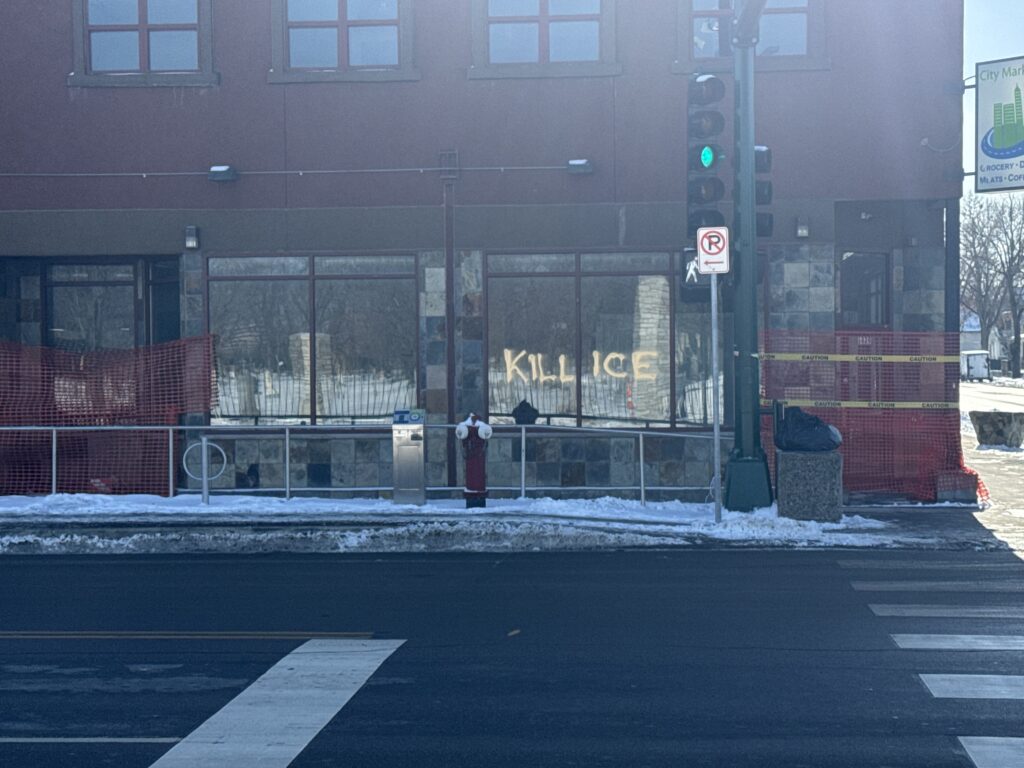
Gov. Tim Walz, D-Minn., and Democrat Mayor Jacob Frey just put this dynamic in practice. After weeks of encouraging a network of agitators to obstruct and be violent with federal agents, while refusing to let state and local police support Immigration and Customs Enforcement (ICE) operations, they appeared to obtain certain concessions from the Trump administration.
On Wednesday, border czar Tom Homan, who was dispatched to Minneapolis after agitator Alex Pretti was shot, announced a “draw-down” of 700 law enforcement personnel “effective immediately.”
But the lawlessness persists. Road blockades are erected by agitators who cross-reference license plates with a database of suspected or confirmed ICE vehicles before allowing Minneapolis citizens to pass through.
One at the intersection of Cedar Avenue and East 34th Street was taken down by Minneapolis police, but in short order, one agitator told me, the blockades will sprout up again.
The social media account Minneapolis Spring is an agitator account that appears to be heavily involved in organizing blockades, and telling others how they can do the same.
Those blockades are guarded by faceless, nameless people who are not afraid of assaulting journalists. I have both experienced and witnessed the snap-hostility with which some of the agitators treat a person once they find out they are a journalist, raising tensions and the potential for violence.
Because of the agitators’ penchant for violence, and their ability to circulate the faces of people they decide they do not like and doxx them, I was advised by everyone I spoke to inside and outside of the Department of Homeland Security (DHS) to move a ride-along scheduled with ICE to my last day in the city.
Once I was seen with ICE, I was told, it would have been unsafe to walk around downtown.
The Sentries
Walking around downtown Minneapolis gives you one primary feeling: not the bitter chill of five degree temperatures, but rather that you’re being watched.
And that’s because you are.
The street corners of avenues Nicollet, Cedar, Portland, and many more are often guarded by sentry-style lookouts watching for SUVs that could be ICE — or not — and signaling to their fellow agitators how many cars there were, and in which direction they were traveling.
The sentries were often in pairs, and one could usually tell they were sentries by physiognomy alone: obese white women with short hair and septum piercings. (Something so on-the-nose can’t be called a stereotype when it’s true nearly every time).
My first run-in with these street patrols was my first night in the city, after having dinner at Pat’s Tap, which, like many businesses, has a warning posted on its door not allowing ICE or Customs and Border Protection (CBP) to enter.
“Members of our community are welcome and feel safe here, and any harassment of our guests will not be tolerated,” the sign from Monarca, which appears to be an agitator organizing group, plastered on the fronts of businesses across the city states. “We have the right to deny ICE and CBP access to private spaces without a judicial warrant. We assert out constitutional rights, which apply to everyone in this country, regardless of immigration status.”
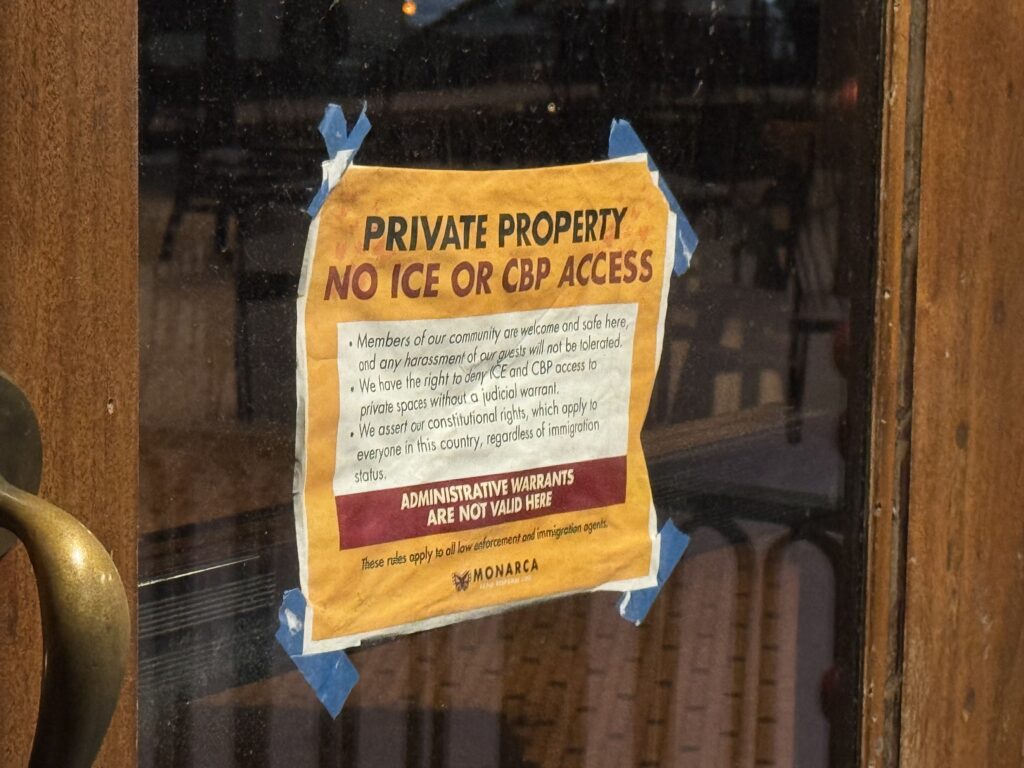
“ADMINISTRATIVE WARRANTS ARE NOT VALID HERE,” it continues, adding, “These rules apply to all law enforcement and immigration agents.”
Outside Pat’s Tap stood two obese white women in their early thirties who had been standing there for over an hour, mesmerized by the moon and “mother earth,” who told me they were there “looking for ICE.”
I did not think much of it at the time, other than that they might have been two random people feeling good about themselves for doing essentially nothing. It was not until the next day that I realized they were dead serious, and they were an essential part of the anarcho-tyranny.
In the following daylight, everywhere I looked traveling around downtown I saw pairs of patrols on street corners and cars idling in the same place for long periods of time, simply watching and waiting for activity to alert up the chain of command.
The alerts may even start at the Whipple Federal Building, ICE’s home base in the city, along with numerous other federal offices, where protesters are constantly monitoring vehicle movement.
The sheer number of people using daytime, weekday hours to do this was astronomical — and clearly suggests they are being paid.
Josiah
One man named Josiah, an organizer at a makeshift memorial for Renee Good, the woman who was shot trying to hit an ICE officer with her car, explained how some of it works.
Josiah is not from Minneapolis, of course, but rather Washington state. Many agitators are not from the cities they help destroy. He’s an average height, red-haired man with painted fingernails and a whistle wrapped around his wrist.
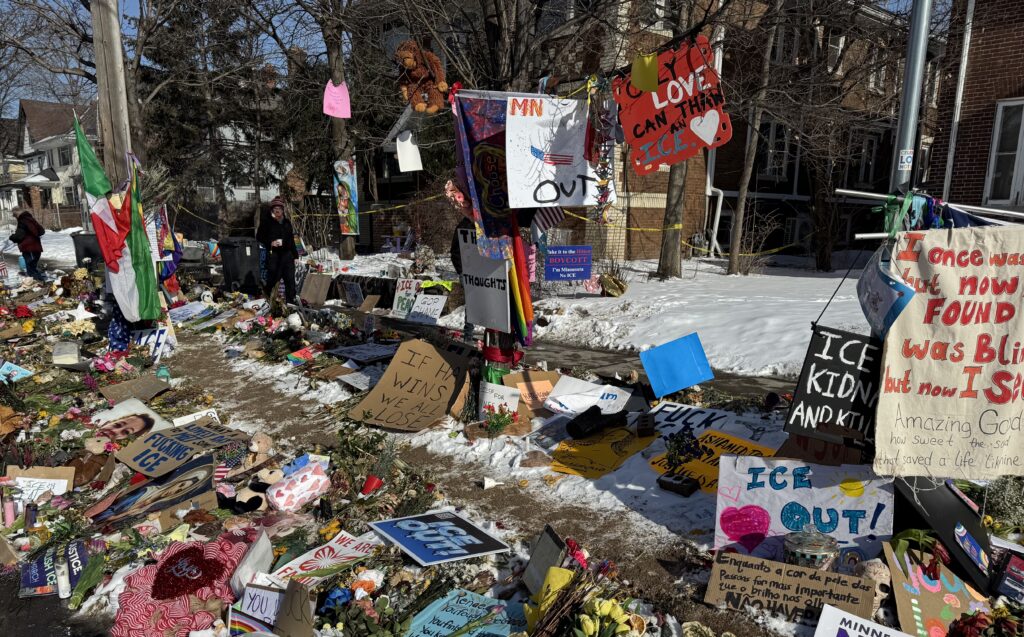
There is a “rapid response that’s been set up across — like, every neighborhood has a signal … They’re connected,” he said, describing the signal as bouncing up and down city blocks to track ICE’s movements and get as many agitators to the location as possible. “They can hear it too, right? With the whistles, and the horns, and the gunshots and, you know, that’s how they figure it out — and then they post about it. But by the time a larger group can get there, usually they’ve f-cked off.”
Getting more agitators to the location of ICE operations seemed to be a logistical problem they aimed to fix.
Josiah also explained that the lookouts also have groups stationed at local schools where “at least five people” wearing yellow, high-visibility vests will receive information about ICE activity in the area.
Those wearing the vests “walk staff to their cars, they’ll walk kids to the parents, or some people will drive the kids home,” he added, “because they’re taking kids.”
As soon as an agent gets out of their vehicle, Josiah claims the “school will go on lockdown.”
In an interview with The Federalist at the Whipple building, Sam Olson, Saint Paul Field Office Director for ICE, confirmed that ICE does not operate in schools or at churches.
While Olson told The Federalist that cooperation with state and local police is better than it is made out to be, Josiah seemed to think the local law enforcement really only stepped in when things got a bit more noticeably out-of-hand.
“[City police] don’t want communities organizing in, like, a self-made capacity that would disrupt what’s usual,” Josiah said. “So in that sense, like, people set up — you might have already heard, but, like, people have set up checkpoints in their communities.”
“Minneapolis, I think, in my mind anyway, is renowned for this, right? Like the community comes together. They’re like, ‘We own this.’ There’s the chant of, ‘We keep us safe. Who keeps us safe? We keep us safe,'” he explained. “That’s really where we’re at. Within that, if we’re gonna use, like, political terms, right? It’s like a pseudo-anarchist thing, in that they’re, I mean, they’re taking care of themselves, right? They’re not relying on the government to do that.”
Josiah went on to explain his involvement in the George Floyd riots of 2020 in Minneapolis where, among other things, “we burned down a precinct.” Whether he was directly involved with that, or he was trying to associate himself with something he deemed righteous, was unclear. But in that instance, under the direction of Frey himself, police were forced to evacuate in order to avoid serious injury or death.
But that’s the price of war, Josiah suggested.
This time around, Josiah said he does not expect something similar to happen “in terms of burning stuff down.” Speaking about arson as though it were a yet-to-be-deployed tool in the agitators’ toolbelt, “I think if there’s riots, the thing that’s gonna burn are ICE vehicles. We’re not gonna go after our own sh-t, and if we did, it would be places where they’re [ICE] at.”
“If we’re going to burn something, it’d be like the Whipple building. It’d be like the detentions, but obviously there’s people in there,” he added.
He explained why Minneapolis was so quick to riot in 2020, versus now where there are a notable lack of riots in a city that cannot, seemingly, get enough of them.
“I think people are very wary of, like, 2020, but the difference is, from my perspective, in 2020 the city was attacking its people and now it’s ICE, so we don’t have anything to burn down, because we’d be burning ourselves down, and we’re the ones that are all collectively under attack,” Josiah said. “I don’t think it’s gonna happen at all.”
Appearing to talk about the Pretti situation, he continued, “I mean this, they just killed him, right? They just shot him. And obviously they did that to Daunte Wright, and they do that to a lot of folks, but like, they were kicking, they were gang beating him, and then they just killed him point blank.”
“If you go up to them, they’ll just pop you, right, whereas I think with the police, those are situations where they feel justified to do it because somebody’s being unruly, or it’s because of whatever the f-ck,” he said.
The reality that both the Good and Pretti incidents appear to be justified use of force did not seem to cross his mind.
‘Progress Over Perfection‘
As a description for the agitators, “progress over perfection” was a perfectly understated phrase I found on a sticker fixed to the middle of a restroom mirror at a coffee shop downtown.
The incessant drive for whatever “progress” means was certainly clear, and whatever “perfection” had to be steamrolled to get there was just cannon fodder. Perhaps, to them, in a more “perfect” world, nonviolence would be preferred. But that might take time, and they seem to enjoy the violence.
In fact, any everyday passerby in Minneapolis will contort their mind into making up the most bloodthirsty fantasies about what bad things police could be doing in order to justify their all-out rage.
One white woman in her 40s was walking her dog across a parking lot near the blockades when a Land Rover with a sticker reading “Minneapolis Police Latino Affairs Volunteer” pulled in after it had been fairly severely rear-ended by another car.
A Minneapolis Police Department squad car pulled in behind it to help the driver with his car. The Land Rover was not a city car, as the Minneapolis Police Department confirmed to The Federalist, and had been involved in an accident at a stop light — though it certainly looked like it had been rammed by an agitator, so I asked the officer, who said the same as the police department.
But that did not stop this woman from churning through scenarios in her mind — though one of the scenarios was certainly not that an anti-ICE agitator could have done this. She was offended at the suggestion.
She quickly started typing into her phone, possibly for a dispatch to an anti-ICE group chat network. She started rambling about how ICE was “enacting racist violence” in the city and that “anyone with a brain is concerned” about it.
At one point, the woman suggested that the ramming could have been a false flag concocted by ICE in order to drum up sympathy. The next moment, she thought that the ramming could have actually been an instance of right-wing violence because the car said the word “Latino,” and people on the right apparently hate Latinos.
As soon as she found out I was a reporter, she started to probe for more information, and then appeared to type into her phone again — perhaps informing the agitators that a reporter was in the area of the blockades.
She is representative of nearly every person I came across in Minneapolis, save the one house I passed by downtown bravely displaying Trump-Vance and “pray for our nation” signs in their front yard.
The woman had clearly been browbeaten into regurgitating the same exact words and phrases used by left-wing media and politicians to mischaracterize ICE operations in the city, and she was not the only on.
At local chain Pizza Luce in Richfield, a close-by suburb of Minneapolis, I witnessed four people compete to out-do each other in displaying their deep knowledge — and very sincere compassion — of the situation.
One white woman with indigenous art earrings, a plaid shirt, and a yellow The North Face backpack in her mid-late thirties actually butted into another person’s conversation from across the bar (which was nearly across the room) at the first mention of ICE — just to make sure to steer the conversation in the right direction.
In her mind, ICE was roving around purposefully shooting pregnant women in the stomach with pepper balls. The incident to which she was referring was apparently in Los Angeles, and it is difficult to tell if the woman is pregnant, but the ideology of the Minneapolis woman appeared to block her from wondering why a pregnant woman would be out agitating against ICE in the first place.
It’s been an unfortunately common occurrence that left-wing women will bring their young children to agitation sessions and expose their children to pepper balls or gas seemingly for the sole purpose of manufacturing these narratives. One woman recently said she would murder her children and commit suicide before being detained by ICE.
But women like the one at Pizza Luce are there to dutifully peddle the narratives, stating that ICE “kidnaps people … that’s, like, our new norm now,” and that ICE is using children “as bait,” all “because he [Trump] hates Walz and hates minorities,” she said.
Her white male significant other with cuffed jeans and metallic-painted fingernails was there to congratulate her for how brave she was being for saying something in a room of about 15 people, all of whom agreed with her.
One middle-aged white male talked about his personal struggle, stating, “I’m white, so I shouldn’t have anything to worry about, but I’m walking home looking over my shoulder,” while claiming that ICE is blocking school buses.
In an unrelated conversation at the same location, one woman in her 20s or 30s said she has “really good friends who were really close” with Pretti, who was an ICU nurse, adding that all of her friends who work in hospitals were part of agitator group chats, and that the “collective action” was “really inspiring.”
Stating that she did not really like Joe Biden or Kamala Harris because they were not far-left enough, she referred to ICE as the “Gestapo,” adding, “I just always think the Nazi regime only lasted 12 years, and it’s been 10 years — two more years.”
The Enclave Of Minneapolis
Minneapolis is a city seemingly closed off from the rest of the country, whose people are ripping it apart at the seams, and whose out-of-state agitators are providing them with the tools to do it faster, and with zeal.
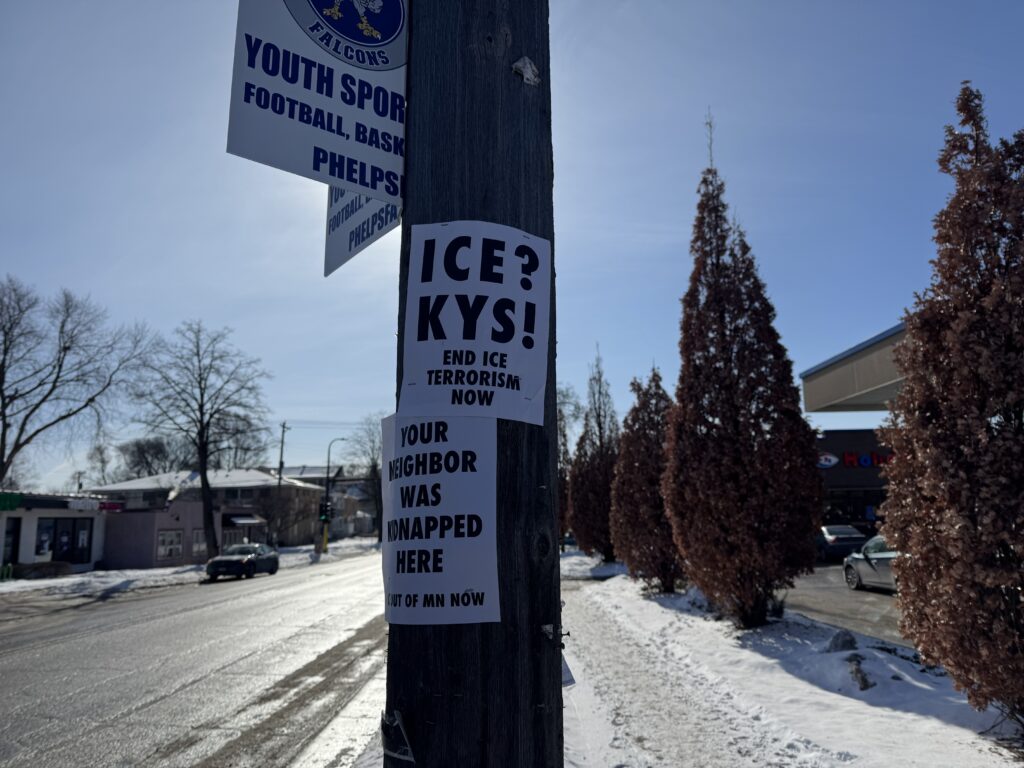
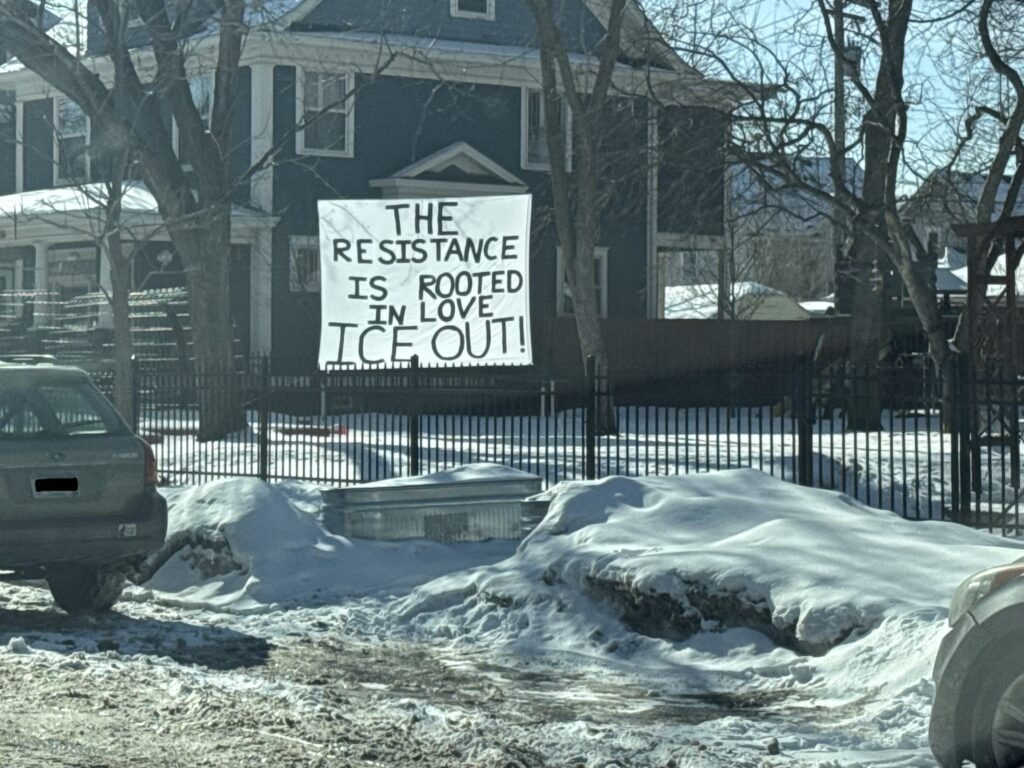
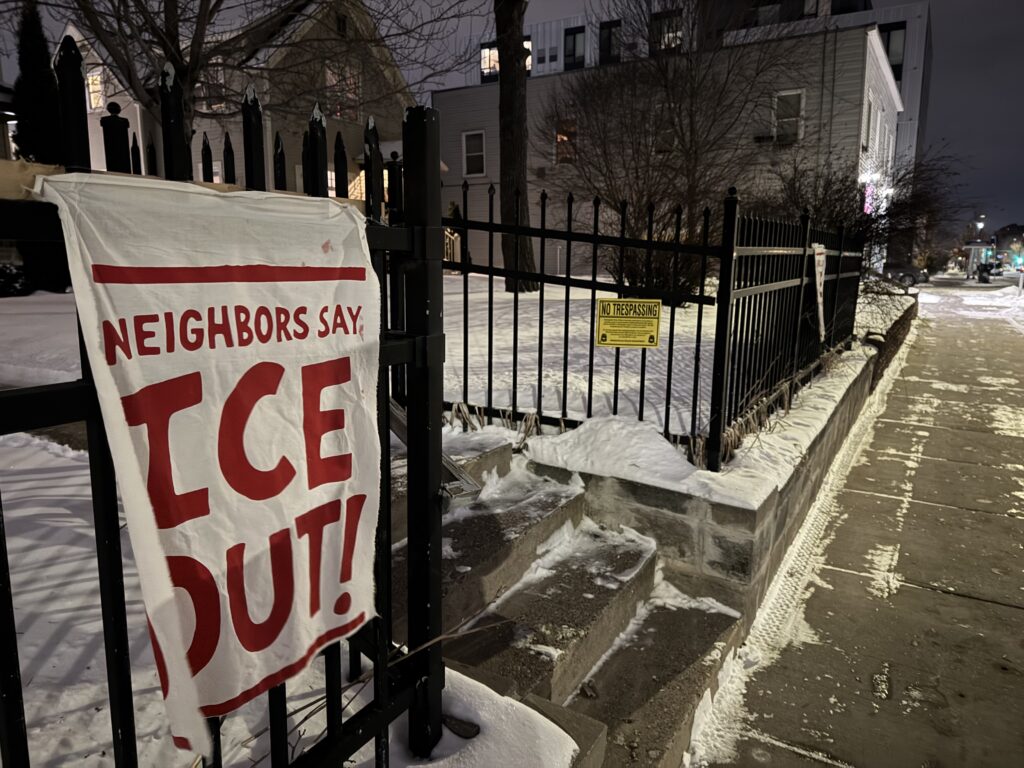
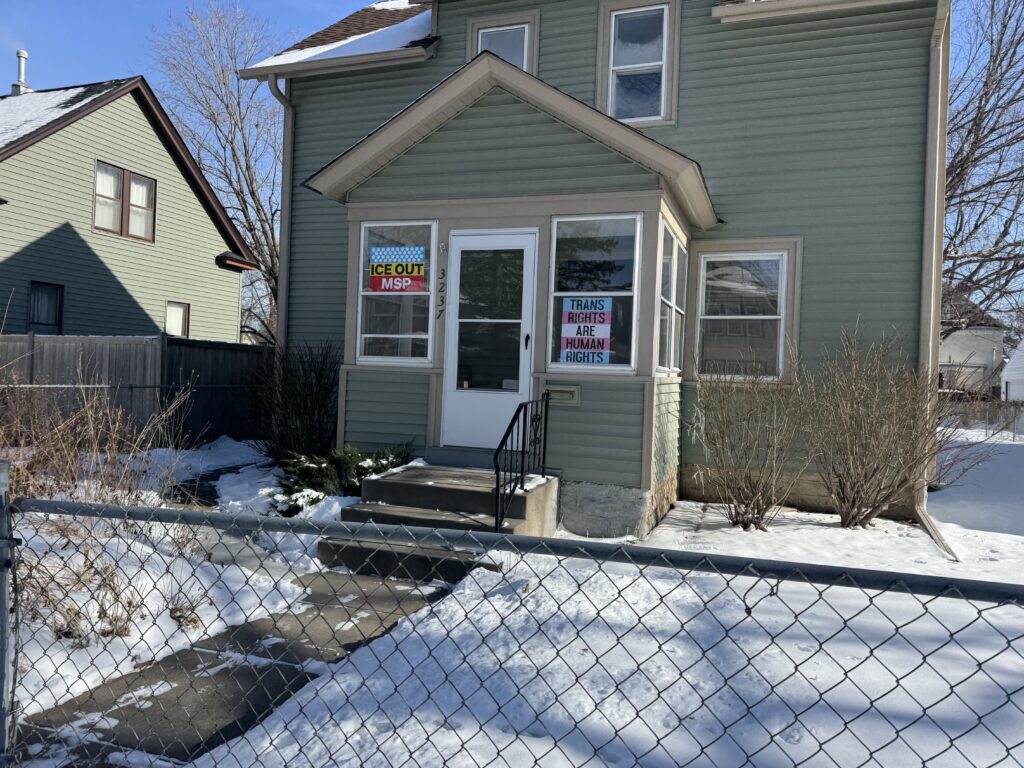
It is extraordinarily difficult to find a residential home or storefront that does not have a “f-ck ICE,” “ICE out,” or worse sign in the front yard or window. In other cities in turmoil I have visited, there is typically a noticeable opposition from the loud attestations of the left-wing — but not in Minneapolis, where it is hard to describe the uniformity.
Many, as was my experience, are true believers. But likely for many more, they need to apply the proverbial lamb’s blood on their doors in order to live in relative peace under the thumb of an ever-present, always threatening mob.
The uniformity itself, in other words, is proof of that the American social and legal systems are functionally unrecognizable in Minneapolis, and at some point, it will the be responsibility of the federal government to re-take the city.