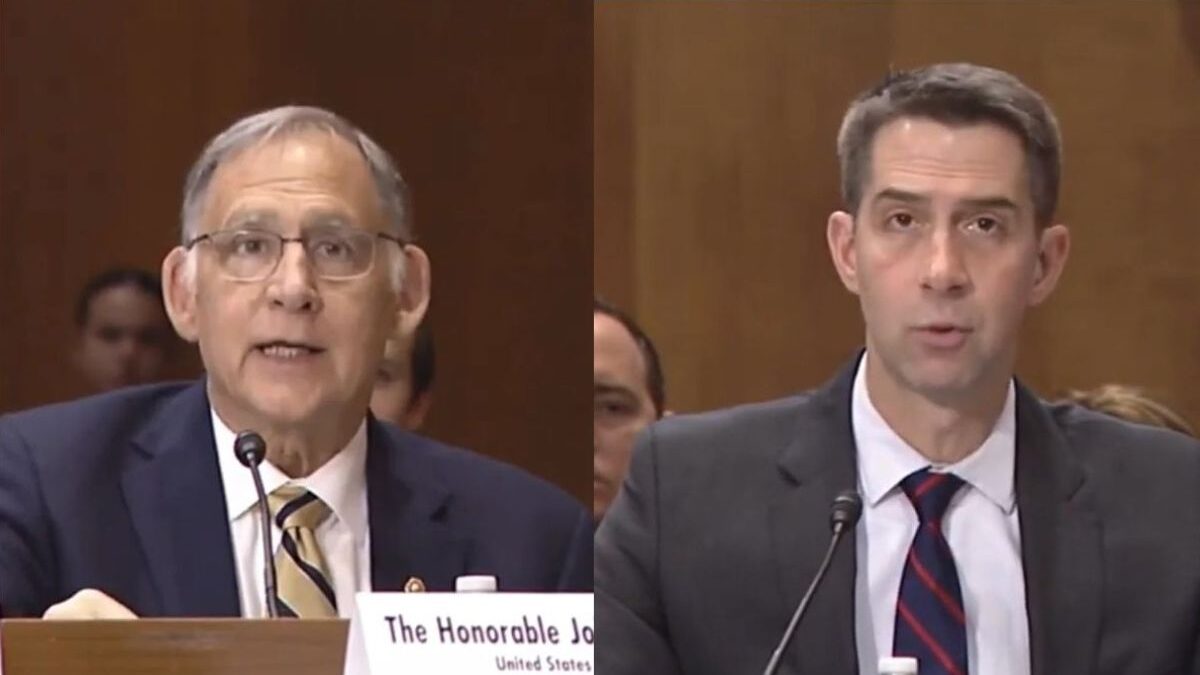

The White House was all but forced to withdraw one of President Trump’s judicial picks on Tuesday after Arkansas Republican Sens. John Boozman and Tom Cotton reportedly maneuvered to block his nomination. The shady move came a week after the GOP took a shellacking in the 2026 midterm elections.
The administration disclosed in a press release that District Judge Lee Rudofsky’s nomination to the 8th Circuit Court of Appeals has been withdrawn from the Senate. The president has instead nominated Arkansas Supreme Court Justice James Hiland for the post.
Rudofsky, who previously served as Arkansas’ solicitor general, also confirmed in a statement that he had been taken out of consideration for the judgeship.
“I will be forever grateful to President Trump for the honor of his nomination. But under our Constitution — which I believe is the most ingenious document in the history of the world — the President’s nomination must be confirmed by the Senate. And the reality is that, without the support of my home-state Senators, confirmation is simply not a practical possibility in today’s Senate,” Rudofsky said. “So I understand completely the President’s decision to withdraw my nomination. Cody Hiland is a solid jurist and a good friend. I look forward to working with him in the federal judiciary.”
As The Federalist previously reported, news reports emerged earlier this week indicating that Boozman and Cotton were working behind the scenes to sabotage Rudofsky’s nomination due to a preference for Hiland. Neither senator introduced Rudofsky during his September confirmation hearing before the Senate Judiciary Committee, as per normal custom.
Boozman, who is up for reelection in 2028, has not disputed the allegations about his efforts to sink Rudofsky’s nomination. When asked by the Washington Examiner on Tuesday about whether he was scheming with outgoing Sens. John Cornyn, R-Texas, and Thom Tillis, R-N.C. — two members of the Judiciary Committee — to block the president’s pick in order to get Hiland the job, the senior senator replied, “Would that be wrong?”
“My conversations with fellow senators are conversations between us,” Boozman added when asked if such efforts were true.
Law professor Josh Blackman recently observed how Hiland “demonstrated absolutely terrible judgment” in August by disclosing to a room full of college students “private communications between him and the White House Counsel” about his consideration for the federal bench. The Arkansas justice openly lamented being passed over for the 8th Circuit position and seemingly boasted about rejecting an offer to serve as a district court judge instead.
“And so, being belligerent, and at times I said no. That is not a position that I’m interested in,” Hiland said. “And he came back with after a five second delay of, you know. not believing what I just said. He said, ‘So you want me to go back into the Oval Office and tell the president of the United States that you’re rejecting an opportunity to be appointed to the federal bench,’ and I said, ‘Yes, that’s exactly what I want you to tell the president of the United States.'”
Rudofsky isn’t the only one of Trump’s judicial selections to face sudden pushback from Republican senators.
Outgoing Oklahoma Sen. Alan Armstrong, who was appointed to replace now-Homeland Security Secretary Markwayne Mullin, abruptly reversed course on Tuesday to oppose Trump’s nomination of Zachary West to serve as a district judge for the Eastern District of Oklahoma. The junior senator’s effort has already received the backing of Tillis, “who said the White House stumbled in vetting Zach West,” according to Bloomberg Law.
“They just need to sort it out or get somebody else,” Tillis said.
Armstrong is set to be succeeded by GOP Rep. Kevin Hern, who won the seat last week, on Nov. 30.
The Senate’s move to confirm Trump’s judicial picks before the end of the year comes amid leading Democrats’ pledge to block such nominations after their party assumes control of Congress in January. There are currently more than two dozen Article III vacancies waiting to be filled, according to Ballotpedia.