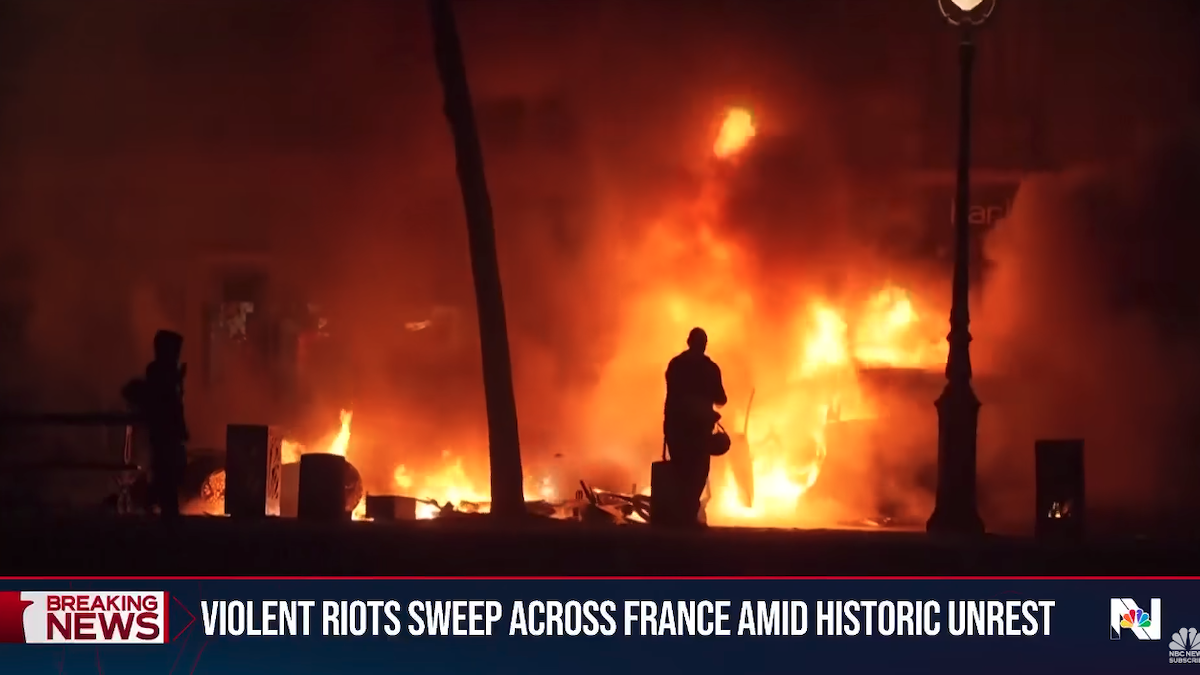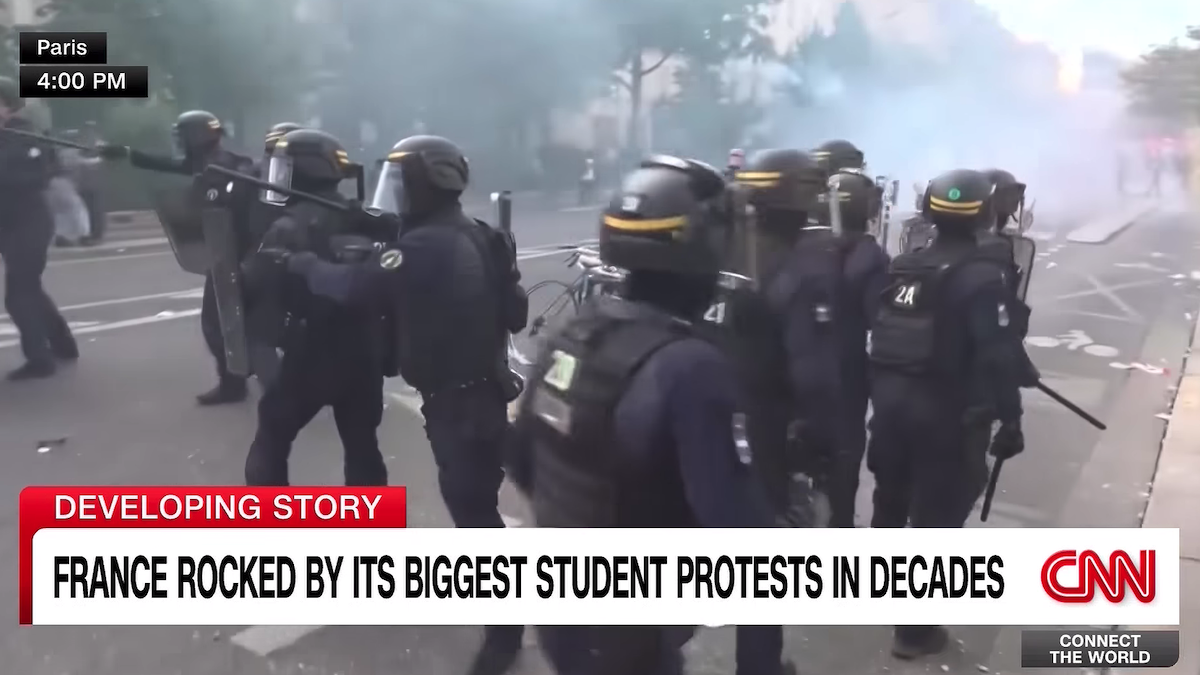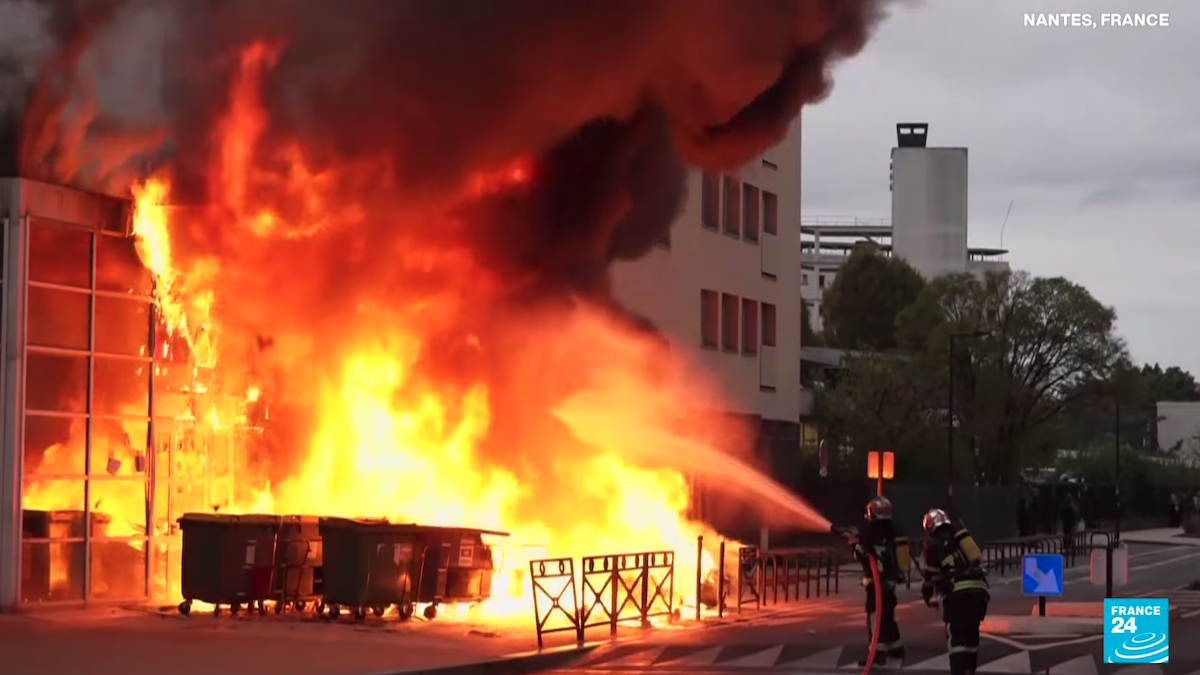

France imported the Third World, so now it’s dealing with the consequences. The “fiery but mostly peaceful” riots that have devastated multiple cities in France have dragged on into their second week.
Under the ridiculous guise of “student protests,” the red-green alliance of Marxists and Islamists has gleefully looted stores, clashed with law enforcement, and caused general havoc on the streets.
France is no stranger to street riots, especially in Paris. In fact, you might call rioting the French people’s true national pastime — ahead of soccer and having wine in the middle of the day. But these new riots aren’t about economic inequality, gas prices, or labor conditions. These riots pose existential questions for France and the West as a whole: whether we’ll be swallowed up by the rising tide of Third World immigration and domestic Marxism or whether Western nations will reclaim their homelands.
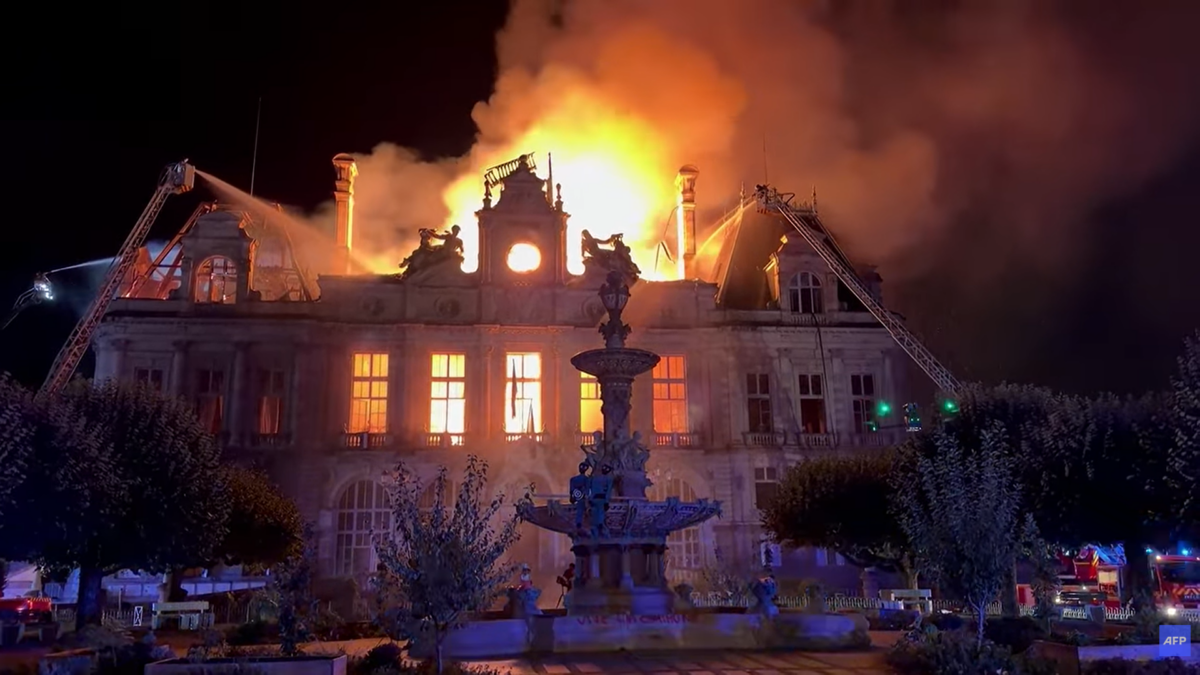
To get a clear illustration of what’s at stake, look no further than the burning of the Limoges town hall over the weekend. This beautiful building, completed in 1883, went up in flames amid the riots. It’s a symbol of France at arguably the height of its power (notwithstanding a short stint under a certain Corsican) — La Belle Époque, the Beautiful Era that came to an end with the trenches and shellfire of World War I. During this age, France, along with the rest of the West, produced stunning music, literature, technological advancements, and architecture that capture hearts and minds to this day.
Firefighters tried to save the building, but it was apparently too far gone. And while the town hall went up in flames, its exquisitely crafted clocktower collapsing into the inferno as a final death knell, the rioters — like a horde of locusts — moved on to the next target of their wrath.
Of course, the government reaction so far has been as spineless as what we’ve come to expect from the Europeans in response to the slow but steady destruction of their civilization.
“Watching these images, we have all asked ourselves how could French people do this to France?” pondered French President Emmanuel Macron during an address to the nation.
By and large, French people aren’t doing this to France. Simply look at any photos and videos of the rioters, and the flags they choose to carry. A plurality, if not an outright majority, are immigrants or the descendants of recent immigrants, clinging to both their home cultures and the idea that they are owed money, power, and France’s own destruction because of perceived historical grievances. Sure, these immigrants have their ethnically French Marxist collaborators, but these riots represent a Third World revolt against France and the West in general.
And the answer to this anti-civilizational violence is simple: deploy the military and suppress the riots. Lawful force is necessary to counter lawless force. The West used to understand this concept.
King Louis XVI hesitated at several critical moments of the French Revolution in 1789 and refused to order his troops to fire on the crowds marching on Versailles. The French Republic didn’t make the same mistake and knew that order had to be restored through force. A young General Napoleon Bonaparte dispersed an attempted insurrection against the republic in 1795 with a “whiff of grapeshot” from his cannons.
After the fall of Napoleon and the restoration of France’s old Bourbon monarchy, the government continued to meet attempted rebellion with force, with mixed results. The revolutionaries triumphed in the Revolution of 1830 and forced the abdication of King Charles X, who had bungled his military response to the uprising. The subsequent king, Louis Philippe, didn’t hesitate to use troops to swiftly crush the 1832 June Rebellion (of Les Misérables fame).
The French Revolution of 1848, part of a continent-spanning series of revolutions and insurrections that year, once again deposed the Bourbons and ushered in a short-lived republic that was then taken over by a Bonaparte who crowned himself emperor (history does, in fact, occasionally repeat itself) — this time Napoleon III.
Napoleon III learned the lessons from his more famous uncle and from the revolutions of 1848 that had catapulted him to power: The mob is dangerous and must be dealt with swiftly. Today, Paris is renowned for its wide boulevards, and the city has Napoleon III to thank for that. Now, he didn’t undertake this massive infrastructure project primarily to streamline traffic or make the city more attractive to tourists. In those previous violent revolutions of 1789, 1830, 1832, and 1848, the citizens of Paris had thrown up massive barricades in the streets that had blocked government forces, and the narrower streets did not allow larger military formations to maneuver easily. These new, wider boulevards remedied both problems. They made the construction of barricades far more difficult, and they allowed cavalry and artillery to more easily traverse the city in the case of another uprising.
Of course, France has seen its fair share of unrest in the years since Napoleon III’s transformation of Paris’ road network. But during the next two major waves of unrest, first in the 1930s and then in 1968, the French government stopped just short of calling in the military to pacify the streets. The result? France’s internal disunion contributed greatly to its poor performance in the early stages of World War II and its fall to Nazi Germany in 1940. And the upheaval of the 1960s led directly to the philosophical nihilism of France’s ruling class and the immigration regime that has flooded the country with Third World migrants.
So, using the military to crack down on this kind of unrest tends to produce a better outcome than merely relying on local police or allowing the riots to peter out on their own. French officials have announced that they will deploy military units ahead of expected unrest this coming weekend.
But deploying and utilizing the military are two very different things. Will France’s current elite, who don’t even have enough courage to stop waves of migrant invaders from penetrating the country’s borders en masse, have the stomach to order the military to suppress the mob? As X user Philippe Lemoine pointed out, it’s doubtful that even a right-wing French government, much less France’s current weak-willed leaders, would have the stomach for it. Soviet die-hards refused to do so as they tried to salvage the collapsing Soviet Union in 1991, “so frankly the idea that French elites in 2027 will is just delusional.”
Point taken about the spinelessness of today’s elites, but overwhelming military force is the only option left once anti-Western forces take to the streets to wreak havoc. French and Western politicians let the problems of unchecked Third World immigration and the internal rot caused by communist infiltration of major civic institutions go on too long for a more reasonable solution to be feasible. These two forces are bent on the destruction of the West, and they won’t hesitate to use violence to achieve it.
Similar riots have already broken out in Italy, and Prime Minister Giorgia Meloni has moved to deploy 500 troops to quell the unrest. And on cue, leftists here in America are already laying the groundwork for similar riots.
Trump failed to deploy a heavy hand during the George Floyd riots of 2020, and cities across the country burned because of it. When left-wing street violence inevitably returns to American cities, whether at the hands of domestic Marxists or Islamic radicals or an unholy alliance between the two, the president or a future administration cannot make the same mistake European governments are making now. Anti-Western riots won’t end until they’re put down with force.