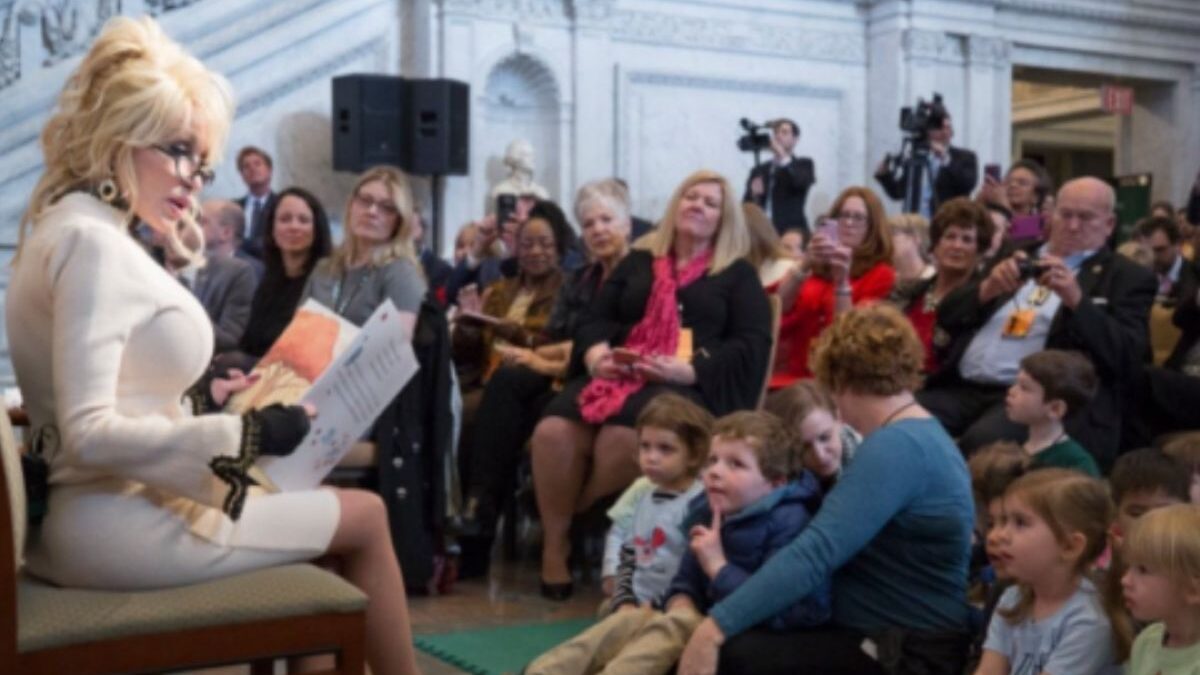

Dolly Parton passed away Tuesday at the age of 80, and beyond her significance as a cultural and country music icon, her flagship charity, Imagination Library, continues a legacy that championed literacy in Tennessee, the United States, and the world.
Parton started Imagination Library in 1995 in her home county of Sevier, Tennessee, as part of the Dollywood Foundation with the goal of mailing “free, high-quality books to children from birth to age five, no matter their family’s income” to children in Sevier.
“Before he passed away, my Daddy told me the Imagination Library was probably the most important thing I had ever done. I can’t tell you how much that meant to me because I created the Imagination Library as a tribute to my Daddy. He was the smartest man I have ever known but I know in my heart his inability to read probably kept him from fulfilling all of his dreams,” Parton said of the program. “Inspiring kids to love to read became my mission. In the beginning, my hope was simply to inspire the children in my home county but here we are today with a worldwide program that gives a book a month to well over 3 million children.”
Although in recent years the book selections have declined in classic literary value and increased in racial consciousness, they otherwise avoid politics and polarizing themes as a rule to stay on the mission of inspiring children to love reading.
As The Federalist’s Editor-in-Chief Mollie Hemingway noted in 2016, “Unlike many celebrities who make it big from small-town roots, Parton stayed close to home and invested there.” But the program grew rapidly and was replicated in places across the U.S., secured statewide coverage for all of Tennessee’s 95 counties, and ultimately expanded to Canada, the United Kingdom, Australia, and Ireland.
All told, the Imagination Library donated 304,539,509 books worldwide by 2025, 38,310,564 of which were distributed in the United States. By 2024, one in seven American children under the age of 5 received a book from the program each month, and now the website says it has increased to one in six.
Last year, an Australian scholar conducted a major study on the effects of the library across all countries in which it operates and found significant increases in literacy among children involved in the program compared to those who are not.
“Research found that after just 10 books, children in the program were at least 4x more likely to demonstrate stronger emerging literacy skills — such as vocabulary and phonological awareness — compared to children not in the program,” the library stated in an article about the study’s global findings.
Other global findings showed that children involved in the program were nine times “more likely to be read to 4 or more days a week,” nine times “more likely to be interested in books,” and 15 times more likely to participate in shared reading. It also noted healthy family reading habits, such as a higher likelihood for the parent or guardian to have conversations about images in the books.
In the United States, children in the program were 11 times “more likely to be interested in books” and five times “more likely to be interested in reading,” and nine times “more likely to initiate shared reading.”
“Children in the US were nearly 3x more likely to demonstrate concepts about print compared to children not in the program,” the library stated.
“When I was growing up in the hills of East Tennessee, I knew my dreams would come true. I know there are children in your community with their own dreams. They dream of becoming a doctor or an inventor or a minister. Who knows, maybe there is a little girl whose dream is to be a writer and singer,” Parton stated. “The seeds of these dreams are often found in books and the seeds you help plant in your community can grow across the world.”