
A much-told story in the news media over the last year and a half is that the rebuilding of Pacific Palisades after a disastrous fire has been slowed by the incompetence of a city government led by Mayor Karen Bass. “For L.A.’s mayor, a Palisades recovery marked by missteps, reversals and delays,” a headline in the Los Angeles Times said near the end of 2025. That’s true, and Bass is presiding over the decline of the entire city, but that’s nowhere near the whole truth. Much of the story now has moved outside of the clearly political, providing a reminder about the limits of government.
Pacific Palisades is the most pleasant neighborhood in the City of Los Angeles, and one of the best city neighborhoods in the country. It backs up to the hills and fronts on the ocean, and it’s an urban enclave: just off Pacific Coast Highway, but far from major freeways like the 10 and the 405. For decades in a dirty and decaying Los Angeles, the Methodist-founded Palisades persisted as what was effectively a small town within a giant city, safe and peaceful, in an island of natural beauty.
Then it burned, in a shocking piece of government failure that’s gradually being exposed by time and litigation. Six thousand homes were destroyed here, with more homes being lost outside the boundaries of the Palisades and about a thousand nonresidential properties destroyed. As a sign of how burned-out residents view the whole thing, a neighborhood coalition that formed around fire recovery topics calls its website They Let Us Burn.
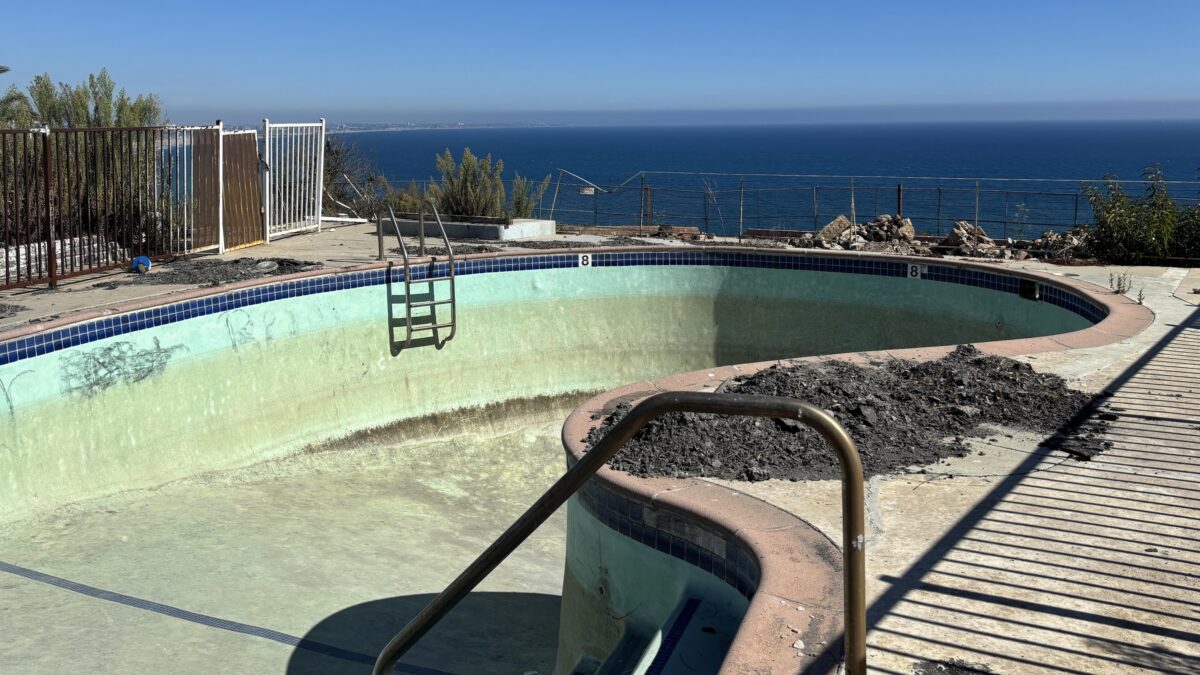
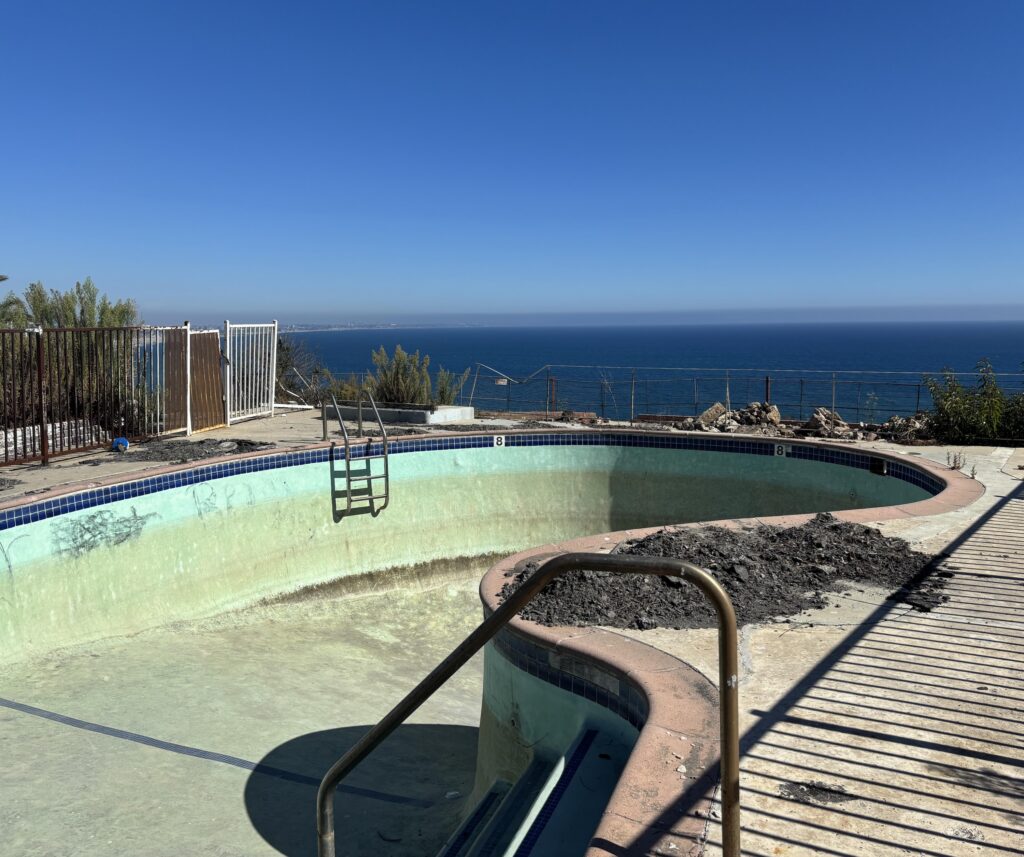
Today, not quite 20 months after the fire, the Malibu Village mobile home park — which, despite the name, isn’t in Malibu — looks like this:
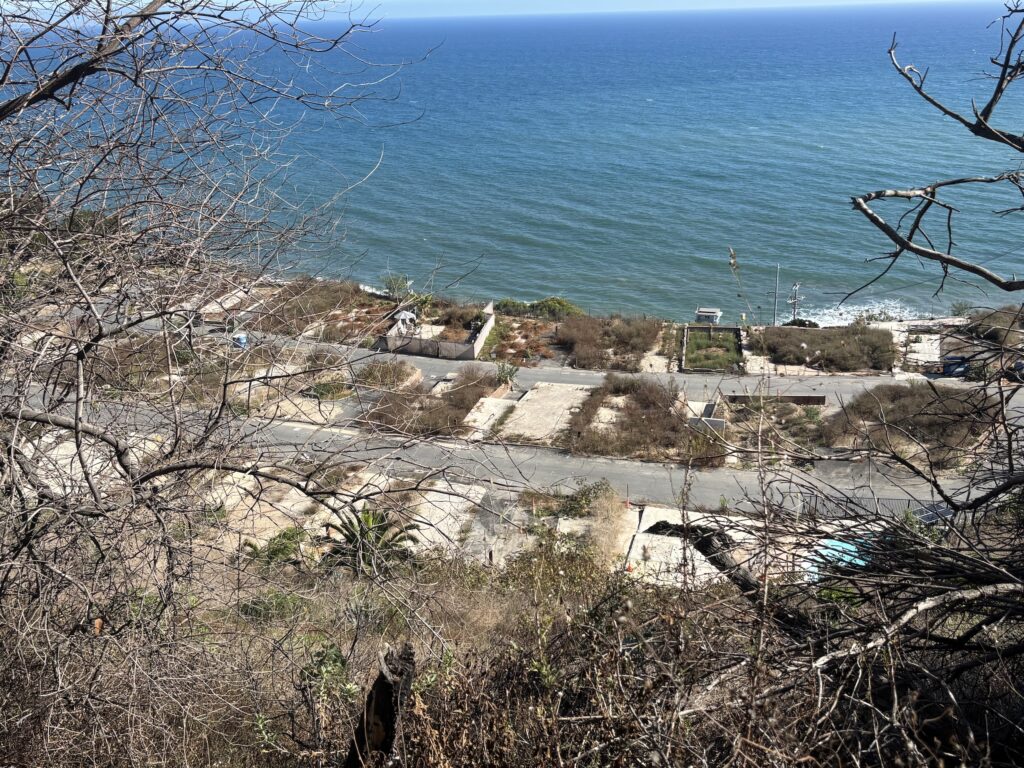
If you look closely, you’ll see the top of a lifeguard stand on the beach, sticking up behind the ruins across Pacific Coast Highway. That’s a pretty good hint about the old quality of life in Pacific Palisades.
Up the hill from that still-ruined community, along Sunset Boulevard, weeds grow in the foundations of apartment buildings that aren’t being rebuilt, and concrete stairs climb to nothing. You can see the outline of what was here in the ruins that have replaced it.
Burned-out lots stand behind fences, with piles of uncleared fire debris. Blackened trees crack and collapse, still unmanaged.
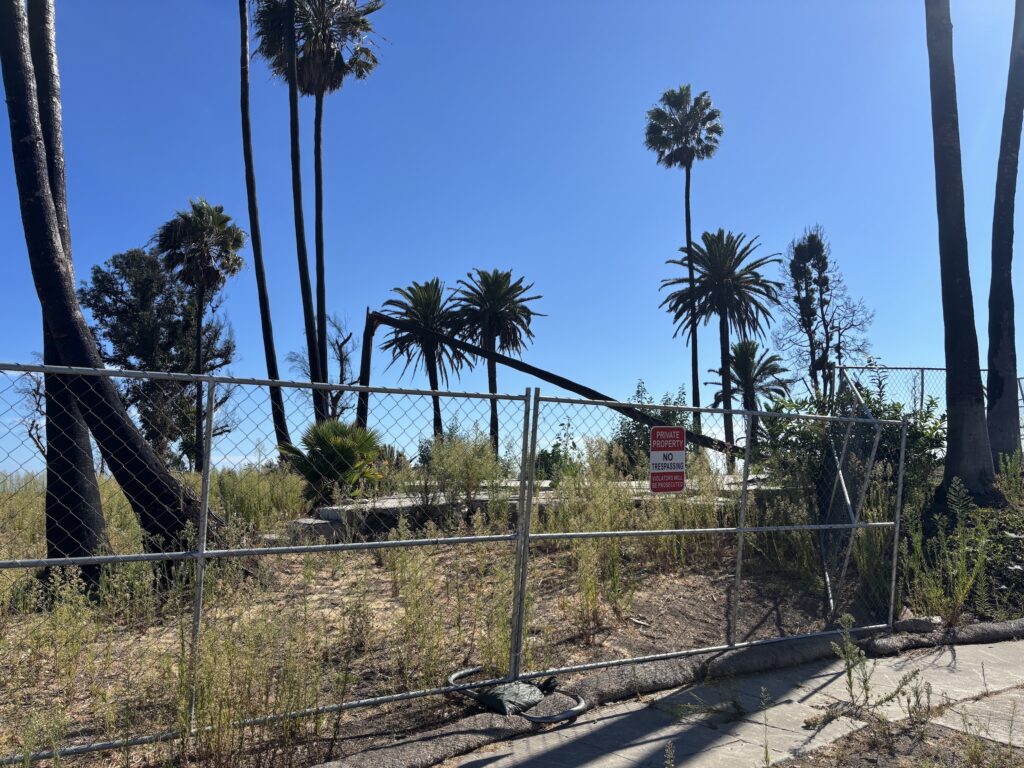
In the hills you can find a somewhat cleaner version of more of the same, bare foundations where people used to live.
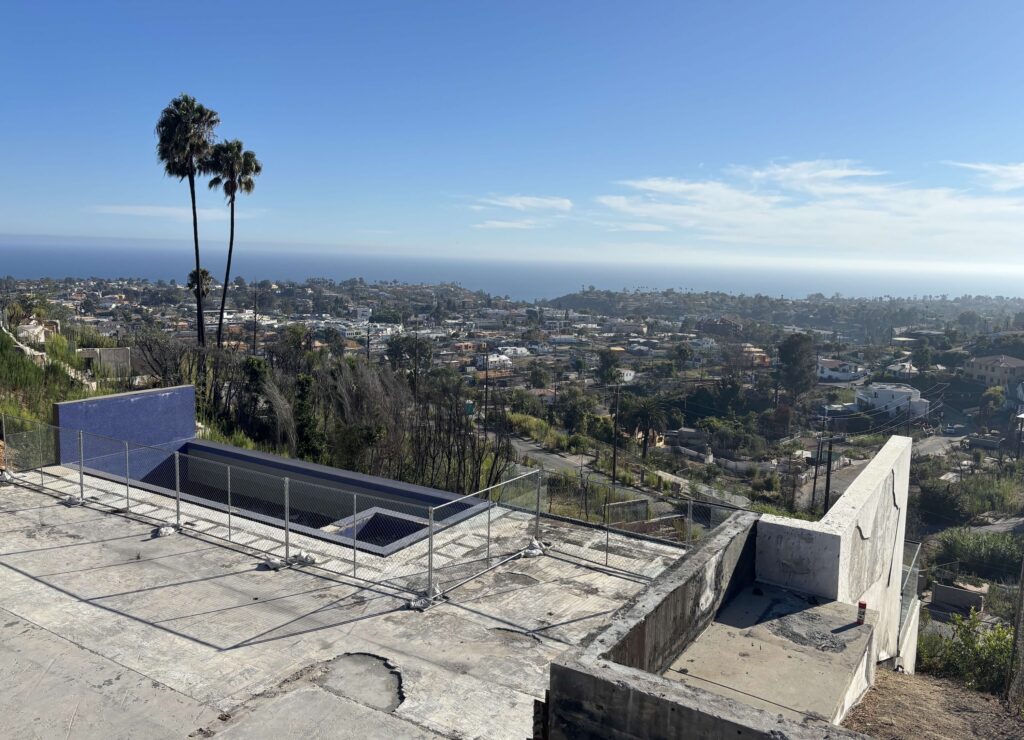
But you can also see this, and you can see it everywhere:
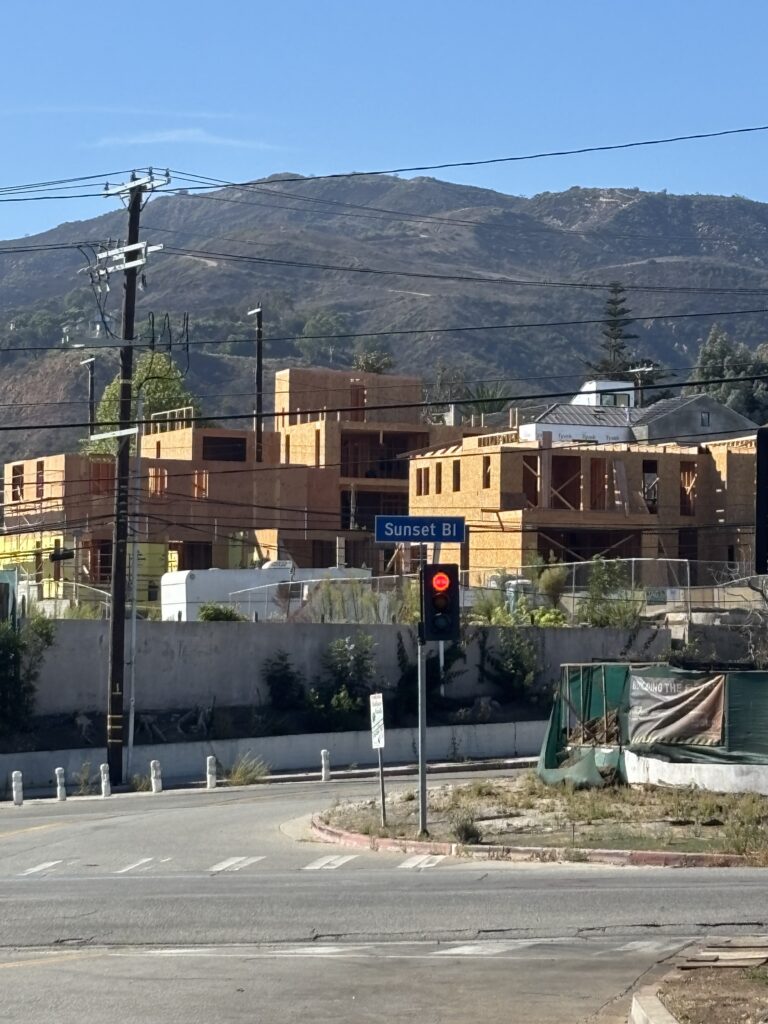
At the cultural center of Pacific Palisades, in the “alphabet streets” named for Methodist ministers (Albright, Bashford, Carey, Drummond …), construction is well underway, and whole blocks have active construction on nearly every lot. From several intersections, you can look in all directions and see homes being built everywhere you look.
Ruined lots, no construction, uncleared fire debris, and also construction everywhere, some of it well into advanced stages. Which one is the real story?
Twenty months after the fire, they both are. And it gets more complicated from there.
‘A Potemkin Village’
In an essay posted over the weekend, Palisades resident and former mayoral candidate Spencer Pratt blasted the re-opening of Palisades Village, a commercial center owned by the developer Rick Caruso. He called it an island of fake recovery in a ruined neighborhood, “a mere facade covering up a very grim reality.”
Twenty months later, Pratt concludes, rebuilding statistics reveal “a very bleak status.” Six thousand homes burned, and “only 30 or so have been fully rebuilt.” Rebuilding has failed, and the community is dying. “It’s a miserable place to live,” Pratt writes, “and people have no more patience.”
The president of the Pacific Palisades Residents Association hadn’t seen that essay, and she laughed out loud when she heard what it said. Jessica Rogers had just seen new permitting data, and she thought the figures were “pretty outstandingly good.” In one of the wealthiest communities in the city, many burned-out residents have the resources to rebuild, and they’re rebuilding. Pacific Palisades is not a story of failure. “It’s coming back, and it’s coming back faster than predicted,” she told The Federalist.
She also said this, just a few minutes later: “People are suffering. This is a disaster of such proportions. I can’t say that things are going well.”
That’s particularly true for elderly residents who bought homes in the Palisades decades ago, in a much different real estate market, when it cost less to live here. But there’s some degree of truth in it for everyone, as problems are solved but then replaced by new problems.
Famously, President Donald Trump flew into Los Angeles for a series of meetings with state and city officials and Palisades residents after the fire, and the media described those roundtable meetings as tense and angry. Rogers was in the room, and she offers a different take: “The federal government did what they said they would do.”
Behind the scenes, Rogers told The Federalist, Trump administration officials and city officials developed a collaborative effort that identified problems and solved them. Politicians sniping at each other in public had staff who were working collaboratively.
There are signs of adaptation and openness in the way events have played out. In January of this year, Trump signed an executive order directing federal officials to develop ways to preempt local permitting authority, offering direct federal approval for residential rebuilding. But today, people who are rebuilding are doing so with city permits, and the Trump administration has dropped the preemption effort. A headline in Politico described that switch like this: “Trump announced a hostile takeover of LA’s wildfire rebuild. Collaboration ensued.”
California Gov. Gavin Newsom’s office described that change in its usual sneering and angry language: “This is typical behavior from the Trump administration who are more interested in getting headlines than actually helping with LA recovery or moving viable policies forward.” But Rogers says that the Trump administration dropped the permitting preemption effort because Palisades residents told them that permitting was “not really the issue.”
“They listened,” she told The Federalist. And they worked with city officials to solve permitting problems and move on. That’s not the story you’ve been hearing in the news.
The Federalist spent several days trying to get both the Trump administration and city officials to discuss the rebuilding effort in Pacific Palisades, with limited success. A spokesman for Councilmember Traci Park, who represents Pacific Palisades on the Los Angeles City Council, didn’t respond at all to several email messages.
The White House press office didn’t answer specific questions, but spokeswoman Lauren Bis sent this statement: “The Trump Administration has obligated nearly $2.6 billion to support the California wildfire response and recovery, and extended the period of time for providing financial assistance to homeowners and renters as they rebuild their lives since Governor Newsom and California’s radical left policies fail to meet the most basic needs of their own residents.”
‘No Longer the Primary Bottleneck‘
With the City of Los Angeles getting the permitting process under control, the current problems all shift elsewhere. (A similar story can be told in the unincorporated community of Altadena, outside the City of Los Angeles, which also suffered a catastrophic fire on the same day.)
Anthony Marguleas is the founder of a real estate firm that has sold hundreds of houses in Pacific Palisades, and he’s watching his clients rebuild. He’s also rebuilding his own house. “Twenty months after the fires,” he told The Federalist, “approximately 1,556 rebuilding permits have been issued, but only 39 individual addresses have received certificates of occupancy. To me, that tells you the problem has moved downstream. Permitting is no longer the primary bottleneck; insurance funding and utility connections are.”
While some homeowners continue to negotiate with their insurers, Marguleas told The Federalist, every problem is solved but the problem of paying for it all: “You can have approved plans, a permit, and a contractor ready to go, but if you don’t have the insurance proceeds needed to fund construction, you can’t build.”
Construction funding has become an ugly problem, well-covered in the local news. As the Los Angeles Times recently reported, burned-out homeowners have even received insurance payouts only to find that “mortgage lenders are delaying and denying access to their insurance funds held in escrow.”
In the other much-reported big problem, homeowners who complete their rebuild find that the Los Angeles Department of Water and Power can’t get their utility connections done. Delays in reconnection are keeping people out of fully rebuilt homes.
People who were burned out of Pacific Palisades disagree about what all of this means: slow success, or failure with a small number of counter-examples?
“Yes, there’s rebuilding happening after 19 months,” Palisades activist Jeremy Padawer recently wrote on social media. “No, it’s not impressive. 1200 of 7000 lots have permits. Between 15-20% after 19 months. That’s a bad look.” That’s a widely shared local view, but it’s also contested in the same neighborhood.
“Five years from now,” Marguleas told The Federalist, “I think people will be shocked by how completely the Palisades has come back.”
Whatever happens, Rogers told The Federalist, the rebuilding is only the first thing that has to be addressed. A post-recovery Pacific Palisades will need more reliable water systems, better evacuation routes, consistent clearance of flammable vegetation, and regular cooperation between local, state, and federal government. “We’re in the dark ages when it comes to wildfire,” she told The Federalist. All of that is still up in the air, and it shouldn’t be.
“I don’t want to go through this again,” she said.