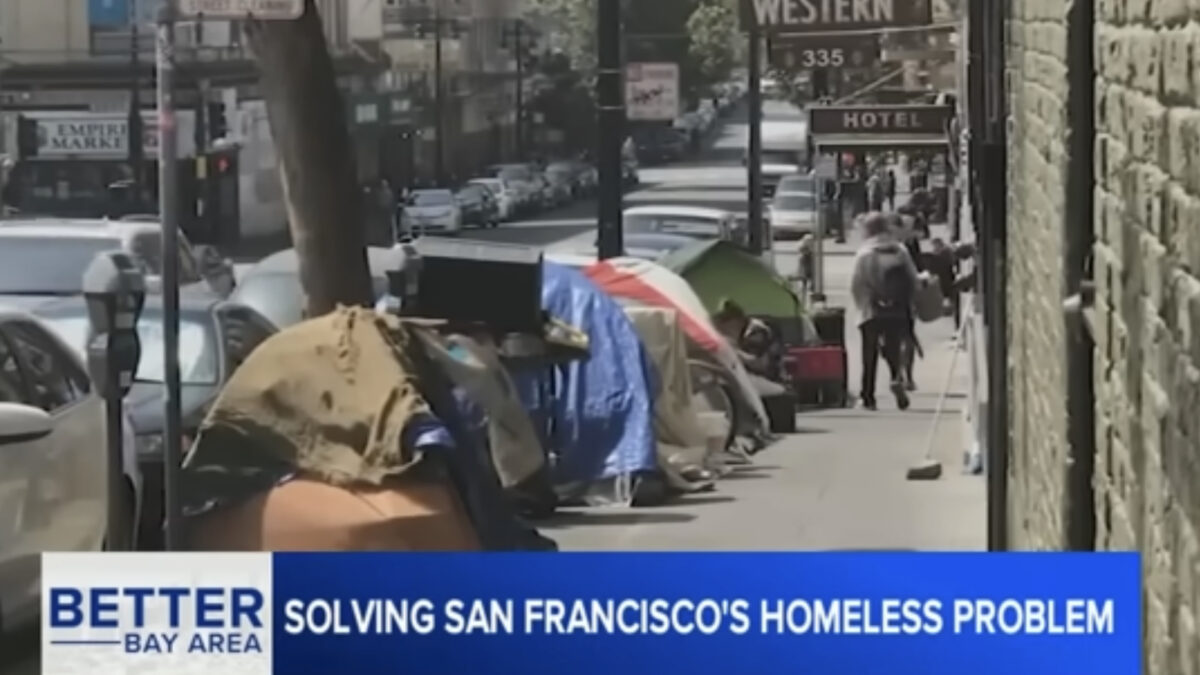

Shocking no one, a grim new report from San Francisco’s civil grand jury concludes that insanely expensive local spending on homelessness is being wasted on failed programs and ineffective nonprofit groups.
“San Francisco spends roughly $700 million annually on homelessness, and its Department of Homelessness and Supportive Housing (‘HSH’) administers nearly $500 million on nonprofit contracts to deliver services each year, yet this system has gaps that jeopardize safety, accountability, and results,” the report says.
The most recent count from the city puts San Francisco’s homeless population in the neighborhood of 8,000 people on a typical night, though that number is much lower than the estimate of people who are homeless at some point during the year and eligible for city homeless services. A 2025 city report draws the distinction between numbers like this:
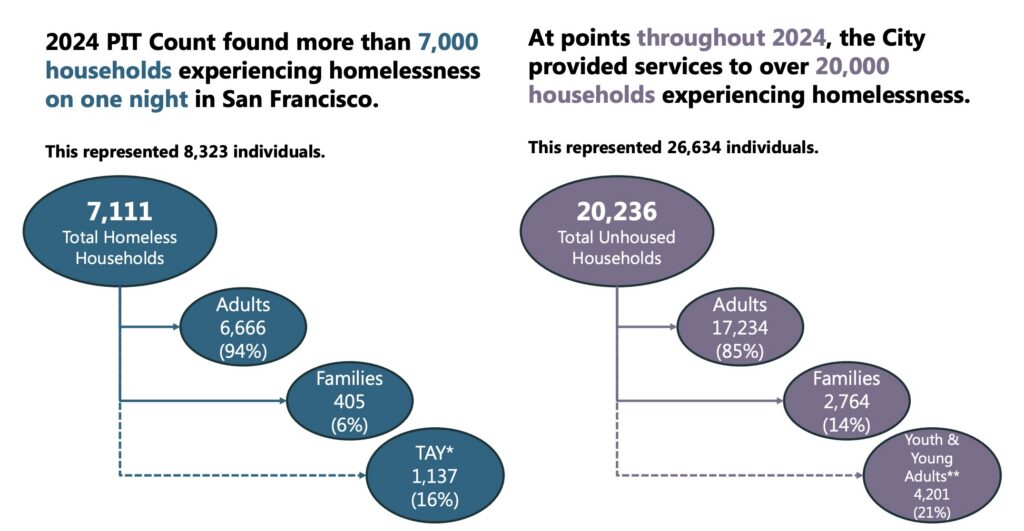
You can do the math either way: $700 million to support about 8,000 people who are homeless on any given night, or $700 million to support a varying population that slips in and out of homelessness and adds up to about 27,000 people. It’s a lot of money either way, but it’s a little over $87,000 per person if you take the point-in-time count of around 8,000. (Recent news reports on the city’s claims that its homeless count just hit the lowest level in fifteen years are mostly a word game about “unsheltered” homelessness.)
Taking the higher number, the grand jury finds the heart of the problem by identifying the service model: “HSH was created in 2016 to bring unity and simplified accountability to the City’s homelessness programs, and it now serves roughly 27,000 people per year with a nearly 100% outsourced model through a network of nonprofit service providers.”
The money is public, but the service providers are private non-profit corporations. A local government spends hundreds of millions of dollars on the homeless through a giant network of NGOs, and no one is really watching them. As the grand jury describes the city’s homelessness agency, underselling the point, “its functional oversight is weak.”
Government accountants do “desk audits,” seeing if the numbers on reports add up, but far less attention falls on the things that happen on the streets and in the shelters. “Historically, the City’s oversight mechanisms emphasized fiscal compliance and fell short on programmatic measures,” the grand jury says.
Programmatic measures: How much of the stuff they’re supposed to do that they actually do.
To understand what that means in practice, consider the death of Eric McCain. An alcoholic with a history of homelessness, McCain was receiving shelter in a city-funded, nonprofit-operated supportive housing facility that required contractors to regularly check on vulnerable clients who were supposed to be transitioning out of homelessness and addiction. But when firefighters found McCain’s body inside his apartment, it was already in a state of significant decomposition. Records showed that staff at the facility had last checked on him twelve days earlier.
As a local news story would report, the operator of the supportive housing facility received a “corrective action letter” from city officials over the death, warning the nonprofit to check on its clients.
McCain’s death was something close to the local normal. In fact, the grand jury charges, permanent supportive housing facilities are the place addicts go to die. “Roughly 25% of drug overdose deaths in San Francisco occur in PSH sites — which house only 1.5% of the city’s population.”
That high risk of death in supportive housing facilities is happening in the face of another problem with homelessness, a crisis inside a crisis: What the grand jury identifies as “increasing levels of acuity among the homelessness population.” Prolonged homelessness is leading to higher rates of physical and mental illness, and to higher rates of addiction. The longer it goes on, the worse it gets.
Finally, finding a structural trap, a section of the grand jury report appears under this heading: “Rise of Homeless Nonprofits: ‘Too Big to Fail’ Now?” That section examines the growth of individual NGOs and their growing share of public funding. Here’s the grand jury’s observations about a single NGO, Urban Alchemy:
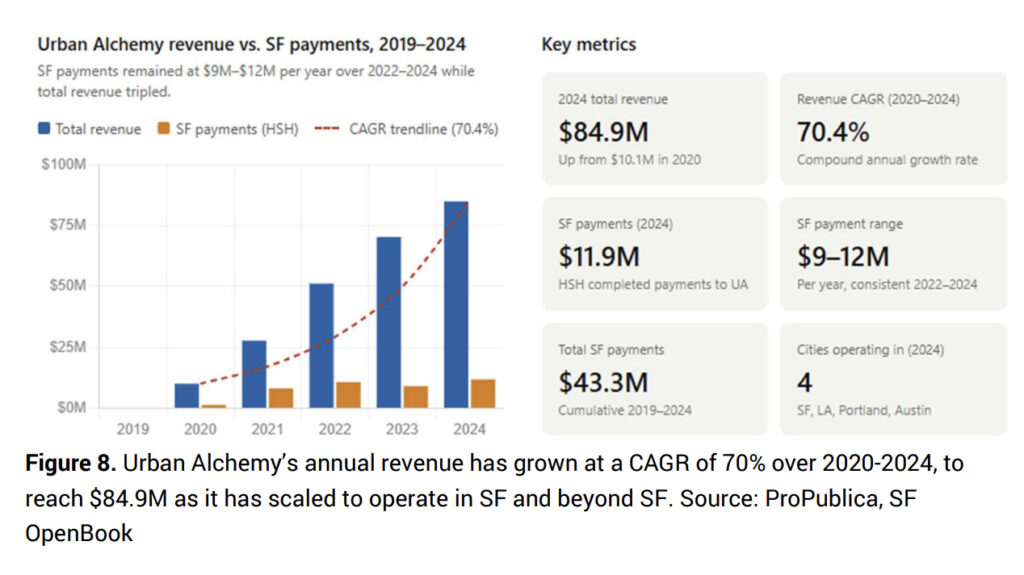
A nonprofit that was founded in 2018 had no city revenue in 2019, then saw explosive revenue growth as the city pushed more and more responsibility to a new organization.
Urban Alchemy tells the same story about itself: “Beginning in San Francisco and Los Angeles providing street cleaning, public restroom monitoring and activating public spaces, today we have grown into a thriving social enterprise with over 1,300 Practitioners (staff) and operations in California, Oregon, Texas, and Alabama.” They’re a growth business, and they mean to be.
What that rapid growth means, the grand jury warns, is that the city has become dependent on its increasingly important homeless service NGOs. To shut them down would be to suddenly have a giant dependent population but no one to deal with them. “The scale, scope, and operational footprint of these multifaceted nonprofits increasingly make them difficult to replace in the short term without significant disruption to services,” the grand jury concludes.
Homelessness grows, the homeless decline into increasing dysfunction, the NGO-focused system that keeps growing to address the crisis increasingly can’t address it, but that system also can’t be replaced.
The population of San Francisco is a little over 800,000 people. With a consolidated city-county government, it spends $17 billion a year. Another consolidated city-county government, Indianapolis, has a slightly larger population, around 900,000 people. It spends $1.7 billion a year. Yes, there’s a decimal point in the middle of that second number.
The blue model is a bonfire: for lives, for value, for money. It doesn’t work, but it spends a fortune to fail. And America can’t allow itself to become California.