
California’s elections are quite the spectacle.
Over the past decade, California has adopted a litany of changes to its state election code justified by the big lie of voter access. It has eliminated guardrails that were established over the 20th century to protect voters (particularly the most vulnerable) from political operatives and well-funded campaigns to steal and manipulate ballots, voters, and votes. This had led to election results that are not trustworthy or reliably accurate.
Since 2020, my work as an election lawyer has been focused on election systems: how to ensure voter access with proper safeguards so that no voter, group of voters, or politically powerful incumbents or operatives can manipulate the election system or its outcomes.
The Election Integrity Network I founded in 2021 consists of hundreds of citizen volunteers across the country who have tirelessly engaged in the election processes in their states and communities and become experts in every facet of that process.
With their input and expertise, last month the Election Integrity Network published the Model Election Laws Handbook. An election system grounded in the laws outlined in the handbook will provide not only voter access but more importantly, control by the voters — not the political class — of election outcomes.
California’s election laws and, indeed, its entire system are the exact opposite of every model law in the handbook. The handbook outlines a system in which there is authentication of every step in the election process: authentication of voters, authentication of ballots, and authentication of counts.
Authentication of Voters
Start with voter registration. The handbook proposes that every person’s identity, citizenship, state residency, legally compliant address, and other eligibility factors be verified before being added to the rolls. California law requires none of that. Since 2018, anyone interacting with the Department of Motor Vehicles and other state agencies is automatically added to the voter rolls.
Same-day registration coupled with legalized ballot harvesting produced the recent scenes of homeless people in Los Angeles who have told stories of strangers bringing and collecting voter registrations and ballots to their tents and paying them a few bucks to register and “vote” as they were told.
California voter rolls are hardly a model of accuracy. Public Interest Legal Foundation analyzed California’s voter rolls last year and found approximately 94,500 deceased, 57,700 registered in other states, 7,700 with placeholder/fictitious birthdates, and thousands of same-address duplicates.
Authentication of Ballots
California sends ballots to every active registration on the problematic voter rolls. Verification is ostensibly a signature matched to a registration record, but stories abound about what election officials are known to accept instead of a matching signature: Happy faces? Squiggles? Fine.
The handbook would end no-excuse vote by mail and require a verified application for an absentee ballot. Validation of each application and returned ballot would be through a unique voter identifier (pre-printed QR code or voter number) that can be linked to one specific registered voter. No more smiley faces or squiggles.
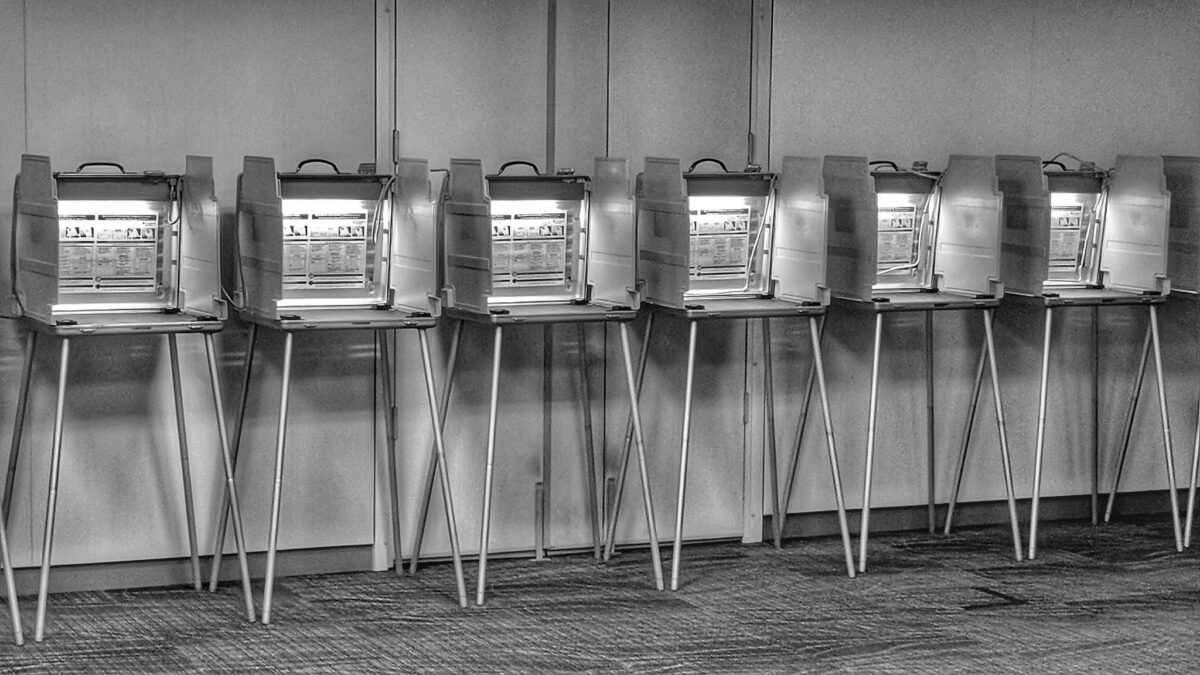
The best authentication is in-person voting on hand-marked ballots, pre-printed on secure paper, at precincts near voter residences.
Authentication of Counts
Authenticating the count requires chain of custody for every ballot through precinct tabulation after the polls close on Election Day, with all ballots received by that deadline to be counted. The number of voters who voted at the precinct should match the number of ballots issued and any differences should be reconciled immediately, at the precinct.
Reconciliation, as described in the handbook, is fundamental to ensuring accurate results, something not realistic or feasible under California’s jumbled process, where ballots arrive from myriad sources unrelated and generally unrelatable to specific voters.
Voter Access and Integrity
The handbook must be on the right track, as pro-corrupt elections champion Marc Elias has attacked it repeatedly. He claims without evidence that “Cleta Mitchell’s election denial network releases new blueprint to severely restrict voting.” Placing at least some modicum of responsibility on each voter is not “anti-voting.” Rather, it ensures all voters remain in control of accurate and trustworthy outcomes.
Voter access must always be balanced with measures protecting the integrity of the process. The purpose of the handbook is to serve as a guide for accomplishing that dual purpose.
The Declaration of Independence says that “governments derive their just powers from the consent of the governed.” As the governed, voters give — or withdraw — their consent through elections they control. That consent is undermined when elections become performative exercises with outcomes shaped in advance by government leaders, rather than determined by the voters.
Our ballots — and our votes — are the legal tender of our constitutional republic. Like currency in circulation, ballots must be tracked and scrutinized from start to finish. Because votes are essential to self-government, they must be safeguarded at every step.
Either voters control the system through properly authenticated voters, ballots, and results, or elections become hollow exercises and no real authority is vested in the electorate.
The handbook provides a cure to the maladies in America’s election systems created over many years by a vast network of Democrat politicians and operatives, leftist nonprofits, and billionaire donors and foundation.
As we approach America’s 250th birthday, it is imperative that we restore integrity and trust in our elections and reject the California vision of elections that last for weeks after the polls close, where the political insiders predetermine the outcomes, and the “consent of the governed” is non-existent.
California shows us what we as a nation must avoid if we want to ensure the survival of our republic for the next 250 years.