

Congress often appears to function via the mantra of “one step forward, four steps back.” Even when policymakers take action — as in recent steps to fight fraud in government programs — they continue to ignore bigger issues with entitlement spending.
The annual release of the Medicare trustees’ report illustrates the problem. This year’s report showed that, by the end of last year at least, the administration’s anti-fraud efforts had not delayed the program’s (technical) insolvency date. Meanwhile, another year passed without lawmakers acting to fix a program that has been functionally insolvent for years.
Contributing to Deficits
Other observers noted that the trustees’ report release provides an opportunity to reinforce how Social Security and Medicare are exacerbating our nation’s deficit problems. At a time when the federal government faces annual deficits approaching $2 trillion, these programs will appreciably worsen the problems Washington faces in the coming decades.
Despite talk of trust funds that cover Social Security and Medicare’s costs, those trust funds contain no resources in the form of hard currency such as gold — just a series of paper IOUs from one part of the government (the Treasury) to another (the trust funds). Because the trust funds have no fixed assets, these programs effectively operate on a “pay-as-you-go” basis, with current workers paying for past retirees’ benefits. And the retirement of the Baby Boomers means the number of the former will shrink, while the number of the latter continues to rise.
To think of it another way: Social Security and Medicare accumulated sizable surpluses during the 1980s, 1990s, and 2000s, which Washington turned around and spent on things like the 1980s defense buildup, a series of tax cuts, the post-9/11 conflicts, and much else. Now that the bill is coming due, the added costs associated with the Baby Boomers’ retirement mean that Social Security and Medicare will add to our fiscal woes.
According to the trustees’ report, the Social Security and Medicare trust funds incurred a net of over $132 billion in losses in 2025 — losses that will only grow in future years. Moreover, these numbers understate the scale of our entitlement deficits.
Functional Insolvency
I have written previously that Medicare is functionally insolvent and has been for nearly a decade, all due to Obamacare and the vagaries of trust fund accounting. As part of the 2010 law, which raised taxes and lowered Medicare spending, Democrats used those savings both to 1) extend the life of the Medicare trust fund and 2) pay for Obamacare.
But any rational person knows you can’t spend the same money twice — at least not without ending up in jail. That’s why Medicare is functionally insolvent and has been since roughly 2017. In 2009, before Obamacare passed, the Medicare trustees’ report pinned Medicare’s insolvency date at 2017.
By any honest accounting — one that sees Obamacare savings pay for Obamacare rather than spending the same money twice — Medicare’s Hospital Insurance Trust Fund should have reached insolvency long ago. (While a separate trust fund covers outpatient physician and prescription drug spending for Medicare, those programs are funded with general revenue, meaning they cannot become insolvent on their own.) Likewise, the slight surpluses the Hospital Insurance Trust Fund ran from 2021-25 would have shown as major losses under more transparent accounting procedures that eschew Obamacare’s double-counting scheme.
Effects of Biden Blowout
Other bad news lurked elsewhere within the trustees’ report. I previously noted in these pages how, last fall, the Congressional Budget Office (CBO) increased the 10-year projections for the cost of the Part D prescription drug benefit by half a trillion dollars. The trustees’ report echoes that conclusion, with a chart showing how much projected spending on Part D has increased just in comparison to last year’s report:
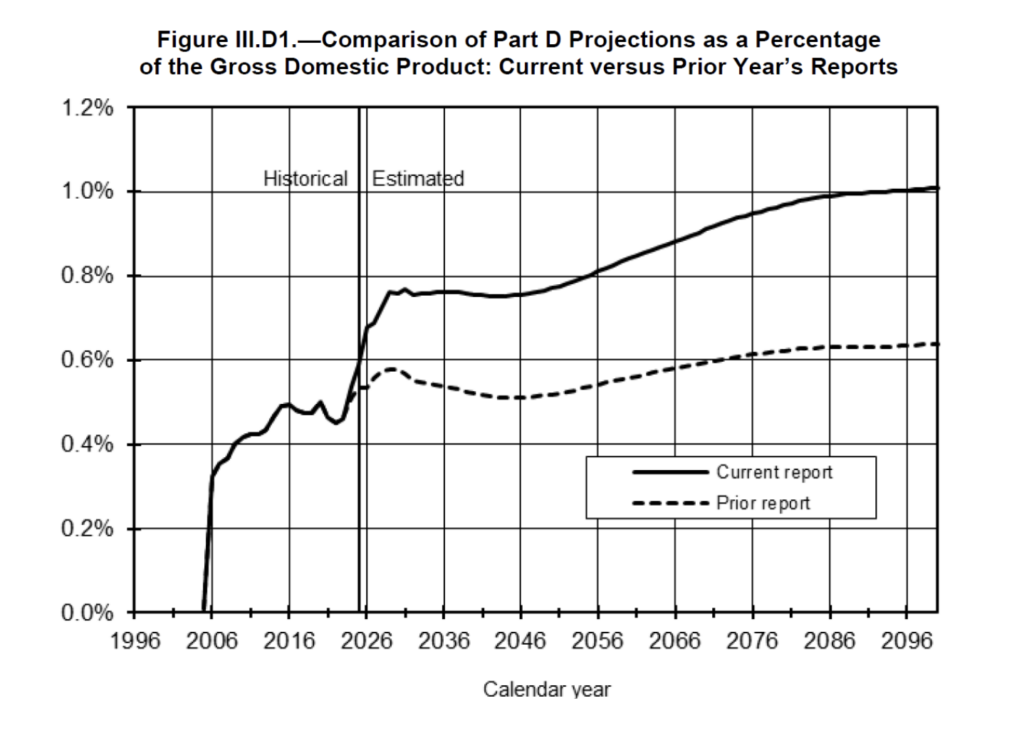
As with CBO, the actuaries who compile the trustees’ report attributed the change to several developments: growth in the utilization of GLP-1 drugs and changes in demographics — namely, lower fertility rates — that result in lower GDP projections and therefore increase Part D spending as a percentage of GDP.
But the report’s reference to “higher cost trends” also provides a reference to the restructuring of the Part D benefit that the Biden administration and congressional Democrats undertook in the 2022 Inflation (Reduction) Act (IRA), which only came into full effect last year. CBO and the Medicare Payment Advisory Commission both previously suggested that the IRA restructuring, by giving seniors an incentive to consume additional “free” (or lower-cost) drugs, has driven up Part D costs and government spending. Now the Medicare actuary’s office has added its voice to support that theory via the trustees’ report.
This finding should provide additional evidence, as if lawmakers needed more, for Congress to act to make Medicare sustainable for the long term. Every day and every year that lawmakers do not act will only make the day of reckoning worse when it finally arrives.