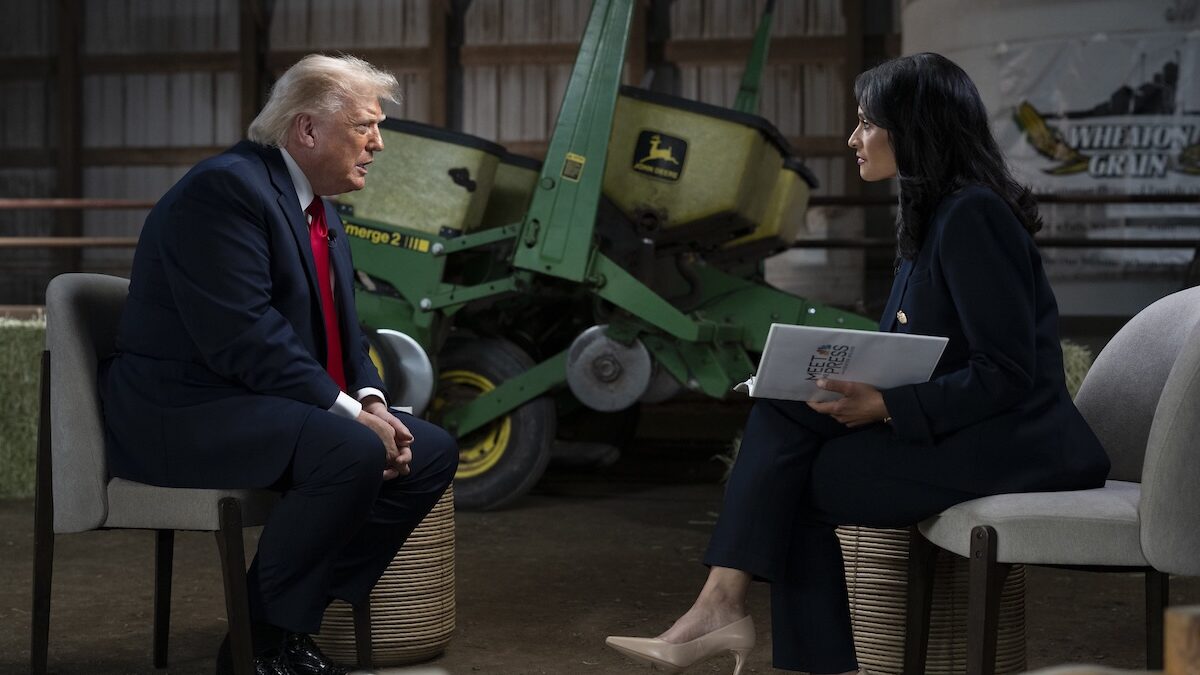
Fox News hosted President Trump on Thursday to talk about the progress of the war in Iran, and he did the usual, which is to say he declared the war effectively complete, while at the same time acknowledging that it’s actually still ongoing. And then he dumped all over the admittedly fallacious news media for its war reporting, saying that for Iran, “The only thing they have is fake news,” which he accused of doing Tehran’s “publicity.”
Here’s the problem with that: A lot of us who are rooting for a successful end to this conflict aren’t so upset with the media. We know how they operate. What’s frustrating us to the point of furious tears are the wildly inconsistent, contradictory and otherwise obviously untrue statements Trump is making about the war on a near-daily basis.
Literally since the start of the war, the president has said it’s over; that it’s still going; that we’re close to a deal with Iran; that Iran isn’t really trying to make a deal; that Iran really wants a deal; that Iran needs to open the Hormuz Strait; that the Hormuz Strait would be open in short order; that we control the strait; that the U.S. wants help from other allies; that the U.S. doesn’t need help from any allies; that Iran must unconditionally surrender; that a deal might not include unconditional surrender; that regime change is a requirement to end the war; that the war might very well end with the existing regime.
Here are just a few of Trump’s real-life, whiplashing inducing declarations on the war since early March, in reverse chronological order:
“[I] have, as President of the United States of America, cancelled the scheduled strikes and bombings against Iran this evening.”— June 11
“The United States will be hitting Iran … VERY HARD TONIGHT.”— June 11, same day
“[T]he UNITED STATES of AMERICA CONTROLS the Strait of Hormuz — NOT Iran.”— June 10
“They’ve taken too long to negotiate a deal that would have been great for them, now they will have to pay the price!!!”— June 10
“Final aspects and details of the Deal are currently being discussed, and will be announced shortly.”— May 23
“Open the F-ckin’ Strait, you crazy bastards …”— April 5
“We’ll be leaving very soon.”— March 31
“They are ‘begging’ us to make a deal …”— March 26
“[Iran] is totally defeated and wants a deal …”— March 13 (Almost two full months after this statement, Trump said Iran shot down a U.S. Army helicopter on June 8.)
“I think the war is very complete, pretty much.”— March 9
“There will be no deal with Iran except UNCONDITIONAL SURRENDER!”— March 6
It’s war with a formidable nation. If that was the route Trump wanted to take, with Israel nudging him along, he owed it to Americans to honestly set our expectations and manage them as events evolved. He’s not doing that. To the contrary, the president has used his public appearances to say opposite things at once, apparently for the purpose of keeping oil prices lower than they otherwise might be and disorienting Iran’s leadership, whoever that may be at any given moment. It may have been useful in buying Trump more time to figure out a way to bring the war to an end, but it has also flummoxed and irritated American voters, who are gearing up to render their judgement on this operation in just a few short months in the midterm elections.
The average price of gas is up more than 30 percent from this time last year, and inflation has spiked, wiping out any pay raises Americans have worked hard for. These circumstances are only made worse when the president continues to string the public along, leaving everyone in the dark about what’s happening and what to expect in the near future.
If there isn’t a promising deal forming, with clear buy-in from the Iranians, he shouldn’t say there is. If the Hormuz Strait is still being held hostage, he should admit it. If Iran’s military is functional enough to remain a threat, Trump is lying when he says it’s “obliterated.”
It’s too late to pretend that this can still be a splendid little war that ends cleanly. Iran has proven resilient and that it’s far more creative than the American administration appears to have anticipated. Trump can start leveling with the public now, and maybe this unpopular war will be less of a liability for his party in November.