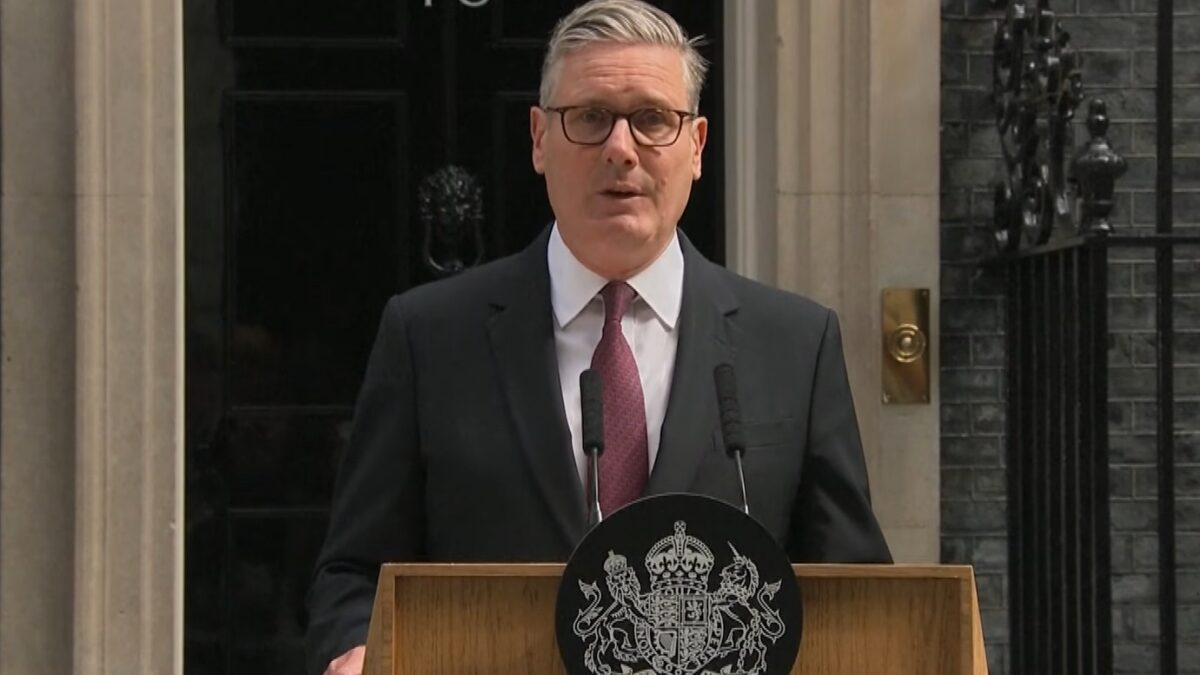
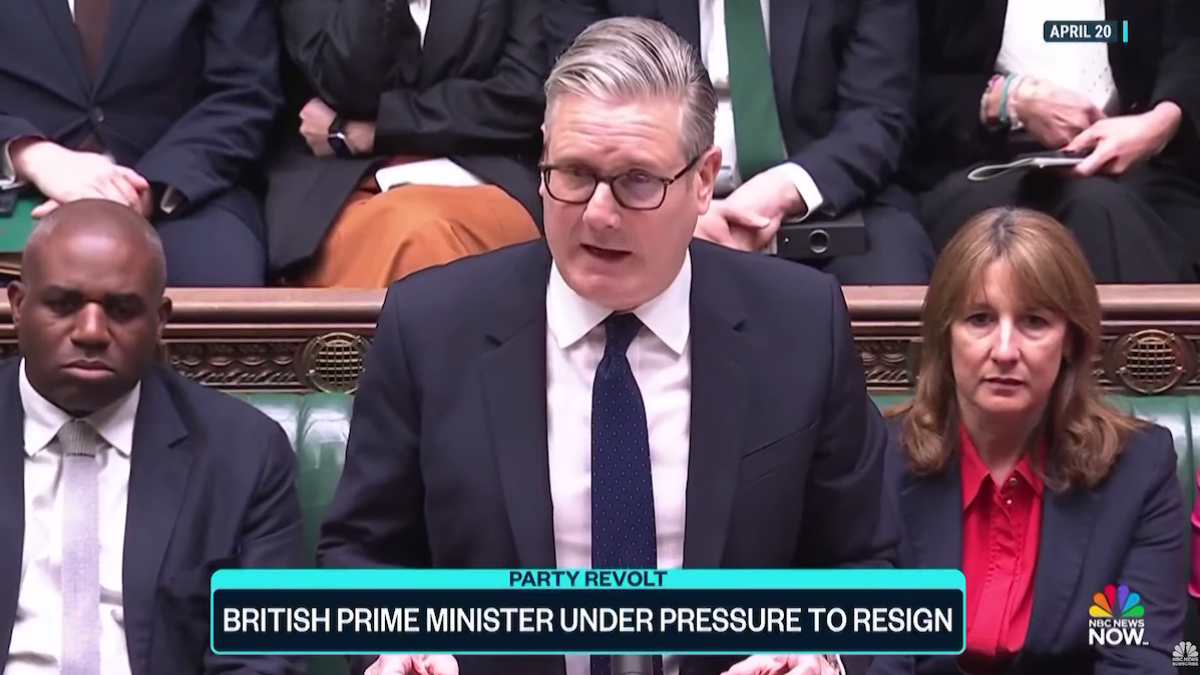

Last week in Britain the ruling Labour Party suffered historic losses in local elections held across the country, while the right populist Reform UK won an astounding 1,400 seats. Reform leader Nigel Farage called it a “truly historic shift in British politics.” Labour, led by the increasingly unpopular Prime Minister Kier Starmer, lost 1,300 councilors, triggering calls for Starmer’s resignation from Labour MPs and unions. In Scotland and Wales, pro-independence nationalist parties made gains at the expense of both Labour and Conservatives.
Because these were municipal and not parliamentary elections, Labour remains in power — and Starmer has vowed to remain in office and not “plunge the country into chaos” despite the pressure for him to step aside. But the election results leave little doubt what polls have consistently shown: Britons are rejecting the establishment parties, Labour and Conservatives, in favor of upstart parties like Reform, the Green Party, Liberal Democrats — as well as a growing number of independent Islamopopulist politicians. Labour is likely facing a wipeout in the 2028 parliamentary elections, and Reform, by far the most popular party in Britain, might well win an outright majority.
It would be easy to look at these results and conclude that they amount to a resounding rebuke of globalist left-wing politics embodied by leaders like Starmer and other fixtures of the European establishment, and that a populist victory by Farage and Reform will rescue Britain and pull her out of what seems to be the impending collapse of civil society.
But that’s the wrong lesson to take away. What’s happening in Britain is the political expression of a loss of social cohesion and the first signs of brewing civil conflict along ethnic nationalist and post-nationalist lines. Broadly speaking, the rejection of the establishment parties by British voters signals a deeper loss of confidence in the political process in Britain and the legitimacy of the British political elite.
On a more granular level, the elections produced major Reform gains in working-class areas of northern Britain and the Midlands. Voters in these places rejected the establishment parties responsible for mass immigration and the demographic and cultural upheaval that forced multiculturalism has brought to Britain in a relatively short period of time. Stated bluntly, disaffected ethnic English voters are turning to Reform as a vehicle for their discontent. This isn’t just happening in rural and suburban areas that once voted Conservative, but also in post-industrial cities that were once Labour strongholds.
In elevating Reform, voters are shattering the old right-left political divide in much the same way that Trump’s winning coalition has in the United States. But Britain is a smaller and less ethnically diverse society than the U.S., and so the breakdown of traditional right-left politics represents a volatility that points beyond mere political realignment and toward something darker: the real possibility of civil war.
David Betz, a professor of war studies at King’s College London, has been warning about the prospect of civil war in Britain for years now. He is part of a small but vocal cadre of academics who have spent their careers studying civil conflicts and asymmetric warfare in other countries. They argue that the dynamics and ingredients for civil war they have studied overseas are increasingly visible in British society — namely, an underlying instability brought on by the refusal of the ruling elite to respond to the legitimate concerns of the native population, especially on matters of immigration and cultural cohesion.
The elections last week only confirm this assessment, writes Betz, who warns the gains of Reform should not be interpreted as a workable corrective to the problem besetting British society: “Electoral mobilisation by the disaffected is an early symptom, not a cure because the structural drivers (mass migration, elite refusal to acknowledge cultural incompatibility, economic/cultural decline) are too deeply embedded for conventional politics to fix them. If Reform wins seats but cannot deliver meaningful change — or if mainstream parties double down — the pressures will only intensify, which is what I continue to expect.”
There is good reason to suspect that Reform under Farage’s leadership will not, in fact, be able or willing to deliver meaningful change in the face of an intransigent establishment and a deeply entrenched civil service (Britain’s deep state makes our own looks like kid’s play).
What’s more, pressures are also intensifying on a completely different electoral front, in the form of gains for the far-left Green Party and a growing number of independent Muslim candidates. This latter group is important, if still small, because it represents the further fracturing of British society along explicitly ethnic and religious fault lines that, until now, had been largely hidden by the absorption of the “Muslim vote” by the Labour and Green parties. In parts of East London, Birmingham, East Lancashire and West Yorkshire, independent candidates who are best described as Islamopopulist won municipal seats in areas with significant Muslim populations.
Previously, there had been a few dozen such local politicians in the entire country, as well as just four independent Muslim MPs, elected in 2024 on more or less a pro-Hamas platform after October 7. Last week, British Muslims elected more than 100 independent Muslim municipal candidates, marking the definitive emergence of a Muslim bloc in Britain — a bloc motivated primarily by Gaza and the Palestinian cause, as well as the furtherance of specifically Muslim interests in Britain.
Paul Stott, Head of Security and Extremism for Policy Exchange, a British think tank, said the rise of a Muslim bloc in Britain is the result of “an activist led 25-year plan to develop a bloc of Muslim politicians, whom its adherents believe may hold the balance of power after a future general election.”
“Islamopopulism combines international, national, local and at times personal issues in a cocktail that is proving increasingly palatable to Muslim voters,” writes Stott. “At the top sits support for the Muslim ummah (the global community of Muslims) and in particular the Palestinian cause, followed by a robust rejection of the Labour party and Prime Minister Starmer.”
What Britain is facing, in other words, is the dissolution of its establishment parties and the traditional right-left politics they represented, and the emergence of a politics based explicitly on ethnic and religious identity. Ethnic English flocking to Reform on one side, Muslims organizing their own political bloc on the other, allied (for now) with leftists and globalists in the Labour and Green parties.
So much for Britain, our mother country. But why should Americans, especially those of a MAGA/America First disposition, care about British politics? Because the same dynamic is playing out here, even if we aren’t as far along as our cousins across the pond. The inability of our political establishment to respond to legitimate concerns of the electorate is more or less exactly what we see in British politics. So is the emergence of identity politics as a mainstream phenomenon that crosses the right-left divide.
Witness the Democrats’ insane reaction this past week to losing an electoral redistricting battle at the Virginia Supreme Court. Denied the ability to gerrymander racially-defined districts, Democrat Party leaders are now talking openly of packing the state supreme court, the U.S. Supreme Court, and gutting the federal judiciary the moment they have the power to do so. They are willing, in other words, to gut Article III of the U.S. Constitution just so they can create congressional districts that appeal to voters solely on the basis of racial and ethnic identity.
This is not the kind of politics you see in a healthy society. It’s what you see in a society in crisis — one that’s losing social cohesion and heading, slowly but inevitably, toward civil war.