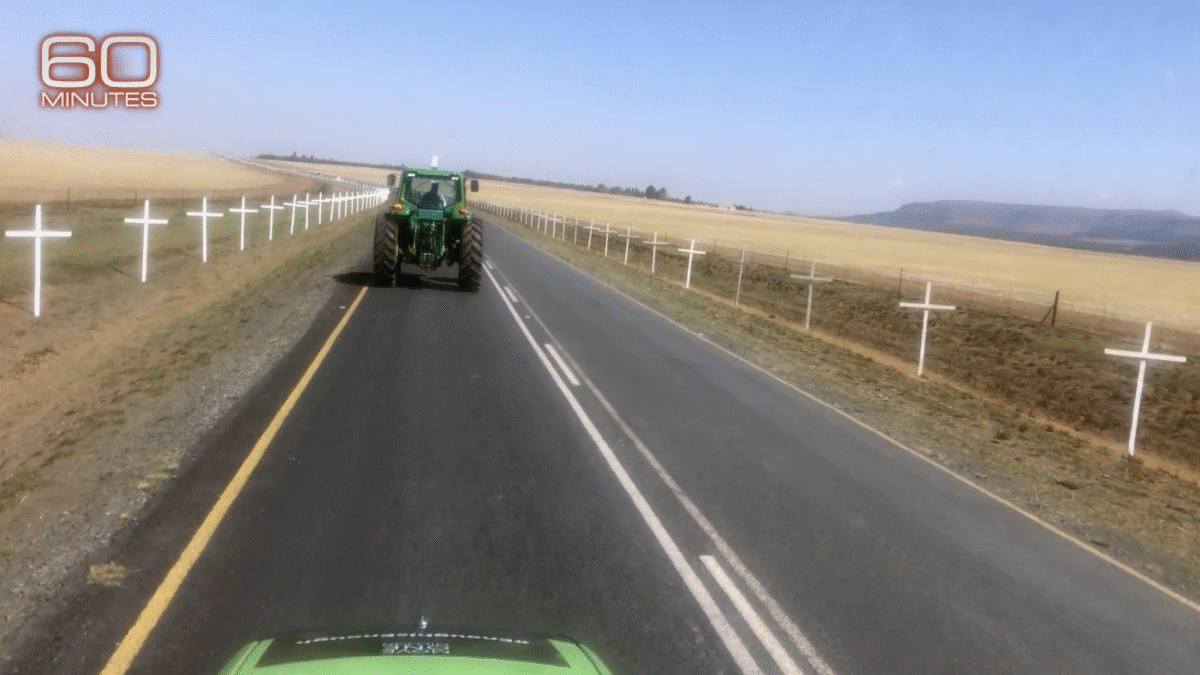

In the latest airing of 60 Minutes, Anderson Cooper delivered what may be one of the most spectacular media self-owns in recent years. The segment was constructed around a single objective: dismantling President Trump’s claim that more than 1,000 white South African farmers were buried along a rural road marked by white crosses. Trump had shown footage of those crosses during the May 2025 White House visit of Cyril Ramaphosa, arguing that the scale of killings targeting white farmers was so severe that it warranted international attention and, in his view, amounted to genocide.
For the segment, Cooper traveled to South Africa intent on puncturing that image. He returned viewers to the same stretch of road where the crosses once stood and noted that they were no longer there. He tracked down the farmer who had erected them and established that the crosses were temporary memorials rather than literal burial sites. The report leans heavily on this distinction, presenting it as a decisive correction that rendered Trump’s claim false.
Yet as the segment unfolds, that conclusion quickly collapses under the weight of Cooper’s own reporting. The same farmer who explained that the crosses were memorials goes on to recount how his father was brutally attacked and how three of his closest friends were murdered on their farms. These were not distant acquaintances or abstract statistics — they were friends and fellow farmers whose loss he had experienced firsthand. How many viewers could name even a single friend who had been brutally murdered, let alone three, all in the same line of work? The testimony was immediate, tangible, and devastating, and it completely undermined Cooper’s attempt to reduce the issue to a semantic debate over crosses versus graves or the precise meaning of the word genocide.
The segment continued with an interview of the wife of one of the murdered farmers, who had witnessed her husband’s killing. Cooper quickly shifted attention to the son who now runs the farm, as if that could somehow diminish the horror of what had occurred. To cap it all, he callously pressed the widow to say she did not consider the murders genocide, reducing her trauma to fodder for more “Get Trump” footage.
The killings of white farmers are neither a new nor a fringe concern, though Cooper never mentions it. In 1998, Nelson Mandela gave a full speech condemning the “cold-blooded killings that have been taking place on the farms in the past few years,” and noting that while farm crime had existed before, incidents of murder and assault had “increased dramatically in recent years.”
More striking still is that the segment completely ignores the historical context that makes these attacks politically and culturally charged. Not that viewers would know it from 60 Minutes, but the farming group in South Africa is anything but an incidental demographic. The Boers, which means “farmers” in Afrikaans and Dutch, were the original European settlers who arrived at the Cape in the seventeenth century, not as colonizers but as farmers working for the Dutch East India Company, which needed a reliable food supply for its ships passing by on voyages between Europe and the Dutch East Indies.
These settlers later moved inland, establishing much of the agricultural foundation of what would become modern South Africa. Over time, the term “Boer” came to refer more broadly to Afrikaners, the Afrikaans-speaking descendants of those settlers who developed a distinct language, culture, and political identity rooted in farming. Farming, Afrikaner identity, and the country’s origins are deeply intertwined, and understanding that history is essential to making sense of the attacks on this group.
Even the notorious “Kill the Boer” chant, pushed by some South African politicians and noted by Trump, takes on real significance only when understood against this historical backdrop. By ignoring all of this, Cooper reduces the issue to random crime so he can focus on a semantic quibble over whether the white crosses were actually graves.
Groups that track crime against farmers continue to report staggering figures. By conservative estimates, the total number of white farmers murdered since the official end of apartheid in 1994 runs into the several thousands. A 2010 report in the London Times already noted more than 3,000 murders. AfriForum, a group that emerged from a trade union and represents Afrikaner interests, records roughly one farm attack per day. The precise figures can be debated, but the sheer scale and persistence of this brutal violence is undeniable, particularly given that there are only a little over 30,000 commercial farmers, most of them white, which puts the murder rate at roughly three times the national average, a fact Cooper never mentions.
In the end, the 60 Minutes report fixates on a semantic issue while conceding the underlying reality. Trump said burial sites, whereas the crosses are memorials. Yet the memorials exist because farmers have been attacked and killed in massive numbers, a reality that Cooper’s own interviews make impossible to ignore. He also quibbles over whether the attacks constitute genocide, though he never defines the term and never addresses the broader historical context of the Boers. Ironically, the more 60 Minutes pushed to show the crosses were not graves, the more it ended up documenting exactly what Trump had claimed.