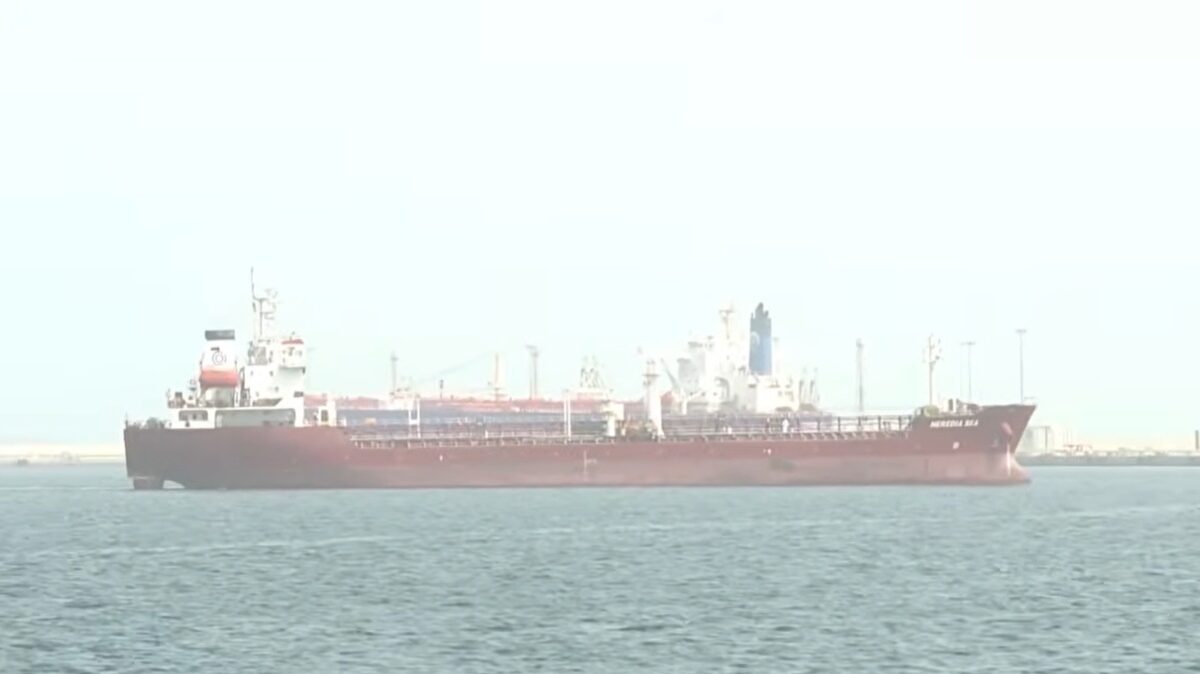

Somewhere in Houston last week, a federal prosecutor dusted off a body of law that hasn’t seen daylight since Teddy Roosevelt charged up San Juan Hill. The Justice Department (DOJ) confirmed it is reviving maritime prize courts to seize the tankers running Iran’s sanctioned oil out from under the Navy’s blockade of the Strait of Hormuz. U.S. Attorney Aaron Reitz, whose Southern District of Texas office is running point, called prize law an ancient body of maritime law already on the books, and for the first time since the Spanish-American War, Washington is putting it back to work.
That’s a fancy phrase for something every kid understood on the playground before we got sophisticated about it. You lose, I keep your stuff. For about 80 years, America treated that idea as vaguely embarrassing. Now, Washington has quietly relearned how winners are supposed to behave.
Here’s what a prize court actually is. It’s a federal district court exercising a specific constitutional authority Congress has held since the founding: the power to decide whether a vessel or cargo captured during an armed conflict can be lawfully condemned, meaning ownership transfers to the United States, which can then sell it and keep the proceeds. The Constitution gives Congress power to “make Rules concerning Captures on Land and Water,” and the Supreme Court confirmed in 1794, in Glass v. The Sloop Betsey, that federal district courts hold that authority directly.
The process runs in three steps. The military captures the vessel. A judge first determines whether the capture was lawful under the law of war. If it was, the court condemns the property and clears title, the same title a buyer needs to actually purchase the oil or the ship at auction. That’s the entire mechanism, and it ran continuously from the Revolutionary War through the Spanish-American War before sitting unused through two world wars and the wars in Korea, Vietnam, and the Gulf.
Iran’s Case
I’ve spent 30 years chasing other people’s money for a living. As a financial services guy who now testifies in federal and state courts as an expert witness on fiduciary duty and asset disputes, I know the difference between a remedy that promises to eventually, maybe, recover an asset, and one that just takes it. Civil forfeiture, the tool DOJ has used against Iranian oil for years, is the first kind. In 2020, the government filed its forfeiture complaint against four tankers carrying Iranian fuel in July, didn’t get a seizure order until mid-August, and needed until October to sell the roughly 1.116 million barrels it recovered. Prize law skips most of that delay and most of the third-party claims that come with it.
The Iran blockade is not theoretical. The war began with strikes on Feb. 28 and has run hot and cold since, through a collapsed ceasefire and a naval blockade the administration says it can sustain indefinitely. Iranian officials describe their own fuel reserves as approaching exhaustion, with lines blocking streets in Tehran and Mashhad. Prize law is the sharper version of that pressure. It moves the oil, and the money, faster than forfeiture ever could.
Venezuelan Oil
You can watch the slower version play out 90 miles from Florida. On Dec. 10, 2025, federal agents boarded the tanker Skipper off Venezuela’s coast, carrying roughly 1.8 million barrels of Venezuelan crude. That case is running through ordinary civil forfeiture, and DOJ didn’t file its complaint to actually claim title until Feb. 27, more than two and a half months after the boarding. Prize law would have moved that cargo to auction in weeks, not months.
A few days ago, the same logic jumped from cargo to the oilfield itself. President Trump announced what he called the biggest oil deal in world history: a hundred-year concession granting a private venture rights to develop 17 Venezuelan oil fields holding 65 billion barrels, with the United States taking an effective 55 percent share of output. The deal follows January’s operation that captured Nicolas Maduro and installed his former vice president, Delcy Rodriguez. Same doctrine the prize courts are reviving, just applied upstream, at the wellhead instead of the tanker.
DOJ’s Revival of Prize Courts
Expect the fight to start the moment a court blesses the first capture. Owners, insurers, and cargo claimants can appear and object, but their arguments run narrower than in a civil forfeiture case, according to Bloomberg Law. The central battle will be over whether a formally recognized armed conflict exists to trigger prize jurisdiction at all, since Congress has not formally declared war on Iran. Expect shipowners and their protection and indemnity insurers to argue their vessels were neutral carriers rather than enemy property, a distinction prize law has litigated since the age of sail. Victims of Iranian terrorism may also file competing claims against the same seized assets, adding a second front over who gets paid first. None of that makes the strategy frivolous. It makes it a fight, the same kind of fight that shows up in any high-stakes asset case I’ve worked as an expert witness, where the underlying claim is sound but the money moves slowly because everyone with a stake in it lawyers up.
None of this requires us to romanticize war or pretend capture is a passive accounting exercise. It requires us to stop pretending that winning should come with an apology attached. The founders wrote prize law into the Constitution because they had just fought a war and understood that an enemy’s ships and cargo, lawfully taken, belong to the country that took them. We spent the back half of the 20th century concerned about optics, and adversaries from Tehran to Caracas noticed our hesitancy. Reviving a 200-year-old statute, and writing a 100-year oil concession while we’re at it, will get fought over in courtrooms for years. That’s fine. It is still America remembering that the rules it wrote for itself already say the quiet part out loud: to the victor go the spoils.