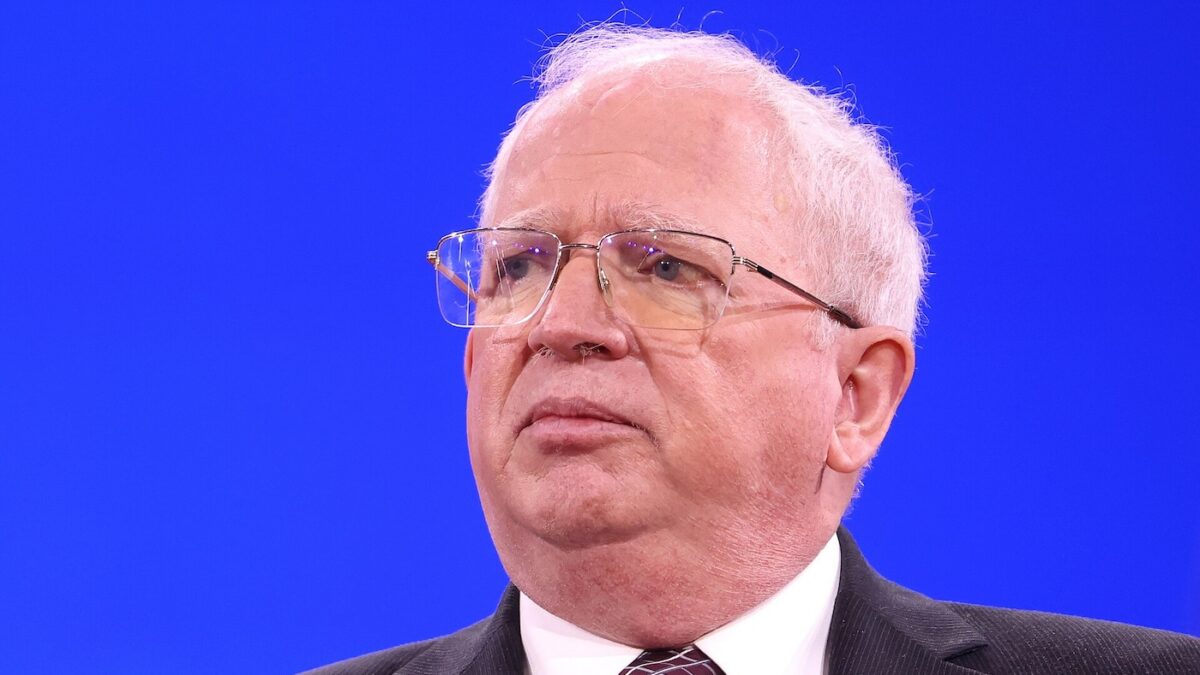

The disbarment of John Eastman represents the logical endpoint of a systematic abuse of legal and administrative processes commonly described as lawfare, a pattern that has been escalating for nearly a decade. What began in 2016 with the targeting of Trump campaign associates, who at least operated within the political arena, has evolved into the professional destruction of a law professor who held no office, ran no campaign, and whose only “offense” was providing a legal opinion on constitutional law.
The modern term “lawfare,” a blend of “law” and “warfare,” was popularized in 2001 by U.S. Air Force Maj. Gen. Charles Dunlap Jr., who defined it as “the use of law as a weapon of war,” specifically the exploitation of legal processes or rules of war to gain military advantage. In the contemporary American context, it increasingly refers to the use of law as a weapon of politics, where those who fail at the ballot box turn to investigations, prosecutions, and professional disciplinary processes to achieve what they cannot win electorally.
Environmental groups pioneered the technique domestically, using regulatory complaints and litigation to obstruct economic activities they could not stop legislatively. But lawfare entered the political arena in earnest during the Trump presidency. The result is an inversion of law, where legal mechanisms are applied not to remedy wrongdoing but to punish association and deter participation.
Russiagate and the Birth of Modern Lawfare
The Russia investigation marked the opening phase. Built on false premises, it ensnared dozens of individuals whose lives and finances were severely damaged, including Michael Flynn, Paul Manafort, Carter Page, George Papadopoulos, and Roger Stone. The stated objective was to investigate President Trump, but the broader effect was to signal that anyone associated with him could be investigated, bankrupted, and publicly destroyed. Lawfare is not limited to its principal target. It operates by raising the cost of association to a prohibitive level.
Others, including innocent bystanders such as Sergei Millian, were drawn into the process and saw their lives disrupted as friends, clients, and associates were investigated and interrogated, often based on completely made-up claims. In several cases, including Page and Millian, the opening of an investigation served primarily as a vehicle for media leaks that generated a self-reinforcing cycle of damaging reporting and speculation. At the same time, FBI attorney Kevin Clinesmith falsified evidence to support surveillance of Page, received probation, and remains in good standing with the bar.
This pattern continued throughout Trump’s first term. The Ukraine impeachment is another prominent example, where mechanisms intended for oversight, specifically a whistleblower process, were repurposed for political ends. Once again, individuals were drawn into sprawling investigative processes, forced to retain counsel, testify, and absorb substantial personal and financial costs. Trump was ultimately acquitted, and the entire narrative collapsed just this week when long-suppressed evidence was finally released after seven years, confirming what critics had argued from the start, that Trump had been set up.
From Impeachment to Disbarment
The 2020 election cycle saw these dynamics intensify further. The handling of information related to Biden family corruption functioned as an extension of the earlier Ukraine narrative. Legal and quasi-legal pressures shaped what could be publicly aired and when.
One particularly stark case involves Andrii Telizhenko, a Ukrainian diplomat who sought to provide information to U.S. Sens. Ron Johnson and Chuck Grassley regarding alleged Ukrainian interference in both the 2016 and 2020 elections, as well as firsthand testimony relating to a White House meeting involving Joe Biden’s efforts to fire the Ukrainian prosecutor investigating Hunter Biden. For this, he was sanctioned through a quasi-judicial process, expelled from the country, and cut off from the financial system, effectively destroying his ability to earn a living, travel, or operate normally. He remains in this position to this day. How many other Ukrainians will come forward after seeing this? None. And that is precisely the point of lawfare.
Under the Biden administration, these dynamics expanded further. Trump himself, along with individuals in his orbit, faced a wave of investigations, prosecutions, and professional sanctions. Lawyers increasingly became targets not for misconduct in representation but for representing or advising a client deeply opposed by the Washington, D.C., establishment and other institutional power centers.
America prides itself on the fact that even a mass murderer on death row gets legal representation because, in a just society, all people have the right to legal advice, no matter how horrific they are. But this elementary principle apparently does not extend to Donald Trump, as a whole series of lawyers associated with him have been targeted, including Rudy Giuliani, who remains disbarred, and Sidney Powell, who valiantly and ultimately successfully won her battle against disbarment. But the stench lingers, as do the astronomical financial, health, and other costs.
Others, including Jeff Clark and Ed Martin, continue to face disbarment proceedings related solely to their roles within government, either advising the president, in the case of Clark, or implementing his policies, in the case of Martin.
Disbarment is among the most severe penalties a lawyer can face, typically reserved for things like fraud or the misappropriation of client funds. But in none of these cases is anything remotely close to that at issue. Instead, it is about providing legal advice or advocacy for a client.
When disbarment becomes a foreseeable consequence of advancing controversial legal theories in politically charged contexts, the effect is to narrow the range of permissible legal thought. Lawyers and scholars may begin to self-censor, not only in whom they represent but in what arguments they are willing to articulate. That chilling effect extends beyond legal representation into public discourse itself.
John Eastman’s case represents the culmination of this trajectory, precisely because he was not a political operative or officeholder. That distinction should not be dispositive in principle, but it underscores the shift in practice. He is a constitutional law scholar who provided legal analysis regarding the Electoral College process and the constitutional role of the vice president. Whether one agrees with that analysis is secondary to the principle at stake: Lawyers and legal scholars routinely advance contested interpretations of law. The expectation is that such arguments are answered through debate, not professional exclusion.
Find John Eastman’s legal defense fund here.