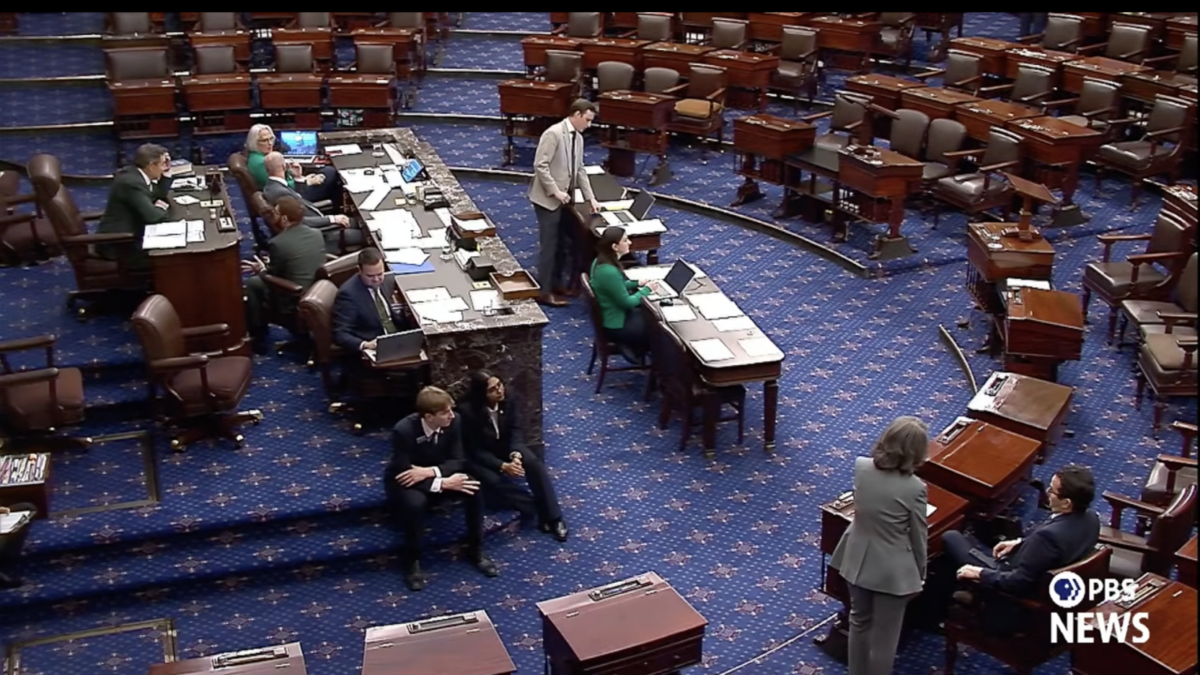

Tennessee Republicans watered down a bill that was initially designed to let public schools deny enrollment to illegal aliens, instead passing a version on Monday that lets schools ask for proof of legal presence but has no enforcement mechanism.
Passed in a 70-25 vote, the substituted version of SB 836 requires “each [Local Education Agency] LEA and public charter school require all school-age students enrolled in the LEA or public charter school, or who seek to register or enroll in the LEA or public charter school, to produce documentation” establishing that the student is a U.S. citizen, is “in the process of obtaining” citizenship, holds a “valid” legal immigration status, or is “subject to pending immigration proceedings in which a final order of removal has not been issued.”
The bill would require LEAs and public charter schools to report data, including the number of students who failed to provide documentation and the reason why, to the Tennessee Department of Education. The department would then compile and distribute it to other state agencies and offices. The reports “must not include any personally identifiable information for a student or a student’s parent,” however.
The measure will now go to the Senate for further consideration.
The House-passed version of SB 836 is noticeably weaker than the original version of the bill. As The Federalist previously reported, the measure (and its companion, HB 793) initially authorized LEAs and public charter schools “to refuse to enroll students who are unlawfully present in the United States.”
For example, the version of the legislation passed by the Senate last year permitted public schools to “elect not to enroll [a] student without the student or the parent or guardian of the student paying tuition” if that student or their guardian “is unable to provide such documentation, and has exhausted all available appeals.” In situations in which these institutions “determine[] that the documentation provided by a student or a student’s parent or guardian does not establish that the student meets one of the criteria in [the bill] and that the student is not eligible to enroll in the LEA or a public charter school without paying tuition,” the schools may also “refuse to enroll [a] student if tuition is not paid.”
Such enforcement provisions were not included in the measure passed by the House on Monday. What’s more, the newly-passed House version seems to protect public schools that enroll students who do not produce documentation, clarifying that such a decision does not classify a school as implementing “sanctuary” policies.
While the stronger version SB 836 passed the Senate last year, the measure and its House counterpart stalled in the lower chamber amid concerns about potential repercussions the bills could have on federal education funding to Tennessee. According to left-wing NPR, the state sent a letter at the request of Majority Leader and HB 793 sponsor William Lamberth to the Education Department, “asking how much of the potential $1.1 billion in federal funding” the legislation would put at risk.
Despite indicating “earlier this year” that such guidance “is forthcoming,” Lamberth said earlier this month that he could not get “assurances” from the Trump Education Department “that the bill did not run afoul of federal law and jeopardize more than $1 billion in federal education funding,” according to local media. As a result, he “decided to drop” provisions allowing schools to bar enrollment.
The Trump Education Department did not respond to The Federalist’s inquiry about the guidance when pressed on the issue last month.
[READ: It’s Past Time Red States Challenge SCOTUS Decision That Opened America’s Schools To Illegal Alien]
The intended goal of the legislation was to tee up a challenge to the Supreme Court’s 1982 Plyler v. Doe decision. In that ruling, the high court established precedent effectively opening America’s schoolhouse doors to illegal aliens and their children.
Lamberth acknowledged that the state is still “likely” to face legal action over the measure should it be enacted into law.