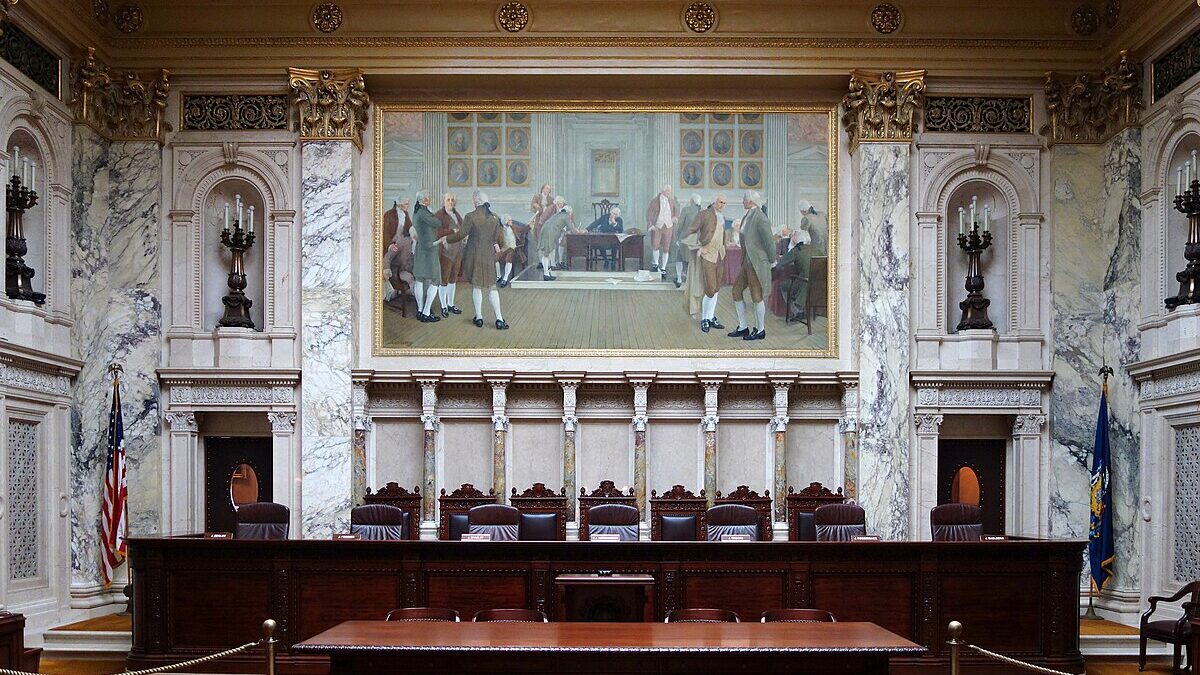

The Wisconsin Supreme Court blocked a bid by the state’s Democrat attorney general to effectively sidestep a U.S. Supreme Court ruling involving a Wisconsin-based Catholic charity.
In its Monday order, the Badger State’s highest court affirmed that the Catholic Charities Bureau (CCB) and its sub-entities are eligible for a sought-after tax exemption status that would allow them to not contribute to Wisconsin’s unemployment system. The decision came months after SCOTUS handed down its ruling on the matter, which favored the Christian organization.
“You’d think Wisconsin would take a 9-0 Supreme Court loss as a hint to stop digging,” Becket Fund for Religious Liberty Vice President and Senior Counsel Eric Rassbach said in a statement. “But apparently Attorney General Kaul and his staff are gluttons for punishment. Thankfully, the Wisconsin Supreme Court put an end to the state’s tomfoolery and confirmed that Catholic Charities is entitled to the exemption it already won.”
CCB first pursued the exemption in 2016 but was repeatedly denied in the years that followed by the state and ultimately, the Wisconsin court system. In rejecting the group’s exemption request, the Wisconsin Supreme Court agreed with the state’s claim that the CCB doesn’t qualify because it didn’t establish that it operates for a primarily religious purpose.
The case eventually made its way to SCOTUS, which determined in June that the Wisconsin Supreme Court’s “application of [existing law] to petitioners violates the First Amendment.” Writing for a unanimous court, Associate Justice Sonia Sotomayor noted that “It is fundamental to our constitutional order that the government maintain ‘neutrality between religion and religion,'” and that while “[t]here may be hard calls to make in policing that rule … this is not one.”
In reversing the Wisconsin Supreme Court’s decision, the high court remanded the case back to the state’s judicial system “for further proceedings not inconsistent with [its] opinion.” While the CCB’s legal team previously told The Federalist such directives “typically mean[] that you do the opposite of whatever the Wisconsin Supreme Court did” (i.e. to grant CCB the exemption), Wisconsin Attorney General Josh Kaul seemingly had other ideas.
A month after the Supreme Court’s ruling, the Badger State Democrat asked the Wisconsin Supreme Court to hold additional briefing in the case to decide how to remedy the situation. Despite protests from the CCB, Wisconsin Supreme Court granted the request in September and instructed parties to file briefs “regarding the appropriate remedial measures.”
In its brief, Kaul’s team argued that rather than grant CCB the exemption it was seeking, the Wisconsin Supreme should throw out the exemption altogether. They specifically claimed, “This remedy, although it means Catholic Charities would remain subject to the state unemployment insurance system, ‘fully addresses [the] First Amendment injury’ that lies ‘at the heart of [this] suit.'”
In its Monday order, the Wisconsin Supreme Court rejected that proposal. The court said that, in light of SCOTUS’ reversal of its prior decision, it has determined “that Catholic Charities et al. is eligible for the religious purposes exemption to unemployment taxation under [Wisconsin law].”
“IT IS ORDERED that this matter is remanded to the circuit court with instructions to vacate [the state’s] decisions and to remand the matter to [the state] with direction to declare Catholic Charities Bureau, Inc. and its sub-entities involved in this case eligible for the religious purposes exemption to unemployment taxation under [Wisconsin statute],” the order reads.
In his statement, Rassbach hailed Monday’s ruling as a major win that “protects not just Catholic Charities, but every faith-based organization that relies on this exemption to serve the public.” He additionally chastised Kaul, who he argued “never should have doubled down on punishing churches.”
“Wisconsin should have taken the L,” Rassbach said. “It turns out that penalizing charities is not a winning legal strategy.”