
Republicans led by Sen. Jim Banks, R-Ind., are attempting to codify the near-total abolition of the Department of Education before Democrats are sworn into legislative majorities in January.
Banks, accompanied by Sen. Tommy Tuberville, R-Ala., who will be leaving in January to become governor of Alabama, as well as Sens. Ashley Moody, R-Fla., and Mike Lee, R-Utah, introduced a package of 10 bills that will permanently transfer major agency programs to other federal departments, thereby stripping the department of nearly all its responsibilities.
“The federal education bureaucracy has failed students and families for decades. President Trump and Secretary McMahon are finally putting parents first and returning power where it belongs,” Banks said in a press release. “Our bills will make their reforms permanent, eliminate layers of Washington bureaucracy, and ensure taxpayers are no longer forced to prop up a failed department.”
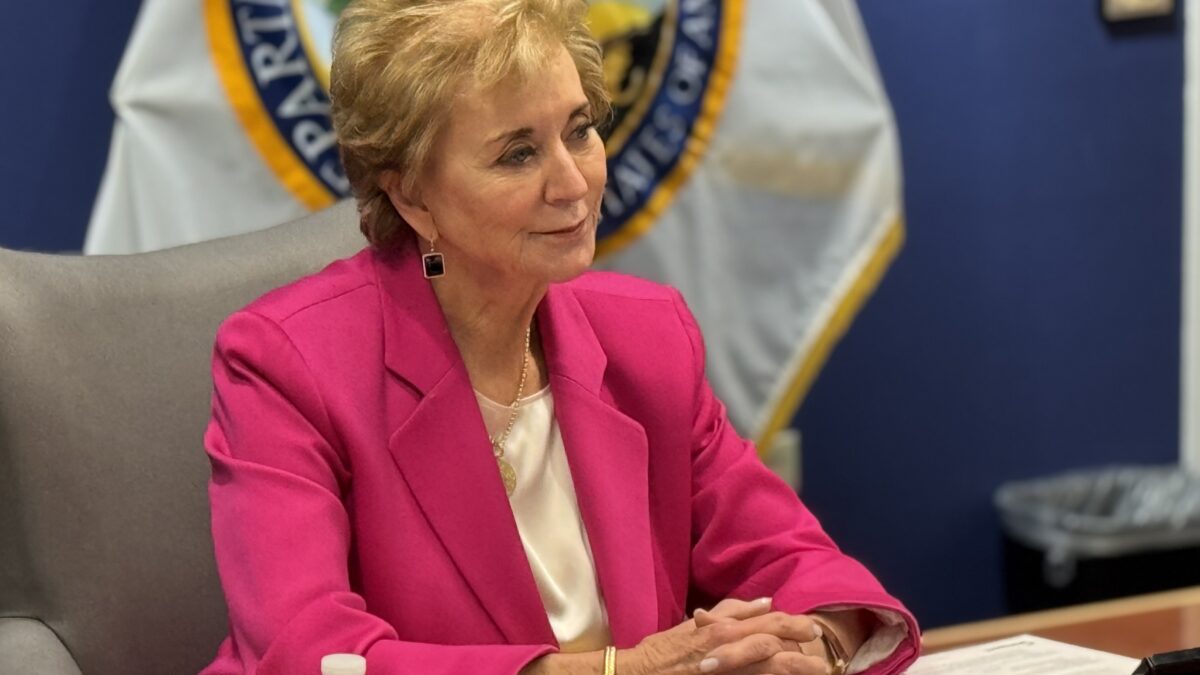
Although it would take 60 votes in the Senate to formally abolish the department, this bill package, called “Less Bureaucracy, Better Education,” would render it a shell, acting only as a “pass-through for federal funds,” said Education Secretary Linda McMahon, who, upon taking office, stated that the “final mission” of department staff was to shut it down entirely.
The Department of Education has been offloading core responsibilities through interagency partnerships signed last year with six other departments. While it falls short of true abolition, it does show proof-of-concept that the Department of Education is at best redundant, and certainly unnecessary.
McMahon said that the package of bills “will make permanent the work we have done to align programs with the agencies best suited to support and return education authority to those closest to the child.”
The 10 bills are separated by spheres of authority, transferring the duties to respective departments that are best suited to handle that responsibility. For example, three of the bills transfer programs to the Department of Labor, including career, technical, and adult education functions; “most functions of the Office of Elementary and Secondary Education,” including charter schools, rural education, and homeless education programs; and minority-focused programs like Historically Black Colleges and Universities (HBCUs), veteran student programs, and programs related to disabilities.
Labor Secretary Keith Sonderling has indicated that housing those programs in his department makes the most sense because it can be responsive to “education and workforce development initiatives that can keep pace with the evolving needs of job creators.”
Another bill transfers student aid, Pell Grants, federal student loans, and loan servicing and collection to the Treasury Department, meaning perhaps the most forward-facing and expensive ($1.7 trillion) responsibilities will leave the Education Department for good, so long as the package passes.
Treasury Secretary Scott Bessent said his department will bring “unique financial and operational expertise to the program, providing defaulted borrowers a clearer path back to repayment, and building a more efficient and accountable system that better serves borrowers and taxpayers.”
The State Department will be receiving responsibility for “foreign gift and contract disclosure requirements for colleges and Universities,” as well as authority over Title VI international education and foreign language programs, which will allow the State Department to target issues with foreign funding in the American education system.
The Department of Health and Human Services will have authority over foreign medical accreditation functions, child care, and community engagement responsibilities previously at the Department of Education.
House Education and Workforce Committee Chairman Tim Walberg, R-Mich., advanced a tandem legislation package in the lower chamber earlier this summer.
Coinciding with the legislative downsizing is the reduction of the Education Department’s footprint in Washington, D.C. The reduction in force, including the firing of around 50 percent of the staff, means that the department’s current headquarters in the Lyndon B. Johnson Building is estimated to be 70 percent empty.
Remaining Department of Education staff will be moving to a smaller building, while the Department of Energy moves into the LBJ Building. According to a fact sheet, the Department of Education will save $4.8 million in rental costs, and the Department of Energy will save $350 million in “deferred maintenance costs.”