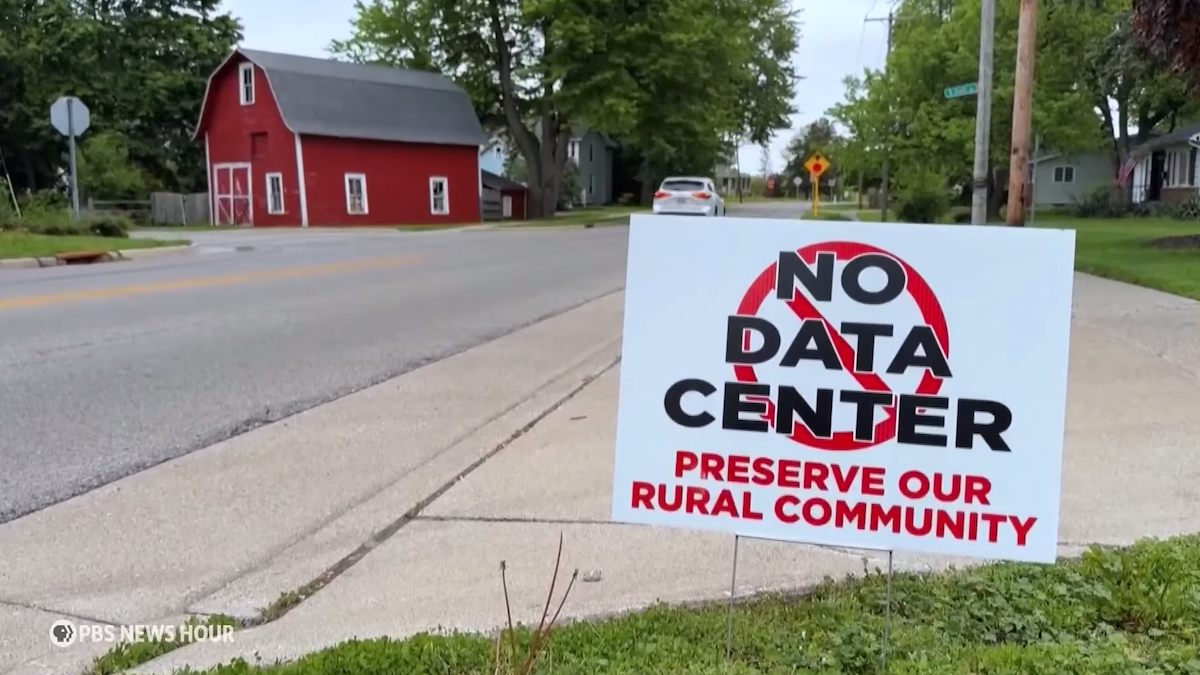

One of the most striking things about the ongoing debate over AI data centers is not just the widespread opposition to them but that the opposition spans political and demographic divisions at a time when Americans from different walks of life and different political persuasions have trouble agreeing on much of anything.
In polls, people say they’re primarily concerned about environmental factors like the amount of water and electricity the data centers will consume, as well as things like pollution and the destruction of farmland. Because these objections dovetail with anti-capitalist and pro-regulation ideas of the left, it has been easy for such concerns to be dismissed by some on the right, often with open contempt, as either climate doomerism or moronic Luddism. “Oh you don’t like data centers? And you’re complaining about it online? On the internet?”
As a tactic to silence data center skeptics on the right, this isn’t going to work. For one thing, concerns over rapid technological and societal change are not hypocritical simply because those who raise them use technology or participate in society. “If you don’t like what the internet has done to society then stop using it,” is not a substantive or persuasive response — as if those who notice the deleterious effects of smartphones, for example, are disqualified from noting those effects if they personally own a smartphone.
More broadly, the tech right is failing to persuade data center skeptics because their skepticism is rooted not in the policy particulars or the mechanics of how data centers work, but in deep anxiety about the digital revolution we have been living through for the past two decades — a revolution that artificial intelligence, powered by these new data centers, will intensify and accelerate.
In other words, you can talk all day long about how over 20 years in Quincy, Washington, data centers reduced the poverty rate and decreased residents’ property taxes and funded a new high school, hospital, library, and so on. You can explain how the new AI data centers will more than pay for themselves, how they will generate their own power needs, how they will create jobs and revitalize local economies. You can do all this, but if all you do is talk about the economic upsides of data centers, and claim that any opposition to them is paid for by China or fueled by ignorance and left-wing talking points, or that it’s pure political theater, you will not persuade the skeptics because you are failing to address the actual fears of those who oppose AI data centers.
What are those fears? Some are obvious, like the fear that an AI-powered economy will eliminate most jobs and productive work, and that ordinary people will be rendered unable to contribute economically, reduced to subsisting on a universal basic income. That particular fear is fomented, sometimes with glee, by AI creators themselves.
Yet we sense, on a gut level, that the end of work in America would destroy our country and make life miserable. It would, at a minimum, mean the end of political liberty or anything like self-government. Citizens who cannot support themselves through productive work and the ownership of property are not citizens at all, but dependents. It would also mean the end of free speech for the obvious reason that an AI-managed and curated public square will be incompatible with free expression.
But the elimination of jobs and the destruction of political freedom is not the only fear lurking in the minds of AI skeptics. A deeper fear, perhaps harder to articulate, is that of rapid and uncontrollable technological change that AI will likely bring about. That fear in turn is twofold: fear of the unknown and unstable future AI will create, and fear of the known aspects of the digital revolution that AI will supercharge.
Specifically, this latter fear is tied to what society will look like if it fully embraces the next phase of the digital revolution. We already know what the first phase of the revolution brought us: the internet, social media, smart phones, and all the pathologies that have come with them. At the outset of this revolution, in the early aughts, we were told that these things would increase social solidarity, that the internet would not only be a great democratizing force but that it would forge real connections between peoples and group that might otherwise never interact.
What happened of course was the opposite. Social fragmentation and isolation, already exacerbated by the conditions of modern life, was amplified by the internet, and especially by the advent of the smartphone and social media. Young people bore the brunt of this. Today they are more depressed, anxious, lonely, and suicidal than previous generations — thanks largely to the effects of the social media. In the twenty years since the arrival of the iPhone, the suicide rate has steadily increased. For young people, it has increased by nearly 70 percent since the turn of the millennium.
In a recent essay for Compact on how the GOP has embraced the vice economy, Brad Wilcox and James Lynch share new survey data from the Institute for Family Studies that show men age 18 to 29 “have been hit hardest by the proliferation of gambling apps, prediction markets, chatbot companions, digital tokens, and harmful substances.” Among this cohort, “Forty-three percent agree that ‘I am inclined to think that I am a failure.’ Sixty-one percent say they often feel they have little control over the things that happen to them. Almost half agree that they will never achieve the American dream.” A majority or near-majorities say they struggle with online gambling, porn addiction, and compulsive video gaming. Yet most young men also say they want to get married, start a family, buy a house, and be financially independent — all of which they feel is out of reach.
The vices and struggles are different for women but no less dispiriting. Rampant use of SSRIs, substance abuse, and rates of anxiety and depression among young women tell a similar tale. Under these conditions, it’s no surprise that young people are failing to couple up, get married, and have kids, let alone even dating at rates they once did.
None of this is natural, and all of it is part of the legacy of the digital revolution. Anyone now arguing that AI will boost social solidarity and improve life for ordinary people has to make the counterfactual case that this time, for the first time ever in history, rapid technological change won’t fragment the social order and exacerbate existing societal tensions. They have to argue, against the obvious sociological evidence, that more internet, more app use, more social media, more virtual communication will somehow not produce the isolation, addiction, loneliness, and despair that these things have produce over the past twenty years.
Put simply, the reason so many people are skeptical of the next phase of the digital revolution is because they don’t believe the first phase has made their lives better. They know that an AI-dominated society — powered by massive data centers scattered across the land — means more of what the internet age has already brought us, in increasingly powerful and irresistible forms.
So if you want to make the case for data centers, don’t talk about how they will reduce electricity bills or increasing local tax revenue, or how they don’t actually use that much water. That is not why people really object to them. They object because they know that the promises of the digital revolution were empty, and that the internet and social media and hyper-connectivity has not made life better. Life is not better because you can use an app to get toilet paper delivered to your house or because you can place bets in real time on everything imaginable. Actually, life is worse because of those things, in ways that are hard to quantify, unlike GDP or utility rates.
If the tech right wants to make a persuasive case, it will have to address the actual fears that people harbor about being left naked before the rapacious forces of the AI revolution — a revolution no one understands and no one can control.
Seen in that light, no wonder they want instead to talk about local tax revenue and water usage.