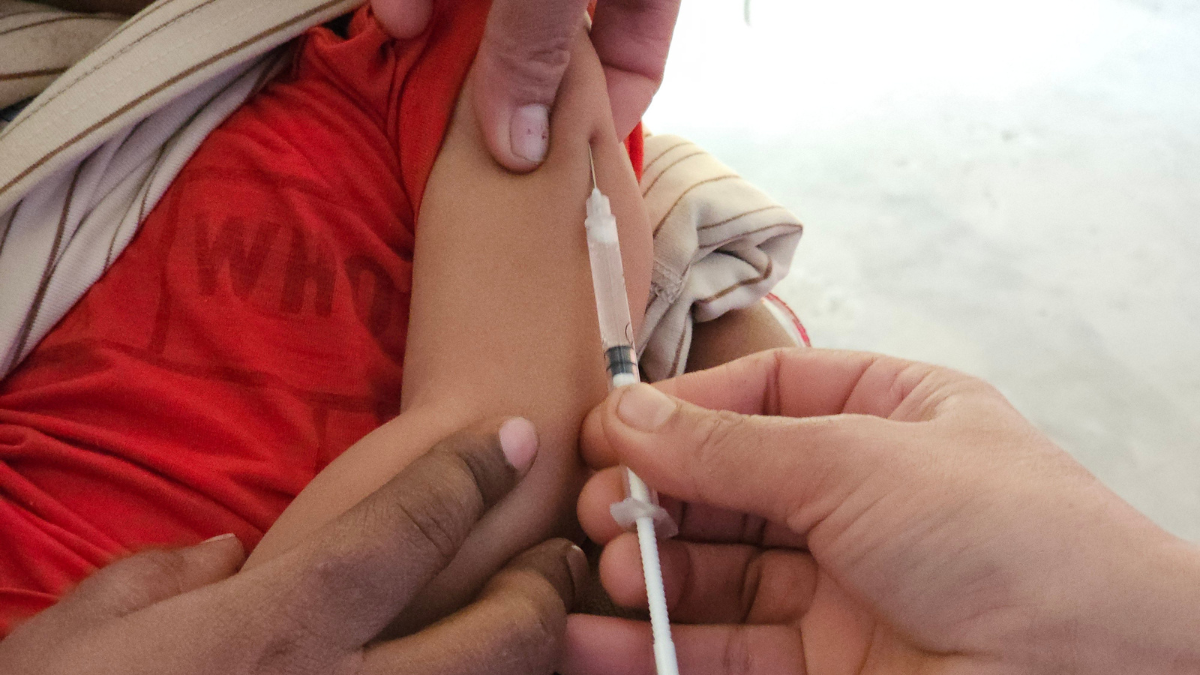

Parents across Michigan who want a nonmedical vaccine waiver for a child to attend school must now complete an online course before the local health department will certify the exemption. The course — built for the state by Michael Rubyan, a University of Michigan professor, and roughly 40 public health nurses — opens with a pre-training assessment. Before a parent has been shown a single slide, video, or fact, three statements appear:
I think vaccines are safe.
I think vaccines are important for children to have.
I think vaccines are effective.
Each is answered on a five-point scale: strongly agree, tend to agree, tend to disagree, strongly disagree, do not know. At the end of the course, a post-training assessment asks all three again. What the course measures as learning is indistinguishable from agreement.
Officials might point out that “do not know” is available, but that isn’t a refusal. It is a claim about one’s own state of knowledge, recorded as data. There is no “that is not the state’s business” button, and no explanation of where the answers go or who reviews them. The only privacy policy apparently available to parents is the county health agency’s HIPAA notice, which nowhere mentions the waiver process, the course, or attitudinal data.
A parent can see the compelled-speech problem without a lawyer’s help. But Michigan needn’t reach a constitutional question, because the rule the state is enforcing never authorized this in the first place.
What the Law Says, and What the Course Says the Law Says
Michigan’s vaccine exemption is both statutory and old. Under MCL 333.9215(2), a child is exempt if a parent “presents a written statement to the administrator of the child’s school … to the effect that the requirements of this part cannot be met because of religious convictions or other objection to immunization.” That is the whole test: a written statement, to the school. The legislature wrote “or other objection” deliberately, declining to ask what the objection is, whether it’s sincere, or whether it’s any good.
Now, here is question two of the module’s first graded section:
Maria is a parent in Michigan who wants to obtain a non-medical vaccine waiver for her child for religious reasons. To get a valid waiver in Michigan, Maria needs to:
— Ask her family doctor for a letter granting the waiver
— Ask a religious leader for a letter granting the waiver
— Attend a vaccine education session and get a waiver from the local health department
— Fill out and sign a waiver form at home and send it to the school
The third option is the “correct” choice. But the fourth describes what the 1978 statute actually requires. The administrative gloss has so thoroughly displaced the statute that the state now teaches parents the statutory text is the wrong answer. Current practice has drifted far enough from the statute that the statute now reads as a distractor option.
How the Drift Happened
In 2014, with waiver rates climbing, the Michigan Department of Health and Human Services (MDHHS) added rule R 325.176(12). The rule states that “each nonmedical exemption” “shall be certified by the local health department that the individual received education on the risks of not receiving the vaccines being waived and the benefits of vaccination to the individual and the community.”
The performer of that duty is the health department, but the sentence assigns the parent nothing, and it prescribes no method of certification. MDHHS said as much in its own rulemaking file, anticipating that departments would provide education “using a variety of methods based on local needs.” At least one Michigan county health department has since argued the rule was misread from the start, and that simply mailing the required education to the parent would satisfy it.
But grant the state its strongest counterargument. Say that certifying a parent “received” education implies confirmable delivery. That would mean a parent must receive information and acknowledge receiving it. It does not get you within a hundred miles of a graded course with an attitude survey at both ends.
The rule was never primarily about educating anyone, however. MDHHS worried in its rulemaking file that “the ease of obtaining a non-medical exemption has been associated with an increased number of vaccine exemptions,” and so it built the rule to make exemptions harder. Suzanne Waltman of Michigan for Vaccine Choice, who learned of the rule the day it took effect, called it “a stealth move.”
Nor has the education changed many minds on the issue of vaccines. Juan Marquez, medical director for Livingston and Washtenaw counties, estimated that of roughly 10,000 waivers his two counties issued over 10 years, the in-person sessions that preceded the online course “changed the minds of maybe one or two people.”
Twice since 2014, lawmakers have been asked to write the requirement into the statute, in 2016 and again in 2024. Both bills died. So, the agency is enforcing by rule precisely what the legislature has declined to enact by statute, twice.
A third bill, House Bill 4552, introduced in June 2025 by 11 Republicans, would strip the department of any power to add requirements beyond the statute’s, and bar local health departments from demanding their own forms. It has sat without a hearing for nearly 15 months.
What Should Change
The simplest remedy is to rescind the 2014 rule and fall back on the 1978 statute. Short of that, enforce the rule as written: The department provides the education, the department certifies, and the parent is asked nothing.
If the module stays, three changes are the minimum. Give every attitudinal item an explicit option to decline to answer, so comprehension can be verified without compelled assent. Publish a privacy notice specific to the course before a parent answers the first question. And preserve a genuine in-person alternative in every county.
Nothing here turns on the merits of vaccination. The question is whether a state agency may condition a statutory right on a declaration of belief, and whether it owes an account of what it does with the data it compels.
As it stands a father who wants his daughter in school must first tell the state, on a five-point scale, what he thinks about vaccine safety. He may answer however he likes, but he may not decline to answer. And he will answer. His daughter needs the waiver, and no principle is worth a year of her childhood. He will click something, the state will record it, and later in the week he will have stopped thinking about it.
But the statute he is seeking to comply with only asks him for a written statement. It has never asked what he believes.